
How Dedicated Lanes and Signal Priority Allow Bus Rapid Transit to Match Light Rail Speeds
By combining transit signal priority with dedicated right-of-ways, Bus Rapid Transit (BRT) systems are reducing intersection delays by 50 percent and cutting overall commute times. The approach offers cities a transit solution that mirrors light rail performance at a fraction of the initial capital cost.

Share this story
In short
- Bus Rapid Transit (BRT) utilizes dedicated lanes and Transit Signal Priority to match the speed and reliability of light rail.
- TSP technology allows buses to extend green lights by up to 30 seconds, reducing intersection delays by 50 percent.
- BRT costs approximately $45 million per mile to construct, compared to $230 million per mile for light rail.
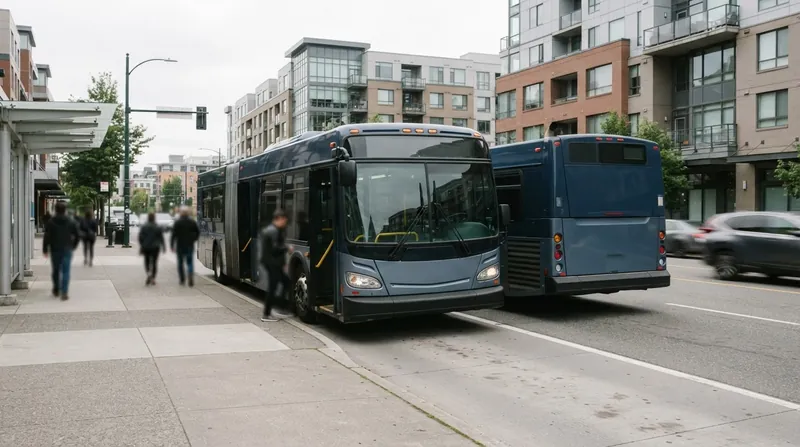
On May 20, 2022, the Transportation Research Board identified transit signal priority—rather than just dedicated asphalt—as the single most critical component of a Bus Rapid Transit (BRT) system. That engineering consensus shifted how municipalities approach public transit. Instead of viewing buses as inherently slower than trains, transit planners began treating the roadway itself as a programmable network. By granting buses the ability to hold traffic lights green, cities could suddenly offer rail-like commute times without laying a single mile of steel track.[1]
For a prospective homebuyer or a renter calculating their daily commute, the distinction between a standard bus route and a true BRT corridor dictates how much of their day is lost to traffic. A standard local bus spends up to 20 percent of its route idling at red lights and another 15 percent merging in and out of mixed traffic.
BRT eliminates those bottlenecks. By combining dedicated lanes with signal prioritization, these systems reduce key intersection delays by 50 percent and cut overall travel times by 15 to 40 percent, depending on the corridor.[1]
The impact on local real estate is measurable. When transit authorities reduce a 45-minute commute to 25 minutes, the surrounding housing market reacts. On May 20, 2026, the Center for Neighborhood Technology and St. Louis REALTORS published a 12-year analysis of housing prices near high-frequency transit routes. The study found that median home sale prices near the city's most frequent bus routes increased by 167 percent between 2012 and 2024, far outpacing the 65 percent citywide average.[4]
"Public transit delivers value far beyond the ride," said Kimberly Cella, CEO of Citizens for Modern Transit, during the presentation of the St. Louis data. "It plays a meaningful role in strengthening neighborhoods and supporting long-term economic growth. These findings underscore the opportunity to leverage high-frequency transit investments, including potential Bus Rapid Transit, to drive positive change."[4]
The mechanics of that time savings rely on two primary infrastructure upgrades: dedicated right-of-ways and Transit Signal Priority (TSP). Dedicated lanes physically separate the bus from mixed traffic congestion. In Seattle, the Madison Street BRT utilizes a combination of dedicated and mixed-flow lanes to bypass gridlock. That physical separation alone reduced the average peak-hour travel time along the corridor by 33 percent, dropping a 22.5-minute trip to just 15 minutes.[6]
But physical separation only works between intersections. The true time savings occur at the traffic lights. TSP software allows an approaching BRT vehicle to communicate directly with the intersection's traffic controller. If the light is green, the system can extend it by up to 30 seconds to ensure the bus clears the intersection. If the light is red, the system can truncate the cross-traffic's green phase, granting the bus an early green light by five to 10 seconds.[1]
According to the Reason Foundation, installing TSP technology is highly cost-effective for local governments. Upgrading an existing intersection controller costs approximately $5,000, while replacing the software and hardware entirely costs around $20,000 per intersection. On a standard urban route, TSP can eliminate 10 to 15 complete stops at traffic signals, fundamentally altering the speed and reliability of the service.[1]
The combination of these technologies has driven a surge in BRT adoption. On August 11, 2025, the Federal Transit Administration (FTA) reported that 317 miles of BRT lines had been implemented across the United States since 2016. Over the decade ending in 2023, total miles traveled on BRT systems rose by 44 percent, making it the fastest-growing transit mode in the country.[2]
For municipal planners, the appeal of BRT lies in its capital efficiency compared to Light Rail Transit (LRT). Constructing a light rail system requires acquiring right-of-ways, laying track, building overhead catenary power lines, and constructing specialized maintenance facilities. BRT utilizes existing roadway infrastructure, requiring only lane repainting, station construction, and software upgrades.[3][5]
The cost disparity is stark. When the Los Angeles County Metropolitan Transportation Authority expanded its transit network, the LRT Expo Line extension cost $230.1 million per mile. Concurrently, the agency built a four-mile expansion of the BRT Orange Line for just $45 million per mile. Despite the massive difference in capital expenditure, the two systems operate at nearly identical speeds: the Orange Line averages 15.5 miles per hour, while the Expo Line averages 14.4 miles per hour.[7]
However, the lower per-mile cost of BRT does not equate to identical capacity. According to a September 2025 engineering brief by the Institute for Sustainable Infrastructure, a typical BRT system can accommodate approximately 6,000 passengers per hour per direction (pphpd). In contrast, a light rail system can move roughly 25,000 pphpd.[3]
This capacity difference means that while BRT is cheaper to build, its cost per unit of peak capacity is remarkably similar to light rail. Factlen's analysis of the Los Angeles cost data and the Institute's capacity figures reveals that BRT requires $7,500 in capital expenditure per peak passenger hour, compared to $9,204 for light rail. BRT's primary economic advantage is its lower absolute barrier to entry, allowing mid-sized cities to deploy high-quality transit without securing billion-dollar federal grants.[8]
For residents, the choice between BRT and light rail is often less important than the frequency and reliability of the service provided. A transit system that arrives every 10 minutes and bypasses traffic congestion fundamentally changes how a neighborhood functions. It allows households to reduce their reliance on personal vehicles, cutting transportation costs and freeing up capital for housing or other expenses.[4]
To future-proof these investments, engineering standards now encourage municipalities to design BRT corridors as "rail-ready." By aligning horizontal clearances, vertical clearances, grades, and turning radii with light rail specifications during the initial BRT construction, cities can upgrade the corridor to rail later if passenger demand eventually exceeds the 6,000 pphpd capacity limit.[3]
As urban populations grow and traffic congestion worsens, the ability to move people efficiently through existing street grids remains a primary challenge for city planners. By leveraging software to control traffic signals and dedicating lanes to high-capacity vehicles, municipalities are proving that rubber tires on asphalt can deliver the speed and reliability once reserved exclusively for steel wheels on track. The next phase of transit expansion relies on optimizing the roads cities already have.[8]
Definitions
- Transit Signal Priority (TSP)
- Technology that allows approaching transit vehicles to communicate with traffic lights, extending green lights or shortening red lights to reduce intersection delays.
- Dedicated Right-of-Way
- A traffic lane reserved exclusively for transit vehicles, physically separating them from mixed automobile congestion.
- Peak Passenger Capacity
- The maximum number of passengers a transit system can move past a single point in one hour, typically measured per direction (pphpd).
- Level Boarding
- Station design where the platform is at the exact same height as the vehicle floor, allowing passengers, wheelchairs, and strollers to roll directly on without climbing steps.
Questions & answers
What is the difference between BRT and a regular bus?
Bus Rapid Transit (BRT) operates in dedicated lanes to bypass traffic and uses Transit Signal Priority to hold traffic lights green. It also typically features off-board fare collection and level boarding, making it function more like a light rail train than a standard local bus.
How much time does Transit Signal Priority actually save?
By communicating with traffic lights to extend greens or shorten reds, Transit Signal Priority can reduce intersection delays by 50 percent and cut overall route travel times by 15 to 40 percent.
Does living near a BRT line increase property values?
Yes. Studies show that homes near high-frequency transit routes appreciate significantly faster than citywide averages. A 12-year analysis in St. Louis found that homes near frequent transit appreciated by 167 percent, compared to a 65 percent citywide average.
Why do cities build BRT instead of light rail?
BRT costs roughly 80 percent less per mile to construct than light rail because it utilizes existing roadways rather than requiring new tracks and electrical infrastructure. This allows cities to build longer transit networks with limited budgets.
Analysis by camp
Municipal Transit Planners
City governments prioritize BRT for its lower upfront costs and faster deployment timelines.
For local governments operating under tight budget constraints, Bus Rapid Transit represents a pragmatic compromise. Planners emphasize that BRT can be deployed in a fraction of the time it takes to build light rail, utilizing existing roadways rather than requiring complex land acquisitions or tunneling. By implementing Transit Signal Priority and dedicated lanes, municipalities can deliver 80 percent of the performance of a rail system for 20 percent of the per-mile capital cost, allowing them to expand high-frequency transit networks across a wider geographic area.
Light Rail Advocates
Rail proponents argue that BRT lacks the permanent capacity and economic development pull of steel-wheel transit.
Advocates for traditional light rail point to the hard physical limits of rubber-tire transit. While BRT is cheaper to build, its maximum capacity of roughly 6,000 passengers per hour per direction falls far short of light rail's 25,000-passenger throughput. Furthermore, rail advocates argue that the permanence of steel tracks signals a long-term municipal commitment to a corridor, which historically drives denser, more sustained commercial real estate development than a painted bus lane that a future city council could easily revert to mixed traffic.
Local Homebuyers and Renters
Residents value the immediate reduction in commute times and the resulting property value appreciation.
For the communities living along these corridors, the primary metric of success is time recovered from daily commutes. Residents and local real estate professionals view high-frequency, reliable transit as a premium neighborhood amenity. As demonstrated by the St. Louis market data, properties within walking distance of reliable BRT stations see significantly higher appreciation rates. Buyers are increasingly willing to pay a premium for housing that allows them to bypass arterial gridlock and reduce their reliance on personal vehicles.
- Municipal Transit Planners
- Focus on cost-efficiency, rapid deployment, and maximizing geographic coverage with limited funds.
- Light Rail Advocates
- Emphasize higher peak passenger capacity and the permanence of rail infrastructure.
- Urban Real Estate Professionals
- Value transit primarily as a neighborhood amenity that drives property demand and appreciation.
Perspectives this story doesn't cover
- Automobile Commuters
- Local Business Owners Losing Street Parking
Sources
Source coverage
8 outlets
3 viewpoints surfaced




- [1]Reason FoundationMunicipal Transit Planners
Transit signal priority improves bus rapid transit service substantially
Read on Reason Foundation → - [2]GenfareMunicipal Transit Planners
Bus Rapid Transit benefits
Read on Genfare → - [3]Institute for Sustainable InfrastructureLight Rail Advocates
Planning BRT for Future LRT Conversion
Read on Institute for Sustainable Infrastructure → - [4]St. Louis REALTORSUrban Real Estate Professionals
St. Louis Housing Prices Near Transit Study
Read on St. Louis REALTORS → - [5]U.S. Government Accountability OfficeMunicipal Transit Planners
Bus Rapid Transit Shows Promise
Read on U.S. Government Accountability Office → - [6]CDM SmithUrban Real Estate Professionals
Dedicated lanes and mixed flow lanes
Read on CDM Smith → - [7]Reason FoundationMunicipal Transit Planners
Bus Rapid Transit is a cheaper, faster alternative to light rail
Read on Reason Foundation → - [8]Factlen Editorial TeamMunicipal Transit Planners
Synthesis by Factlen editorial team
Read on Factlen Editorial Team →
More in Automotive & Transportation
See all →Railway Engineering
How Lateral Catenary Wire Stagger Prevents Pantograph Grooving
3 sources
IMO Carbon Tax
US President Attacks Global Shipping Carbon Tax at UN as Decarbonization Target Slips
5 sources

Railway Engineering
The Adhesion Limit: How the Coefficient of Friction Between Steel Wheel and Rail Dictates Maximum Tractive Effort
9 sources
Aerodynamic Efficiency
The CdA Metric: Why Frontal Area, Not Just Drag Coefficient, Dictates Vehicle Range
9 sources
Comments
Every angle. Every day.
Get Automotive & Transportation stories with full source coverage and perspective breakdowns, free every day.