
Fencing Injury Watch: Nick Itkin's Recovery and the Medical Stakes at the 2026 World Championships
As the 2026 FIE Senior World Championships approach in Hong Kong, the fencing world is closely monitoring the health of top foil contenders Nick Itkin and Kirill Borodachev. The tournament coincides with a landmark sports medicine conference aimed at addressing the sport's cumulative injury burden.

Share this story
The grueling 2025/2026 international fencing season culminates next week at the FIE Senior World Championships in Hong Kong, but the physical toll of the circuit is already reshaping the men's foil bracket. As athletes descend on the AsiaWorld-Expo, the focus has shifted from pure technical preparation to injury management and recovery.[1]
American foilist Nick Itkin, a multiple world individual medalist, enters the tournament as a premier title threat despite an injury-plagued season. Carrying 133 FIE points, Itkin's ability to navigate the physical demands of the World Championships will depend heavily on his medical team's success in managing his recovery over the past few months.[1]
Similarly, Russia's Kirill Borodachev, the top-seeded threat who recently captured gold at the Shanghai Grand Prix, is looking to rebound from a physical setback. A minor injury contributed to an uncharacteristic round-of-32 exit at the recent European Championships, making his physical conditioning a major storyline ahead of his bouts in Hong Kong.[1]
The spotlight on athlete health at this year's championships is not coincidental. On July 23, alongside the tournament, the International Fencing Federation will host the FIE Hong Kong Sports Medicine Conference. The landmark event represents a core pillar of the FIE Medical Commission's 2025–2028 Strategic Plan, emphasizing proactive athlete safety and longevity.[1][2]
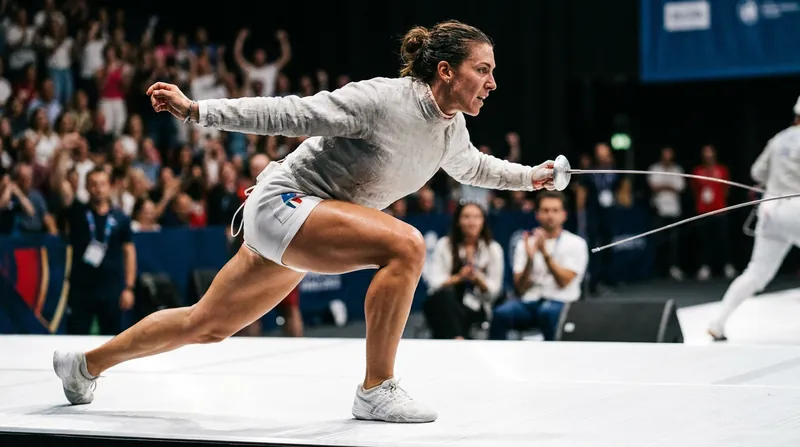
The conference will bring together sports physicians, physiotherapists, and biomechanics experts to address the specific physical toll of modern fencing. Key topics include the Fencing Injury Surveillance System (FISS), training load monitoring, and the biomechanical demands of the sport's explosive, asymmetrical lunges.[2]
Recent medical data underscores why these interventions are necessary. A comprehensive 2026 study published in PLOS ONE analyzed the cumulative injury burden among competitive fencers, revealing that years of training exposure—rather than acute in-bout trauma—drive the majority of physical setbacks.[2][5]
The research found that overuse injuries predominantly affect the knee, ankle, and dominant upper extremity. Because fencing requires sustained, asymmetric mechanical loading, athletes like Itkin and Borodachev are particularly susceptible to tendonitis and joint strain as the season wears on.[2][5]
Despite these cumulative risks, acute injuries remain remarkably rare. A sweeping data analysis by USA Fencing, encompassing more than 637,000 direct elimination bouts over six seasons, found a medical withdrawal rate of just 0.338%. The data confirms that while the sport is exceptionally safe, managing chronic wear-and-tear is the true differentiator for elite longevity.[3][6]
Beyond monitoring, researchers are actively testing new rehabilitation protocols to speed up recovery. A May 2026 study published in the Journal of Sports Science and Medicine explored the use of Blood Flow Restriction (BFR) therapy for fencers rebuilding strength after knee injuries.[4]
The study found that six weeks of low-load BFR quadriceps training produced significant improvements in rear leg kinematics during the fencing lunge. By allowing athletes to rebuild the explosive propulsive power of the lunge without placing heavy stress on healing joints, BFR is emerging as a critical tool for fencers racing against the clock to return to the piste.[4]
As the men's foil competition kicks off in Hong Kong, the athletes on the podium will likely be those who have best balanced the razor's edge of high-performance training and strategic recovery. With new data and dedicated medical conferences guiding the way, the sport is equipping its fencers to compete harder and heal smarter.[1][2]
Key points
- Nick Itkin and Kirill Borodachev are battling to recover from injuries ahead of the 2026 FIE World Championships.
- The FIE is hosting a major sports medicine conference in Hong Kong to address athlete safety.
- New data shows that cumulative overuse injuries to the knee and ankle are the primary threat to fencers.
- Acute injury rates remain extremely low, with medical withdrawals occurring in just 0.338% of bouts.
- Blood Flow Restriction (BFR) therapy is emerging as a key tool for accelerating fencers' return to the piste.
How we got here
2019 - 2025
USA Fencing collects data on 637,000 bouts, establishing a baseline medical withdrawal rate of 0.338%.
March 2026
PLOS ONE publishes a landmark survey detailing the cumulative overuse injury burden among competitive fencers.
June 2026
Kirill Borodachev suffers a minor physical setback, leading to an early exit at the European Championships.
July 21-27, 2026
The FIE Senior World Championships take place in Hong Kong, featuring returning stars like Nick Itkin.
July 23, 2026
The FIE hosts its multidisciplinary Sports Medicine Conference alongside the World Championships.
- Sports Medical Researchers
- Focus on data-driven injury prevention and understanding the cumulative burden of asymmetrical movements.
- Fencing Federations
- Prioritize overall athlete safety, low acute injury rates, and implementing global health protocols.
- Fencing Coaches
- Balance the need for intense repetition with the necessity of rest and targeted rehabilitation.
Perspectives this story doesn't cover
- Local club coaches managing amateur injuries
- Equipment manufacturers designing safer footwear and pistes
Sources
Source coverage
6 outlets
3 viewpoints surfaced





- [1]International Fencing FederationFencing Federations
Men's Foil Preview: 2026 FIE Senior World Championships in Hong Kong
- [2]PLOS ONESports Medical Researchers
Injury patterns and cumulative injury burden among U.S. competitive fencers: A survey
Read on PLOS ONE → - [3]Academy of Fencing MastersFencing Coaches
Identifying Competition Safety Focal Points
- [4]Journal of Sports Science and MedicineSports Medical Researchers
The role of blood flow restriction therapy following knee surgery in fencing
- [5]News-MedicalSports Medical Researchers
Years on the piste may be the biggest injury risk of all for fencers
- [6]USA FencingFencing Federations
USA Fencing Medical Withdrawal Data Analysis
More in Sports
See all →Injury
Global Fencing Injury Report: Borel's Resilience, Chamley-Watson's Adaptation, and the Science of Recovery
4 sources
Standings
Global Powers Collide: France, Kazakhstan, and USA Vie for Men's Team Epee Supremacy Ahead of Hong Kong World Championships
2 sources
Injury
Global Fencing Injury Report: Kharkova's Defiant Return, Gulyas Recovers, and Roman Sidelined
4 sources
Injury
Global Fencing Injury Report: Unprecedented Safety Data, Overuse Battles, and the Race for Hong Kong
5 sources
Comments
Every angle. Every day.
Get Sports stories with full source coverage and perspective breakdowns, free every day.