
FAA Awards $875 Million Contract to Launch AI-Powered 'SMART' System for U.S. Airspace Modernization
The Federal Aviation Administration has selected startup Air Space Intelligence for a 12-year contract to integrate predictive artificial intelligence into the national air traffic control network.

Share this story
The Federal Aviation Administration has awarded an $875 million, 12-year contract to Boston-based startup Air Space Intelligence (ASI) to integrate artificial intelligence into the national airspace system. The initiative centers on a new software platform called SMART (Strategic Management of Airspace, Routes, and Trajectories), which will use predictive analytics to anticipate congestion and reroute flights before delays cascade across the country.[1][4]
The U.S. airspace is the most complex in the world, currently managed through a human-centric, reactive architecture that relies on aging infrastructure. When a storm system hits a major hub or a sector becomes congested, air traffic controllers must manually deconflict routes in real time. This reactive posture often results in thousands of cascading delays and cancellations, costing airlines and travelers billions of dollars annually.[7][8]
SMART is designed to shift that paradigm from reactive to proactive. Operating as an enhancement within the FAA's broader Flow Management Data and Services (FMDS) platform, the AI ingests real-time data on airline schedules, weather patterns, upper-level winds, and airport capacity. By synthesizing these variables, the system can predict traffic bottlenecks days or even weeks before they materialize, allowing controllers to recommend slight flight path adjustments long before an aircraft leaves the gate.[1][7]
The FMDS platform itself serves as the new technological backbone of the FAA's Air Traffic Control System Command Center. It replaces the antiquated traffic flow management system, streamlining the sharing of data between the FAA and airspace users. While FMDS provides the foundational data and traffic flow analysis, SMART acts as the analytical engine, continuously evaluating operational constraints to identify potential conflicts before they occur.[4][5]
Crucially, the technology functions as a decision-support tool rather than an automated replacement for human operators. The software will not handle safety-critical functions involving the physical separation of aircraft. Instead, it provides controllers with a unified, national visualization of the airspace, easing their workload and allowing them to focus on immediate operational safety while the AI handles macro-level flow optimization.[4][7]
The FAA's selection of ASI—which reportedly beat out established defense and software titans like Palantir and Thales—rests on the startup's proven commercial track record. ASI's foundational Flyways AI platform was first deployed by Alaska Airlines in 2021, where it has since saved the carrier an estimated one million gallons of fuel annually and recovered tens of thousands of flight hours. The technology has subsequently been adopted by Delta Air Lines, United Airlines, and the U.S. military, validating its scalability across both commercial and defense aviation sectors.[4][6]
The aviation industry has broadly welcomed the modernization effort. Airlines for America, which represents the country's major carriers, noted that the software will provide more efficient routings and more predictable information about airspace constraints. By aligning the FAA, airlines, and operators on a shared view of the airspace, the system reduces the friction that typically accompanies severe weather events or sudden capacity drops at major hubs.[7][8]
The $875 million investment represents a structural inflection point for aviation infrastructure. As the FAA deploys SMART over the next 12 to 24 months, with initial operations slated for this fall, the downstream effects are expected to ripple through the broader travel economy. Analysts project that federal adoption of predictive analytics will accelerate similar AI integrations at the airport level, aligning ground-side operations with the new intelligence capabilities in the sky.[1][3]
This contract is a central pillar of a much larger federal push to overhaul the National Airspace System. Following a $12.5 billion allocation for air traffic control modernization signed into law last year, the FAA has been systematically replacing legacy radar systems and telecommunications networks. By layering SMART's predictive software over this upgraded hardware, the agency aims to build a resilient, data-driven architecture capable of handling the next generation of commercial aviation demand.[7]
Viewpoints in depth
Federal Aviation Regulators
The FAA views predictive AI as the linchpin for modernizing an aging, reactive airspace architecture.
For the FAA and the Department of Transportation, the SMART system represents a necessary leap forward in infrastructure management. Regulators emphasize that the current human-centric model, while safe, is fundamentally reactive and ill-equipped to handle the growing volume of commercial air traffic. By integrating predictive analytics, the agency aims to balance capacity and demand proactively, slashing thousands of delays before they cascade through the network.
Commercial Airlines
Major carriers see the technology as a critical tool for reducing operational costs and improving schedule reliability.
The airline industry, represented by groups like Airlines for America, has strongly backed the integration of AI into air traffic control. Carriers have already seen the financial and operational benefits of predictive routing through early commercial deployments, which have yielded significant fuel savings and recovered flight hours. A unified, national system promises to align the FAA and operators on a shared operational picture, minimizing the costly disruptions caused by weather and congestion.
Aerospace Technology Sector
Industry analysts view the contract as a validation of specialized AI startups over legacy defense contractors.
The selection of Air Space Intelligence—a relatively young startup—over established aerospace giants like Palantir and Thales signals a shift in federal procurement. Technology analysts note that ASI's success stems from its proven, commercially deployed products rather than theoretical models. This $875 million contract is expected to catalyze further investment in aviation-specific AI, pushing airport authorities and ground-side operators to upgrade their own systems to interface with the FAA's new predictive capabilities.
Key points
- The FAA awarded an $875 million contract to Air Space Intelligence to deploy the AI-powered SMART system.
- SMART uses predictive analytics to anticipate airspace congestion and recommend flight path adjustments before delays occur.
- The system acts as a decision-support tool for air traffic controllers, providing a unified visualization of the national airspace.
- ASI's foundational technology is already used by major carriers like Alaska Airlines, Delta, and United, saving millions in fuel costs.
How we got here
2021
Alaska Airlines becomes the first commercial carrier to deploy ASI's Flyways AI platform for flight routing.
April 2026
The FAA quietly brings in Palantir, Thales, and ASI to compete for the SMART system contract.
June 2026
The Department of Transportation officially awards the 12-year, $875 million contract to ASI.
Fall 2026
Initial operations of the SMART system are scheduled to begin across the national airspace.
- Federal Aviation Regulators
- Focuses on modernizing infrastructure, reducing delays, and maintaining safety.
- Aviation Industry & Airlines
- Values operational efficiency, fuel savings, and predictable scheduling.
- Aerospace Technology Sector
- Emphasizes the transformational potential of predictive AI and scalable software solutions.
Perspectives this story doesn't cover
- Frontline Air Traffic Controllers
- Passenger Advocacy Groups
Sources
Source coverage
8 outlets
3 viewpoints surfaced








- [1]ExecutiveBizAerospace Technology Sector
FAA Awards ASI $875M Contract for Air Traffic Management Modernization
Read on ExecutiveBiz → - [2]Travel WeeklyAviation Industry & Airlines
FAA taps Air Space Intelligence for air traffic control software
Read on Travel Weekly → - [3]Next MSCAerospace Technology Sector
FAA Awards $875M Contract to Air Space Intelligence to Deploy AI-Driven SMART Airspace System
Read on Next MSC → - [4]FLYING MagazineAerospace Technology Sector
Startup Air Space Intelligence wins $875M FAA contract to build SMART system
Read on FLYING Magazine → - [5]PR NewswireAerospace Technology Sector
American aerospace and defense company awarded $875 million multi-year software and AI contract by the Federal Aviation Administration
Read on PR Newswire → - [6]The Air CurrentAerospace Technology Sector
FAA close to picking ASI over Palantir, Thales for its AI-powered air traffic management system
Read on The Air Current → - [7]FAAFederal Aviation Regulators
FAA Awards Contract to Air Space Intelligence for New Technologies to Improve Traffic Flow
Read on FAA → - [8]ForbesAviation Industry & Airlines
FAA Awards $875 Million Contract To Modernize Air Traffic Control With AI
Read on Forbes →

More in Transportation
See all →Aerospace Consolidation
GE Aerospace Acquires Consolidated Precision Products in $12 Billion Supply Chain Consolidation
5 sources

Airspace Regulation
FAA Proposes Permanent Special Flight Rules Area Around Mar-a-Lago
7 sources

Cargo Aviation
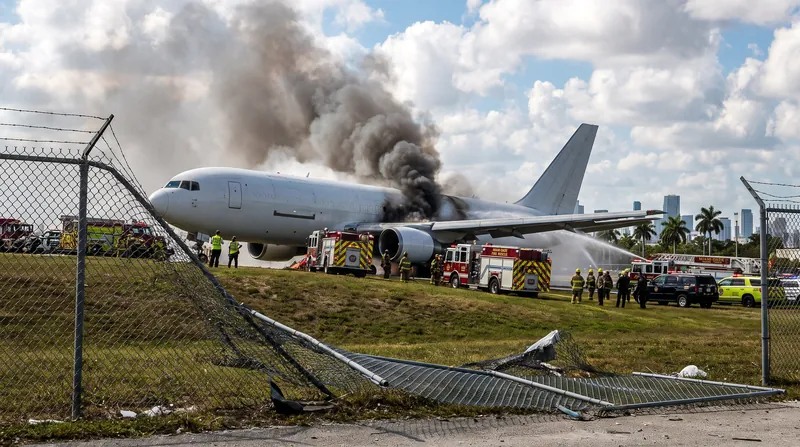
Amazon Prime Air 767 Freighter Overruns Miami Runway, Leaving 5 Dead and Forcing Ground Stop
5 sources
European Ports
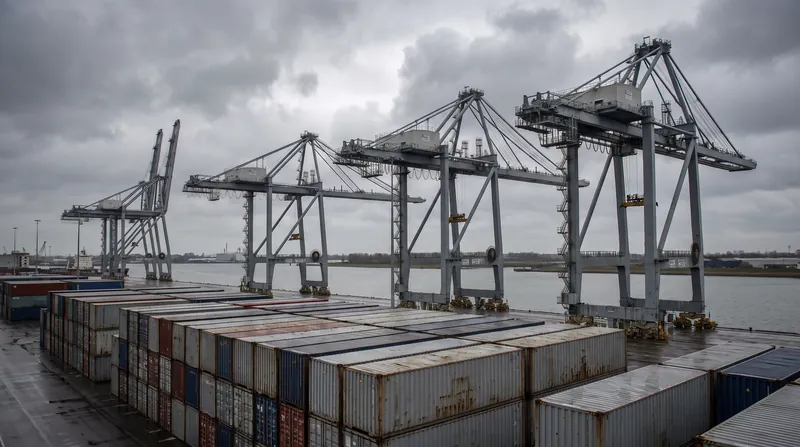
Coordinated Strikes at Hamburg and Rotterdam Paralyze Northern European Ports
9 sources
Comments
Every angle. Every day.
Get Transportation stories with full source coverage and perspective breakdowns, free every day.