
DNA Breakthrough Reveals Ancient Maya Elite Were Buried in Multiple Locations
A landmark genetic study has solved a decades-old archeological mystery, proving that the ancient Maya deliberately divided the remains of their elite, burying their bodies in city tombs while placing their teeth in distant sacred caves.
By Sofia Matos

Share this story
In short
- A landmark genetic study sequenced the DNA of 430 ancient Maya individuals from the Early Classic Period in Belize.
- Researchers discovered that 24 elite individuals had their remains deliberately divided and buried in two separate locations.
- Primary skeletons were found in city tombs, while their teeth were deposited in a sacred cave 26.5 kilometers away.
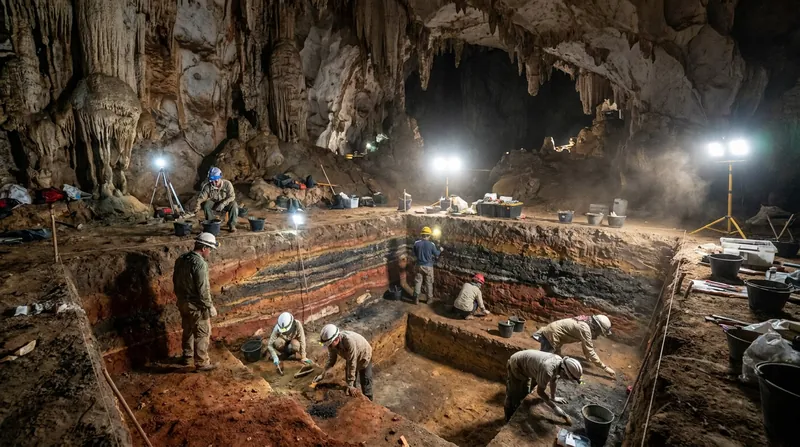
Deep in the rugged Maya Mountains of Belize, a sprawling network of limestone caves has long guarded the secrets of one of Mesoamerica's most complex civilizations. For decades, archeologists exploring these subterranean chambers have uncovered thousands of disarticulated human bones and teeth, scattered far from the monumental pyramids and urban centers where the Maya elite lived and ruled.[1]
Until recently, the exact biological relationships between the individuals buried in the grand city tombs and the isolated remains left in the dark, humid caves remained an unsolvable puzzle. The physical distance and the sheer volume of commingled bones made it impossible to trace a single individual's journey from death to their final resting place.[2][5]
That barrier has now been shattered by a landmark genetic study that successfully sequenced the ancient DNA of hundreds of Maya individuals, revealing a startling mortuary practice. Researchers discovered that the Maya elite were not always laid to rest in a single grave; instead, their bodies were deliberately divided, with specific parts transported across vast, treacherous landscapes to be deposited in sacred caves.[1][2]
The sheer scale of the genetic analysis represents a watershed moment for Mesoamerican archeology. A multi-institutional team screened 487 human tooth and bone samples recovered from both elite and non-elite tombs, as well as distant cave caches, dating to the Early Classic Period between 250 and 750 CE.[2][3]
Overcoming the severe degradation typical of ancient DNA in tropical environments, the researchers successfully generated genome-wide data for 430 of the samples. This unprecedented genetic library allowed them to identify 107 distinct individuals, mapping family lineages and biological connections with a precision previously unimaginable.[2][5]
The most striking revelation emerged when the genetic profiles from the city tombs were cross-referenced with the isolated teeth found in the caves. The data confirmed that 24 specific individuals had their skeletal elements distributed across two entirely different locations.[1][2]
In each of these 24 cases, the primary skeleton was interred in an elite tomb within the urban center, while a ritual cache of their teeth was discovered in a remote cave located 26.5 kilometers away.[2][3]
Transporting these remains was no simple task. The 26.5-kilometer journey traversed the unforgiving terrain of the Maya Mountains, requiring a deliberate and highly organized pilgrimage to deposit the teeth in a specific subterranean chamber.[2][5]
To understand why the Maya would undertake such an arduous process, one must look to their profound cosmological beliefs. In Maya theology, the universe was divided into the heavens, the earthly realm of the living, and a terrifying, watery underworld known as Xibalba.
Because the Yucatán Peninsula and Belize are dominated by porous limestone bedrock, surface rivers are rare. Instead, water flows through vast underground networks. The natural sinkholes, or cenotes, and the deep karst caves that punctuate the jungle were not merely geological formations; they were literal, physical portals to Xibalba.[4]
Entering a cave meant descending toward the heart of the mountain, crossing the threshold into the realm of the death gods. These subterranean spaces were the ultimate sacred geography, serving as the sites for ecstatic rituals, offerings, and the passage of souls.[4]
Within this belief system, kinship and ancestor veneration were the central pillars of the social fabric. Maya rulers legitimized their political power by claiming direct descent from mythical ancestors and the gods themselves.[2][3]
Mortuary practices were designed to keep the dead intimately connected to the living. Rather than a final, static event, death was the beginning of an ancestor's active role in the spiritual and political life of the community.[1][2]
By physically dividing the remains of their elite dead, the Maya were engaging in a geographically expansive form of ancestor creation. Placing a piece of the deceased—specifically the teeth, which are highly durable and often carried deep personal significance—into a cave portal effectively anchored that lineage to the underworld.[2][5]
This dual-burial strategy allowed the elite to maintain a monumental presence in the city of the living while simultaneously securing a direct, physical line of communication with the gods of Xibalba.[4][5]
The exact mechanics of the practice remain a subject of active investigation. While the genetic data proves the teeth belong to the entombed individuals, it is not entirely certain whether the teeth were extracted antemortem—perhaps as a ritual offering while the person was still alive—or postmortem during complex burial preparations.[1][5]
However, given the thin enamel of baby teeth found in similar contexts and the broader patterns of Maya mortuary rituals, experts strongly suspect the teeth were removed after death as the body was being prepared for its dual journey.[1][5]
This discovery fundamentally reshapes our understanding of how ancient societies interacted with their environment. The Maya did not merely build cities on the landscape; they wove their dead into the very geology of the earth, creating a vast, sacred topography that spanned from the highest temple pyramids to the deepest, darkest caves.[5]
As genetic sequencing technology continues to advance, archeologists anticipate that more fragmented mysteries of the ancient world will be pieced back together. The ability to link a single tooth in a dark cave to a skeleton miles away proves that the stories of the dead are far from finished.[2][5]
Terms to know
- Xibalba
- The mythical underworld in Maya cosmology, often accessed through natural caves and sinkholes.
- Cenote
- A natural sinkhole formed by the collapse of limestone bedrock, exposing groundwater, which was considered highly sacred by the ancient Maya.
- Ancestor veneration
- The religious practice of honoring deceased family members, which in Maya culture involved complex rituals utilizing their physical remains to legitimize political power.
- Genome-wide sequencing
- A comprehensive genetic analysis technique that reads the entire DNA sequence of an organism, used in this study to match disarticulated ancient bones.
- Disarticulated remains
- Bones or skeletal elements that have been separated from their original anatomical position, often found scattered in ancient ritual sites.
Questions readers ask
Why did the Maya place teeth in caves?
Caves were considered sacred portals to the underworld, known as Xibalba. Placing remains there was a form of ancestor veneration, designed to keep the dead connected to the spiritual realm and legitimize the ruling elite.
How did scientists prove the teeth belonged to the same people?
Researchers extracted ancient DNA from 487 bone and tooth samples, successfully matching the genetic profiles of isolated teeth found in a remote cave to the primary skeletons located in distant city tombs.
Were the teeth extracted while the individuals were alive?
While it cannot be definitively proven, experts strongly suspect the teeth were removed post-mortem during complex burial preparations, as part of rituals to distribute the physical remains of venerated ancestors.
Different angles
Genetic Archeologists
Focuses on the technological breakthrough of sequencing highly degraded tropical DNA to map ancient kinship.
For geneticists, the primary triumph is methodological. Extracting usable genome-wide data from 430 ancient samples in a hot, humid tropical environment—where DNA degrades rapidly—is a monumental feat. This camp emphasizes that without these advanced sequencing techniques, the commingled bones in the caves would remain anonymous. By cross-referencing the genetic markers, they have transformed isolated artifacts into a precise map of biological relationships, proving that the individuals in the caves are the exact same people buried in the city tombs.
Cultural Anthropologists
Focuses on the religious and political motivations behind the dual-burial practice.
Anthropologists view this discovery through the lens of Maya cosmology and statecraft. In Classic Maya society, political legitimacy was derived from divine ancestry. By physically placing a piece of a venerated ancestor into a cave—a literal portal to the underworld of Xibalba—the elite were anchoring their lineage to the spiritual realm. This camp argues that the 26.5-kilometer journey to deposit the teeth was not merely a burial chore, but a highly choreographed state ritual designed to project power across both the physical landscape and the cosmos.
Geologists & Speleologists
Focuses on the physical landscape and the role of karst formations in shaping Maya civilization.
Earth scientists highlight how the unique geology of the Yucatán Peninsula and Belize dictated Maya theology. Because the porous limestone bedrock absorbs surface water, the region is defined by underground rivers, sinkholes (cenotes), and deep cave systems. This camp points out that the Maya's reliance on these subterranean networks for fresh water naturally elevated caves to sacred status. The arduous 26.5-kilometer trek across the rugged Maya Mountains underscores how deeply the physical environment influenced their spiritual practices.
- Genetic Archeologists
- Focuses on the technological breakthrough of sequencing highly degraded tropical DNA to map ancient kinship.
- Cultural Anthropologists
- Focuses on the religious and political motivations behind the dual-burial practice.
- Geologists & Speleologists
- Focuses on the physical landscape and the role of karst formations in shaping Maya civilization.
- Factlen Editorial Team
- Synthesizes the genetic data with the cultural and geological context to provide a comprehensive view of the discovery.
Perspectives this story doesn't cover
- Modern Maya descendants
- Bioethicists specializing in ancient human remains
Sources
Source coverage
5 outlets
4 viewpoints surfaced




- [1]New ScientistCultural Anthropologists
Elite Maya people had teeth placed in a cave far from their tombs
Read on New Scientist → - [2]bioRxivGenetic Archeologists
Buried in two places: Lineages from elite Maya tombs also found in distant caves
Read on bioRxiv → - [3]ResearchGateGenetic Archeologists
Buried in two places: Lineages from elite Maya tombs also found in distant caves
Read on ResearchGate → - [4]Ancient Maya Cultural TraitsCultural Anthropologists
Caves: Entrances To The Underworld
Read on Ancient Maya Cultural Traits → - [5]Factlen Editorial TeamFactlen Editorial Team
Synthesis by Factlen editorial team
Read on Factlen Editorial Team →
More in Science
See all →Amazonian Archaeology
Lidar Reveals 2,500-Year-Old Urban Network in Amazon, Overturning Dogma of Primitive Early Societies
3 sources
Hominin Evolution
2.8-Million-Year-Old Fossils Show Early Homo Coexisted With Australopithecus
4 sources
Human Evolution
Excavations on Sulawesi Reveal Archaic Hominin Lineage Coexisted with Homo sapiens for Millennia
2 sources
Human Evolution
Ancient Proteins from Chinese Fossils Finally Reveal the Denisovan Face
6 sources
Comments
Every angle. Every day.
Get Science stories with full source coverage and perspective breakdowns, free every day.