
Defying Time: 62-Year-Old Table Tennis Icon Ni Xialian Returns from Wrist Surgery with Eyes on LA 2028
After a severe wrist fracture threatened to end her four-decade career, Luxembourg's table tennis legend Ni Xialian has successfully returned to the international circuit. Competing with a metal plate in her wrist, the 62-year-old is already setting her sights on a historic seventh Olympic appearance.
By Omar Haddad

Share this story
The OVO Arena Wembley in London buzzed with a unique kind of reverence as the 2026 ITTF World Team Table Tennis Championships commenced. Amidst a sea of teenagers wielding carbon-fiber blades, a 62-year-old woman stepped up to the table, her traditional penhold grip steady and her signature smile wide. Luxembourg’s Ni Xialian was not just making another routine appearance on the global stage; she was completing one of the most improbable injury comebacks in modern sports history.[3]
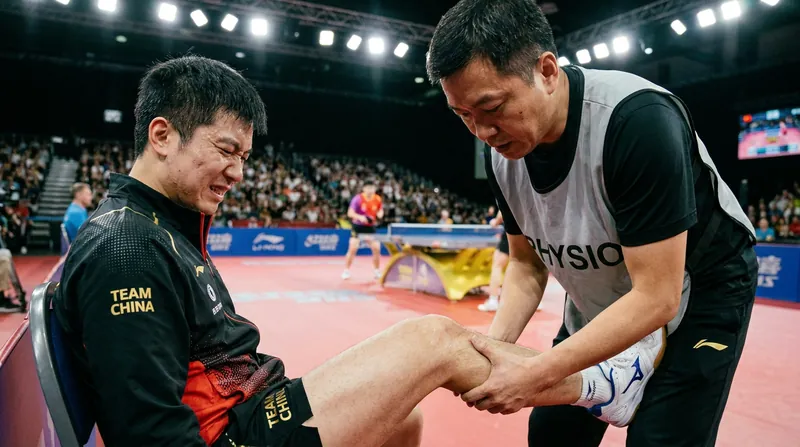
Just twelve months prior, the table tennis world assumed it had seen the last of the legendary paddler. In April 2025, a severe training accident left Ni with a fractured wrist—a devastating blow for any athlete, but seemingly a definitive career-ender for a sexagenarian competing in a sport reliant on microscopic fast-twitch muscle reactions.
The injury forced her immediate withdrawal from the 2025 World Championships in Doha and mandated a grueling surgical intervention. Doctors inserted a metal plate to stabilize the shattered bone, initiating a rehabilitation process that would test the limits of her physical endurance. For over half a year, Ni was completely sidelined, her world ranking plummeting as she focused entirely on regaining basic mobility in her dominant hand.
"I went through a lot during the past year of injury, and I feel fortunate to be back on court," Ni reflected during her international return. Facing a rehabilitation process that requires immense courage, she admitted that the journey was fraught with pain and uncertainty. Yet, the thought of quiet retirement never took root in her mind.
"Why should I stop? I love this sport, and the fans have been waiting for my return," Ni explained to reporters. She views her continued presence on the tour not merely as a personal pursuit, but as a profound responsibility to the game, to her adopted country of Luxembourg, and to the global community of fans who draw inspiration from her longevity.
Her initial steps back to the table were quiet but deeply emotional. In October 2025, she returned to local club competition in Europe, securing her first post-surgery victory. "To be able to play in a match is a special happiness," she remarked at the time, noting that while her flexibility and power were still compromised by the metal plate, her tactical mind remained as sharp as ever.
The true test of her recovery came in April 2026 at the WTT Contender Taiyuan in China. Stepping back onto the international circuit after more than a year away, Ni competed in both women's singles and mixed doubles. Though she exited the tournament early, her mere presence signaled to the world that her rehabilitation was complete and her competitive fire was undiminished.
Competing at the highest level with a surgically repaired wrist in her sixties requires a masterful recalibration of strategy. Ni openly acknowledges that she can no longer match the foot speed or raw rotational power of opponents who are, in some cases, young enough to be her grandchildren. "Physically, I cannot match the younger players," she admitted. "So I focus more on tactics: how to make the best use of my strengths and read my opponents."
Her playing style is a living artifact of table tennis history. Utilizing a traditional penhold grip and pips-out rubber, Ni plays a game of disruption rather than domination. While modern players rely on explosive topspin rallies from mid-distance, Ni stays close to the table, using her pips to flatten the ball's trajectory and reverse her opponent's spin.[1][2]
This unorthodox approach turns every match into a psychological chess game. Younger players, conditioned to face homogenous shakehand topspin styles, often find themselves baffled by Ni's awkward placements and sudden pace changes. Every match, she says, feels like "walking on thin ice," requiring absolute mental perfection to compensate for physical deficits.
Ni’s journey to this point is a sweeping epic that mirrors the globalization of table tennis. Born in Shanghai in 1963, she joined the Chinese national team at just 16 years old. In 1983, she reached the pinnacle of the sport, winning both women's team and mixed doubles gold medals at the World Championships for China.[1]
Following her departure from the Chinese national setup, she moved to Europe and eventually settled in Luxembourg in 1990. In a nation of roughly 600,000 people with virtually no table tennis pedigree, Ni became a sporting pioneer. She has since represented Luxembourg in six Olympic Games, stretching from Sydney in 2000 to Paris in 2024.[1][2]
Her impact on Luxembourg's sporting culture is immeasurable. When she returns from major tournaments, the celebrations in her hometown of Ettelbruck often last for days. She has single-handedly popularized the sport in the country, inspiring the creation of table tennis programs in schools and the establishment of over a hundred local clubs.[1]
The 2026 World Team Championships in London represent more than just a comeback; they are a stepping stone toward an audacious new goal. Despite her age, the metal plate in her wrist, and the grueling demands of the international calendar, Ni has officially set her sights on qualifying for the 2028 Los Angeles Olympics.
If successful, Los Angeles would mark her seventh Olympic appearance, an achievement that would cement her status as one of the most enduring Olympians in history across any discipline. "Dreams are worth having, what if they come true?" she said with characteristic optimism. "It will be difficult, but overcoming challenges is what makes life meaningful."
For now, the table tennis community is simply savoring the opportunity to watch her play. In an era where athletes are heavily scrutinized for their physical metrics and peak performance windows, Ni Xialian offers a refreshing counter-narrative. She proves that mastery, joy, and a deep understanding of the game can outlast the fleeting advantages of youth.[2]
As she packed her equipment after a grueling practice session in London, the metal plate in her wrist completely hidden beneath her sweatband, Ni looked toward the stands. "As long as my body is not injured, I'll still play," she promised. For a woman who has already conquered time, a shattered wrist was merely a temporary pause in a four-decade symphony.[2]
Key points
- 62-year-old Luxembourg table tennis star Ni Xialian has successfully returned to international competition following a severe wrist fracture in 2025.
- The injury required surgery and the insertion of a metal plate, sidelining her for over a year from major events.
- She made her international comeback at the WTT Contender Taiyuan and the 2026 World Team Championships in London.
- Ni relies on a traditional penhold grip and tactical mastery to compete against opponents decades younger.
- Undeterred by the injury, she has officially set her sights on qualifying for her seventh Olympic Games in Los Angeles in 2028.
How we got here
1983
Wins team and mixed doubles gold for China at the World Championships.
1990
Moves to Europe and begins representing Luxembourg in international competition.
April 2025
Suffers a severe wrist fracture during training, requiring surgery and a metal plate.
October 2025
Makes her initial return to the sport in European club matches.
April 2026
Returns to the international circuit at the WTT Contender Taiyuan and the World Team Championships in London.
July 2028
Target date for her seventh Olympic appearance in Los Angeles.
- Veteran Athletes & Sports Scientists
- Focuses on the biomechanical and mental resilience required to return from a fracture at 62.
- Table Tennis Traditionalists
- Celebrates the survival of the penhold pips-out style against modern power games.
- Luxembourg Sporting Community
- Views her as a national treasure who elevated the country's global sporting profile.
Perspectives this story doesn't cover
- Younger opponents facing her unorthodox style
- Surgeons who performed the wrist operation
Sources
Source coverage
3 outlets
3 viewpoints surfaced


- [1]Sixth ToneLuxembourg Sporting Community
The Chinese Table Tennis Champion Who Became a Luxembourg Legend
Read on Sixth Tone → - [2]GMA NetworkVeteran Athletes & Sports Scientists
Paris Olympics: Veteran paddlers prove age is just a number
Read on GMA Network → - [3]International Table Tennis FederationLuxembourg Sporting Community
Centenary Celebrations Begin at the 2026 ITTF World Team Championships
Read on International Table Tennis Federation →
More in Sports
See all →WTT Champions
Miwa Harimoto Becomes Youngest-Ever WTT Champions Winner With Seven-Game Thriller in Chongqing
7 sources
Injury
Global Table Tennis Injury Report: Shin Yubin's Knee Rehab and Harimoto's Strategic Rest Highlight a New Era of Recovery
4 sources
Table Tennis
Ulaanbaatar Hosts Historic First ITTF Ranking Tournaments, Signaling Sport's Expansion in Mongolia
6 sources
Injury
Global Table Tennis Injury Report: Benyamin Faraji's Knee Setback and the Tour's Mounting Physical Toll
2 sources
Comments
Every angle. Every day.
Get Sports stories with full source coverage and perspective breakdowns, free every day.