
Global Table Tennis Injury Report: Shin Yubin's Knee Rehab and Harimoto's Strategic Rest Highlight a New Era of Recovery
As the grueling 2026 WTT calendar continues, top players like South Korea's Shin Yubin and Japan's Tomokazu Harimoto are proving that strategic rest and meticulous injury rehab are the new keys to international success.

Share this story
The modern World Table Tennis (WTT) calendar is a grueling marathon, with over 45 events annually testing the physical limits of the world's best players. For years, the prevailing culture in the sport dictated that athletes play through the pain to secure crucial ranking points. However, the 2026 season has seen a profound shift, with top-tier paddlers proving that strategic rest and meticulous injury rehabilitation are the true keys to longevity and peak performance.[4]
South Korean superstar Shin Yubin has become the premier example of this new approach. Late in 2025, the 21-year-old faced a significant setback when knee ligament discomfort forced her to miss crucial matches at the Mixed Team World Cup in Chengdu. Rather than rushing a full singles workload and risking chronic damage, Shin and her medical team opted for a highly managed recovery protocol.
During the WTT Finals in Hong Kong shortly after the injury, Shin limited her physical exertion in singles play but focused her energy on the mixed doubles event. The calculated risk paid off as she captured the title alongside partner Lim Jong-hoon. She then spent the early months of 2026 diligently rehabilitating her knee, prioritizing strength conditioning over immediate tournament appearances.[1]
Shin's patience yielded spectacular results during the spring circuit. Fully healthy and moving with her signature explosive speed, she reached the semifinals of the ITTF World Cup in Macao in April 2026. The performance made her the first South Korean female player in history to win a medal at the prestigious event, validating her decision to prioritize her physical health over a packed winter schedule.
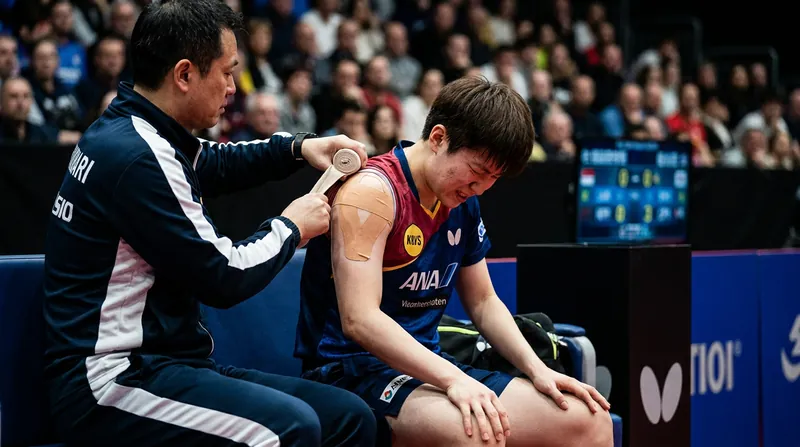
Japan's Tomokazu Harimoto has adopted a remarkably similar philosophy to preserve his own career. After battling lingering leg and knee issues throughout 2025—which culminated in a highly scrutinized medical timeout during the WTT Champions Yokohama—the world No. 4 made a conscious decision to step entirely away from the sport following the World Championships in Doha.[2][4]
In a candid admission, Harimoto revealed that he did not touch his table tennis racket for 10 full days. For a player renowned for his relentless, obsessive training regimen, the break was unprecedented. Harimoto noted that the pause was essential to realign his mind, technique, and body, allowing his joints to recover from the constant high-impact stress of his aggressive playing style.[2]
The strategic reset proved highly effective. Harimoto returned to the WTT circuit with renewed physical energy and mental clarity, recently battling his way to the final of the WTT Champions Chongqing event in June 2026. His movement around the table showed no signs of the previous knee strain, highlighting the benefits of absolute rest.[2]
His compatriot, Hina Hayata, has also become a prominent case study in injury management. Hayata famously won an Olympic bronze medal in Paris while suffering from a left wrist injury so severe that she was unable to dry her own hair. Since that heroic but punishing effort, Hayata has strictly curated her tournament schedule in 2025 and 2026 to avoid aggravating the joint.[3]
This wave of medical caution comes in response to the demanding structure of the WTT tour, which previously penalized top players financially for withdrawing from major events. Following high-profile pushback from athletes who cited physical and mental exhaustion, the tour has begun implementing reforms to better protect player welfare and allow for necessary recovery windows.[4]
As the mid-summer circuit heats up, the triumphant returns of Shin and Harimoto send a clear message to the next generation of paddlers. In a sport defined by lightning-fast reflexes and punishing biomechanical loads, sometimes the most powerful move a player can make is knowing exactly when to step away from the table.[2]
Key points
- South Korea's Shin Yubin successfully rehabilitated a knee ligament injury to win a historic World Cup medal in 2026.
- Japan's Tomokazu Harimoto took an unprecedented 10-day complete break from the sport to heal his body and mind.
- Hina Hayata continues to carefully manage her tournament schedule to protect a severe wrist injury.
- The relentless 45-event WTT calendar has forced elite players to prioritize strategic rest over ranking points.
How we got here
August 2024
Hina Hayata battles through a severe wrist injury to win an Olympic bronze medal in Paris.
December 2025
Shin Yubin suffers knee ligament discomfort but manages the injury to win the WTT Finals mixed doubles title.
Early 2026
Tomokazu Harimoto takes a 10-day complete break from table tennis to recover from lingering leg and knee issues.
April 2026
A fully rehabilitated Shin Yubin becomes the first South Korean female to win a medal at the ITTF World Cup.
June 2026
Harimoto returns to elite form, reaching the final of the WTT Champions Chongqing event.
- Player Welfare Advocates
- Supporters of athletes prioritizing their physical and mental health over ranking points.
- Tour Organizers
- Officials focused on the commercial growth and consistency of the global table tennis circuit.
- Sports Medical Professionals
- Experts analyzing the biomechanical strain of modern elite table tennis.
Perspectives this story doesn't cover
- Lower-ranked players who cannot afford to skip tournaments due to financial constraints.
- National team coaches balancing the health of their athletes with the pressure to win international medals.
Sources
Source coverage
4 outlets
3 viewpoints surfaced




- [1]PingArenaPlayer Welfare Advocates
Shin Yubin Tries Out a Volleyball Serve During Surgery Recovery
- [2]TableTennisDailySports Medical Professionals
Tomokazu Harimoto's 10-Day Rest and Return to Form
- [3]The Japan TimesSports Medical Professionals
Hina Hayata battles through severe wrist pain for Olympic bronze
- [4]South China Morning PostTour Organizers
Chinese table tennis fans slam Harimoto over medical timeout
More in Sports
See all →Standings
The Race to WTT Finals Hong Kong: Kuai Man and Satsuki Odo Ignite the Women's Standings with Summer Surges
6 sources
Standings
Race to WTT Finals Blown Wide Open as Lin Yun-Ju and Wen Ruibo Suffer Shock Exits in Yokohama
6 sources
Injury
Global Table Tennis Injury Report: Benyamin Faraji's Knee Setback and the Tour's Mounting Physical Toll
2 sources
Injury
Mid-Summer Injury Report: Lin Shidong's Shoulder Rehab and WTT's Schedule Reforms Reshape the 2026 Tour
2 sources
Comments
Every angle. Every day.
Get Sports stories with full source coverage and perspective breakdowns, free every day.