
David Malukas Completes Remarkable IndyCar Return at Laguna Seca Following Wrist Injury
After a pre-season mountain biking accident cost him his Arrow McLaren seat, David Malukas has successfully returned to the IndyCar grid with Meyer Shank Racing. The 22-year-old qualified 12th at Laguna Seca, marking a resilient comeback from a grueling four-month recovery.

Share this story
The return of David Malukas to the NTT IndyCar Series grid at Laguna Seca marks the end of a grueling four-month ordeal. After a pre-season mountain biking accident shattered his left wrist and derailed his dream opportunity with Arrow McLaren, the 22-year-old finally climbed back into a race car under the Meyer Shank Racing banner.
For a young driver who spent the spring watching his career temporarily slip away from a hospital bed, simply taking the green flag in Monterey represented a massive personal victory. The paddock welcomed his return, recognizing the immense physical and mental hurdles he had to clear just to be medically cleared to compete at the highest level of North American open-wheel racing.[2]
The journey back to the cockpit was anything but guaranteed. In February, what was supposed to be routine off-season physical training resulted in torn ligaments and a dislocated left wrist, requiring immediate and complex surgery. The initial medical evaluations suggested a six-week recovery timeline, which would have allowed Malukas to return early in the season.
However, the healing process quickly stalled, and the timeline stretched out indefinitely, leaving Malukas sidelined as the championship commenced without him. The physical pain of the injury was soon compounded by the professional anxiety of losing his seat in a highly competitive driver market.[4]
The extended absence ultimately proved too costly for his team to accommodate. On April 29, Arrow McLaren officially terminated his multi-year contract, citing his prolonged unavailability and the lack of a confirmed return date. The dismissal sent the young driver into a difficult mental space, as he was suddenly left without a drive and facing an uncertain future in the sport.
Forced to pivot, Malukas took on social media and promotional duties for the IndyCar Series, using the opportunity to maintain his presence in the paddock and build relationships while focusing entirely on his grueling physical rehabilitation.[2][4]
A sudden lifeline emerged in early June when Meyer Shank Racing sought a mid-season change to their driver lineup. Following a string of disappointing results and a costly first-lap crash at the Indianapolis 500 by rookie driver Tom Blomqvist, MSR co-owners Mike Shank and Jim Meyer made the difficult decision to bench the British driver. The team needed an immediate injection of pace and open-wheel experience to salvage their season, and Malukas’s sudden availability presented a rare opportunity to acquire a proven talent who was hungry to prove himself.[2][3]
MSR’s decision was heavily influenced by the urgent need to secure the No. 66 Honda’s position in the lucrative Leader Circle standings. The IndyCar program pays out more than $1 million to the top 22 full-time entries at the end of the year, making it a critical financial target for independent teams.
Recognizing Malukas’s raw speed and his determination to return to the grid, MSR signed him for the remainder of the season, trusting that his prior experience with Dale Coyne Racing would allow him to quickly adapt to their setup.[2][3]
Malukas’s physical readiness was immediately put to the test. He completed a successful evaluation at the Milwaukee Mile on June 11, an oval circuit that placed less strain on his healing left hand due to its banking and predominantly left-hand turns. However, the true challenge awaited at WeatherTech Raceway Laguna Seca, a demanding road course recently repaved to offer higher grip and significantly heavier steering loads. The physical demands of wrestling an IndyCar through the famous Corkscrew corner would be the ultimate test of his surgically repaired wrist.[3]
Arriving at Monterey, Malukas admitted to battling severe apprehension. He estimated his wrist was only about 85% recovered, requiring him to wear a restrictive protective brace in the cockpit. During his first practice session, the limited mobility caused him to spin out on his second lap, triggering a brief moment of panic about whether he could still drive at the elite level. The mental hurdle of trusting a healing joint at 180 miles per hour proved just as daunting as the physical pain.
The doubts quickly dissipated during Saturday's crucial qualifying sessions. Opting to remove the restrictive wrist brace for the session to regain vital mobility, Malukas delivered a gritty, standout performance. He navigated out of the chaotic Group 1 segment, edging out rivals by mere fractions of a second to advance to the Fast 12. The decision to prioritize range of motion over protection paid off, allowing him to attack the circuit's high-speed corners with the precision required to compete against the series' veterans.[1]
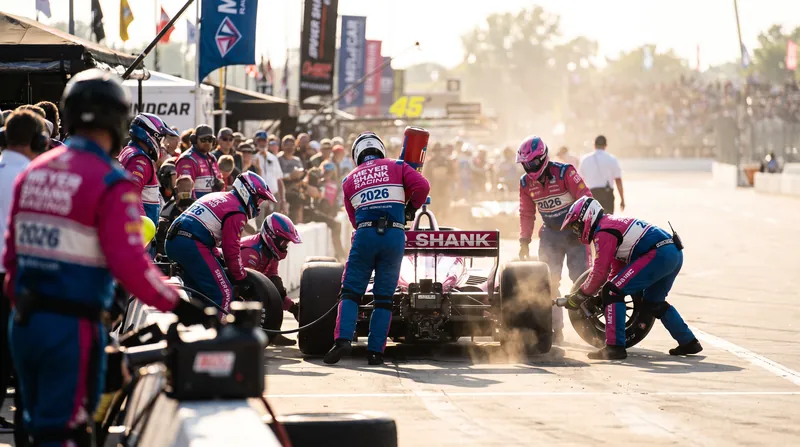
He ultimately secured the 12th starting position, matching the best qualifying effort of the entire season for the No. 66 entry. The result was a massive relief for both the driver and the MSR crew, proving that Malukas had lost none of his inherent pace despite the lengthy layoff. Returning to the pit lane, the sheer exhaustion on his face was overshadowed by a wide smile, validating the months of painful physical therapy and the leap of faith taken by his new team.[1]
The team environment at Meyer Shank Racing has played a vital role in accelerating the comeback. Malukas has publicly praised the family-like atmosphere and the immediate trust placed in him by the crew, noting that the supportive dynamic has allowed him to perform without the crushing pressure he felt earlier in the year. Unlike the intense, corporate environment at McLaren, MSR’s tight-knit garage provided the perfect incubator for a driver needing to rebuild both his physical strength and his professional confidence.
Moving forward, Malukas faces the dual challenge of managing his physical recovery while adapting to IndyCar's newly introduced hybrid power units. Because he missed the early-season testing and the initial rollout of the hybrid systems, he is currently relying heavily on shared telemetry data from MSR’s technical partner, Andretti Global, to accelerate his learning curve. The steep mid-season learning curve is compounded by the fact that he must learn a new steering wheel layout and energy deployment strategies while still nursing his injury.
While medical experts confirm the wrist will not be fully healed until next year, Malukas’s return is already being hailed across the paddock as a triumph of resilience. In a sport where a single injury can permanently derail a promising career, his ability to fight his way back onto the grid—and immediately deliver a competitive qualifying performance—cements his reputation as one of IndyCar's most determined young stars. The dark days of February have finally given way to a bright future in the No. 66 Honda.
Key points
- David Malukas returned to IndyCar racing at Laguna Seca after a four-month recovery from a torn wrist.
- The 22-year-old was dropped by Arrow McLaren in April due to his unclear recovery timeline.
- Meyer Shank Racing signed Malukas in June to replace rookie Tom Blomqvist in the No. 66 Honda.
- Despite his wrist only being 85% healed, Malukas qualified an impressive 12th in his first weekend back.
How we got here
February
Malukas tears ligaments and dislocates his left wrist in a mountain biking accident.
April 29
Arrow McLaren releases Malukas from his contract due to an unclear recovery timeline.
June 7
Meyer Shank Racing signs Malukas for the remainder of the season, replacing Tom Blomqvist.
June 11
Malukas completes his first post-injury test at the Milwaukee Mile.
Late June
Malukas makes his official race return at the Grand Prix of Monterey at Laguna Seca.
- Driver & Team Optimism
- Emphasizes Malukas' resilience, his mental recovery, and the supportive environment provided by Meyer Shank Racing.
- Competitive Reality
- Focuses on the lingering physical limitations of the injury and the steep learning curve of returning mid-season.
- Strategic Team Decisions
- Highlights the business and championship stakes, including McLaren's contract termination and MSR's push for Leader Circle points.
Perspectives this story doesn't cover
- Arrow McLaren Management
- Tom Blomqvist
Sources
Source coverage
4 outlets
3 viewpoints surfaced




- [1]Motorsport.comCompetitive Reality
Malukas puts together gritty qualifying performance in IndyCar return
Read on Motorsport.com → - [2]AutosportStrategic Team Decisions
Malukas to return from injury to race for Meyer Shank Racing
Read on Autosport → - [3]RACERStrategic Team Decisions
Malukas joins Meyer Shank Racing, starting at Laguna Seca
Read on RACER → - [4]WikipediaStrategic Team Decisions
David Malukas
Read on Wikipedia →
More in Sports
See all →Storyline
Alex Palou's Historic Fifth Title Cements a New IndyCar Dynasty as 2026 Season Wraps
6 sources
Storyline
Scott McLaughlin Dominates Laguna Seca Finale as Alex Palou Lifts Fifth IndyCar Championship
8 sources
Trade
Mick Schumacher and Conor Daly Secure Full-Time IndyCar Seats for 2027
2 sources
Trade
Mick Schumacher Signs With Meyer Shank Racing for 2027 IndyCar Season
5 sources
Comments
Every angle. Every day.
Get Sports stories with full source coverage and perspective breakdowns, free every day.