
Chinese Yuan Reaches Four-Year High Against US Dollar on Export Strength
China's currency touched its strongest level since June 2022 as a surge in high-tech exports overpowered sluggish domestic consumption. The milestone follows the central bank's decision to hold benchmark lending rates steady for a 17th consecutive month.

Share this story
For a managed currency to appreciate while its domestic economy slumps, the external trade engine must run hot enough to offset internal weakness. That condition is currently holding for China, where a surge in high-tech exports has overpowered sluggish domestic consumption.[2][6]
Driven by that external demand, the onshore yuan touched 6.6765 per US dollar in morning trading on Wednesday, marking its strongest level since June 2022. The offshore yuan followed suit, trading around 6.6786 per dollar as corporate foreign-exchange settlements accelerated.[3][6]
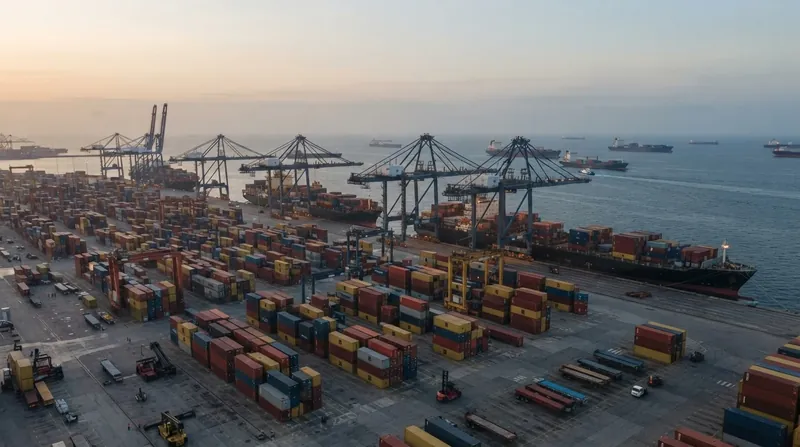
The milestone arrives as exporters increasingly convert their foreign-currency receipts into local currency, reinforcing the yuan's upward momentum. September export data revealed a 36.3% year-over-year surge to $447.18 billion, significantly exceeding the 25.5% consensus forecast.[1][4]
Analysts attribute this export outperformance largely to the global artificial intelligence infrastructure boom, which has sustained heavy demand for Chinese high-tech components. That external revenue has provided a critical buffer for an economy still grappling with a protracted property sector downturn.[4][6]
Central bank guidance
The People's Bank of China has actively managed this appreciation, using its daily midpoint fixing to steer the currency's trajectory. On Tuesday, the central bank set the reference rate at 6.72 per dollar, representing its firmest fixing since February 2023.[1][6]
Because the onshore yuan is permitted to trade up to 2% stronger or weaker than this daily midpoint, a firmer fix mechanically shifts the trading band higher. However, the central bank has consistently set the rate slightly weaker than market models imply.[1][6]
"The direction of the daily PBoC fixing remains a more important gauge of policymakers' intentions," analysts at CSCI Pengyuan Credit Rating noted. By setting the fix below market expectations, officials signal a preference for gradual appreciation while discouraging speculative one-way bets.[1][6]
This currency strength coincides with broader economic data that has temporarily eased pressure on Beijing to deploy aggressive stimulus. Third-quarter gross domestic product expanded by 4.5% year-over-year, accelerating from a three-year low in the previous quarter.[2][5]
Holding the line on rates
With growth rebounding on the back of industrial output, policymakers have opted to maintain their current monetary stance. On Tuesday, the central bank kept its benchmark Loan Prime Rates unchanged for the 17th consecutive month, holding the one-year rate at 3% and the five-year rate at 3.5%.[1][5]
The decision to hold rates steady reflects a delicate balancing act. While domestic demand remains fragile, lowering borrowing costs could widen the yield gap with the United States, potentially triggering capital outflows and undermining the yuan's recent gains.[5]
Instead, authorities are leaning on the trade sector's robust performance to carry the broader economy toward the government's full-year growth target of 4.5% to 5%. The strategy relies heavily on global markets remaining open to Chinese manufactured goods.[5][6]
That reliance introduces significant external risks, particularly as trade tensions escalate with major economic blocs. The European Union is currently assessing import data for potential surges, a preliminary step toward imposing quotas that could follow the recently agreed cap on hybrid vehicle exports.[4]
Global trade implications
A stronger yuan fundamentally alters the pricing dynamics for global supply chains that depend on Chinese manufacturing. As the currency appreciates, Chinese exports become more expensive for foreign buyers, which could eventually cool the very demand that is currently driving the rally.[1][5]
Despite the recent appreciation, some Western financial institutions argue the currency has further room to run. Goldman Sachs analysts recently estimated that the yuan remains undervalued by roughly 20% to 25%, suggesting policymakers may tolerate continued strength to support trade ties.[4][5]
The currency's advance also aligns with Beijing's longer-term strategic goal of establishing the yuan as a viable alternative to the US dollar in international trade. A stable, appreciating currency makes yuan-denominated assets more attractive to foreign central banks and institutional investors.[4]
To capitalize on this momentum, China has accelerated efforts to deepen its offshore financial infrastructure. Recent initiatives include expanding access to panda bond issuance and broadening the range of available yuan-based derivatives and hedging tools for international market participants.[4]
Corporate settlement dynamics
In the near term, the trajectory of the yuan will depend heavily on the behavior of Chinese exporters. Throughout 2026, many corporations had hoarded dollar receipts, anticipating further weakness in the domestic currency.[1][6]
As the yuan's upward trend solidifies, those corporate treasurers are now rushing to convert their dollar holdings before they lose more value. This wave of delayed settlements creates a self-reinforcing cycle, supplying the market with dollars and driving the yuan higher.[1][6]
Key points
- The onshore Chinese yuan reached 6.6765 per US dollar, its strongest level since June 2022.
- September exports surged 36.3% year-over-year to $447.18 billion, driven heavily by global demand for AI infrastructure.
- The People's Bank of China held its benchmark lending rates steady for the 17th consecutive month.
- Corporate treasurers are accelerating the conversion of dollar receipts into yuan, reinforcing the currency's upward momentum.
What we don’t know
- Whether the global AI infrastructure boom will sustain its current pace to keep Chinese exports elevated through 2027.
- How the European Union's ongoing assessment of import surges might translate into new quotas on Chinese manufactured goods.
- The exact volume of hoarded US dollars still held by Chinese corporates waiting to be converted into yuan.
How we got here
July 2022
The yuan trades near 6.67 per dollar before beginning a prolonged depreciation cycle amid domestic property sector stress.
February 2023
The People's Bank of China sets its daily midpoint fixing at 6.72, a level it will not revisit for over three years.
September 2026
Chinese exports surge 36.3% year-over-year to $447.18 billion, driven heavily by global demand for AI infrastructure components.
October 20, 2026
The central bank holds benchmark lending rates steady for the 17th consecutive month following a 4.5% third-quarter GDP print.
October 21, 2026
The onshore yuan touches 6.6765 per US dollar in morning trading, marking its strongest level in more than four years.
- Chinese Monetary Authorities
- Value gradual, controlled appreciation that reflects export strength without inviting speculative inflows or harming manufacturing competitiveness.
- Export Sector Corporates
- Focused on maximizing the local-currency value of foreign receipts, driving the current spot rate higher through accelerated dollar conversions.
- Western Trade Partners
- View the currency's valuation through the lens of trade imbalances, with some arguing the yuan remains structurally undervalued despite recent gains.
Perspectives this story doesn't cover
- Domestic consumers facing weak purchasing power
- Importers of raw materials benefiting from the stronger currency
Sources
Source coverage
6 outlets
3 viewpoints surfaced






- [1]FinimizeChinese Monetary Authorities
China's Yuan Hit A Four-Year High As Trade Stayed Strong
Read on Finimize → - [2]The Edge MalaysiaExport Sector Corporates
Yuan hits four-year high as strong GDP data tempers need for stimulus
Read on The Edge Malaysia → - [3]The Economic TimesExport Sector Corporates
China's yuan strengthens as resilient economic activity and foreign inflows offset lingering domestic demand concerns
Read on The Economic Times → - [4]Trading EconomicsWestern Trade Partners
Offshore Yuan Extends Gains to Over 4-Year High
Read on Trading Economics → - [5]Currency HedgerWestern Trade Partners
Offshore Yuan Hits Four-Year High Near 6.68 as Stronger Growth Eases Pressure for Stimulus
Read on Currency Hedger → - [6]Business RecorderChinese Monetary Authorities
China's yuan hit its highest level in more than four years on Tuesday
Read on Business Recorder →

More in Finance
See all →Trade Economics
Why Currency Depreciation Temporarily Deepens Trade Deficits Along the J-Curve
5 sources
Monetary Policy
Bank of Japan Prepares to Lift 2027 Inflation Projections While Maintaining Policy Rates
5 sources

Energy Markets
Crude Prices Slide Below $106 as US Sanctions Relief Frees Russian Fuel Flows
8 sources

Currency Markets
Triangular Arbitrage in Foreign Exchange: How Zero-Profit Bounds Enforce Cross-Rate Consistency
11 sources

Comments
Every angle. Every day.
Get Finance stories with full source coverage and perspective breakdowns, free every day.