
Food Importer Sues to Block Trump's 50% Tariffs on Canadian Goods Under 1930 Trade Law
New Jersey-based Gellert Global Group has filed a lawsuit in the U.S. Court of International Trade challenging the Trump administration's use of a Depression-era statute to impose sweeping tariffs on Canadian imports.

Share this story
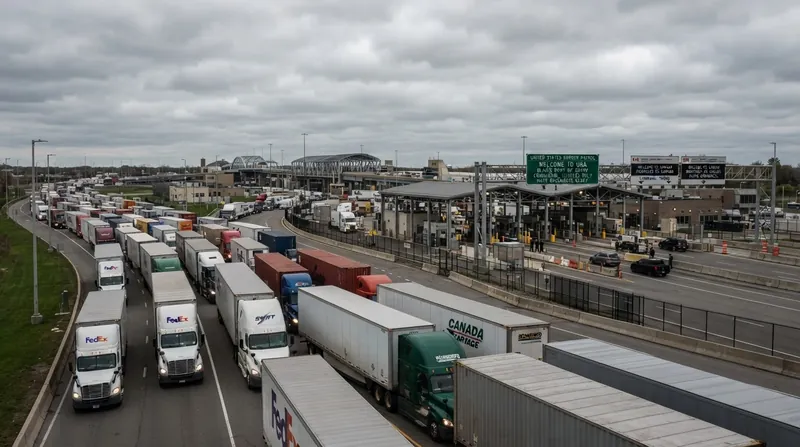
On Tuesday morning in the U.S. Court of International Trade in New York, a third-generation New Jersey food importer formally challenged the Trump administration's sweeping trade offensive against Canada. Gellert Global Group filed a lawsuit seeking to dismantle the 50 percent tariffs imposed over the summer. The complaint asks the court to declare the duties unlawful and halt their collection immediately.[1][2][5]
The legal action represents the first direct judicial test of the administration's reliance on Section 338 of the Tariff Act of 1930. President Donald Trump invoked the Depression-era statute in July to levy heavy duties on a wide array of Canadian products, from hockey sticks and honey to wine and wigs. The administration justified the move by citing alleged trade discrimination by Ottawa.[1][3][5]
Gellert Global Group, which imports specialty cheeses caught in the crossfire, argues that the executive branch has vastly exceeded its statutory authority. The company is seeking not only an injunction against future collections but also interest-bearing refunds for all duties already paid. The Liberty Justice Center is representing the importer and a proposed class of similarly affected American businesses.[1][2][4]
"This case is not about the president. It is about the presidency," said Sara Albrecht, Chairman and CEO of the Liberty Justice Center. She argued that no executive should hold the power to pull a dormant statute off the shelf to impose sweeping import bans without the limits required by Congress. The organization previously defeated the administration's reciprocal tariffs at the U.S. Supreme Court.[2][3]
A dormant statute revived
Section 338 is a provision of the Smoot-Hawley Tariff Act that allows the president to impose additional duties of up to 50 percent to offset specific foreign discrimination against U.S. commerce. Until this year, no president had ever used the 96-year-old law to impose a tariff. The administration's sudden deployment of the statute caught trade experts and importers off guard.[2][3][5]
The lawsuit contends that Section 338 is not an all-purpose authorization for the executive branch to bypass Congress whenever a trade dispute arises. The plaintiffs argue that the law was effectively superseded by Section 301 of the Trade Act of 1974, which established a more comprehensive framework for addressing unfair foreign trade practices. They claim the older statute cannot legally support the current tariff regime.[1][2][4]
The administration's July proclamations specifically targeted Canadian policies regarding dairy, alcohol, and American-made automobiles. However, the Liberty Justice Center argues that these foreign policies do not meet the legal threshold of discrimination required by Section 338. The complaint notes that two of the Canadian measures were actually implemented in direct retaliation to the president's own earlier tariffs.[1][2]
The third Canadian policy cited by the administration involves dairy regulations that are already governed by the U.S.-Mexico-Canada Agreement (USMCA). The plaintiffs argue that using a 1930 statute to override a modern, negotiated trade pact violates established legal frameworks. They maintain that ordinary trade disagreements must be resolved through the mechanisms Congress explicitly approved.[1][2]
Procedural violations alleged
Beyond the broader question of executive authority, the lawsuit alleges that the administration committed specific procedural errors when implementing the duties. The complaint highlights that Canadian cheese was added to tariff lists originally designed to address Canadian liquor policies and automobile tariffs. The administration's foundational dairy proclamation did not actually cover cheese imports.[1][2]
The plaintiffs also accuse the administration of violating Section 338's mandatory 30-day waiting period before collecting duties. According to the filing, the government added the specific cheeses imported by Gellert Global Group to the tariff list on September 8. Customs officials then began collecting the 50 percent duties just seven days later, bypassing the statutory delay.[1]
The immediate financial impact on American importers has been severe, forcing companies to either absorb the 50 percent cost increase or pass it along to consumers. Gellert Global Group claims the duties have caused immediate harm to their operations, their suppliers, and their customer base. The company continues to pay the tariffs at the border while the legal question remains unresolved.[1][2]
The Liberty Justice Center has filed motions for both a preliminary injunction and summary judgment, seeking to expedite the court's intervention. If the judge grants the preliminary injunction, the government would be temporarily barred from collecting the Section 338 tariffs while the broader case proceeds. The White House has not yet issued a public comment regarding the litigation.[1][3]
The broader legal battlefield
This lawsuit is part of a wider, ongoing legal war over the administration's aggressive use of executive trade powers. The Liberty Justice Center is currently pursuing two other cases challenging the president's reliance on different statutes to impose sweeping global tariffs. In February, the U.S. Supreme Court struck down the administration's use of the International Emergency Economic Powers Act for similar purposes.[3][4]
Following that Supreme Court defeat, the federal government was forced to begin refunding an estimated $166 billion to American importers. The administration subsequently pivoted to Section 338 and other obscure trade laws to reconstruct its tariff regime. Legal analysts view the Gellert Global Group lawsuit as a critical test of whether the executive branch can successfully substitute one dormant statute for another.[3][4]
The outcome of this case at the U.S. Court of International Trade will likely dictate the future of U.S.-Canada trade relations and the broader North American supply chain. A victory for the plaintiffs would save American companies tens of billions of dollars and reaffirm congressional authority over taxation. A ruling in favor of the administration would validate a powerful new tool for unilateral executive action.[2][4][5]
For now, the 50 percent duties remain in active enforcement, leaving importers to navigate a highly volatile regulatory environment. The court has not yet scheduled a hearing for the preliminary injunction motion. Until a judge intervenes, businesses like Gellert Global Group must continue financing the administration's untested legal strategy at the border.[1][2]
Supply chain disruptions
The sheer variety of products caught in the Section 338 dragnet illustrates the sweeping nature of the administration's trade strategy. Beyond industrial goods, the tariffs have hit consumer staples and niche imports alike, disrupting established cross-border supply chains. Retailers across the United States are already adjusting their inventory models to account for the sudden 50 percent price hikes.[1][3]
Trade historians note that the Smoot-Hawley Tariff Act, which houses Section 338, is widely associated with exacerbating the Great Depression by triggering retaliatory trade wars. The fact that this specific retaliatory provision sat unused for nearly a century highlights its controversial nature. Legal scholars are closely watching how the court interprets a 1930s legislative intent in a modern, highly integrated global economy.[2][4]
The Liberty Justice Center's proposed class-action structure means that a favorable ruling would automatically cover thousands of other affected American businesses. If the court certifies the class, the government could face another massive wave of court-ordered, interest-bearing refunds. The financial stakes for the federal treasury are consequently enormous, setting the stage for a protracted legal battle that will likely reach the appellate courts.[1][2]
Key points
- New Jersey food importer Gellert Global Group sued the Trump administration to block 50 percent tariffs on Canadian goods.
- The lawsuit argues the executive branch exceeded its authority by reviving Section 338 of the 1930 Tariff Act.
- Plaintiffs are seeking an immediate halt to tariff collections and interest-bearing refunds for all duties paid.
- The Liberty Justice Center, representing the importer, previously defeated the administration's reciprocal tariffs at the Supreme Court.
What we don’t know
- Whether the U.S. Court of International Trade will grant the preliminary injunction to halt tariff collections while the case proceeds.
- If the court will certify the lawsuit as a class action, which would extend potential refunds to all affected importers.
- How the Canadian government might further retaliate if the 50 percent tariffs are upheld by the U.S. judiciary.
How we got here
1930
Congress passes the Smoot-Hawley Tariff Act, including Section 338, which remains unused for 96 years.
February 2026
The U.S. Supreme Court strikes down the administration's global tariffs under IEEPA, forcing $166 billion in refunds.
July 2026
President Trump invokes Section 338 to impose 50 percent tariffs on Canadian goods, citing trade discrimination.
September 8, 2026
The administration adds Canadian cheese to the Section 338 tariff list.
September 15, 2026
Customs officials begin collecting the 50 percent duties on cheese imports, allegedly bypassing a 30-day statutory waiting period.
October 20, 2026
Gellert Global Group files a lawsuit in the U.S. Court of International Trade seeking to block the tariffs and secure refunds.
- American Importers
- Argue that unilateral executive tariffs unlawfully tax domestic businesses and bypass congressional authority.
- The Administration
- Maintains that dormant trade statutes provide valid legal authority to penalize foreign discrimination.
- Trade Analysts
- Warn that reviving 1930s retaliatory laws destabilizes modern supply chains and violates recent trade pacts.
Perspectives this story doesn't cover
- Canadian exporters whose products are priced out of the U.S. market by the 50 percent duties.
- U.S. Customs and Border Protection officials tasked with enforcing the rapidly shifting tariff lists.
Sources
Source coverage
5 outlets
3 viewpoints surfaced





- [1]QuartzAmerican Importers
Food importer is suing to block Trump's 50% Canada tariffs imposed under 1930 law
Read on Quartz → - [2]Liberty Justice CenterAmerican Importers
Lawsuit on behalf of third-generation American food business challenges 50% tariffs imposed under a never-used Depression-era statute
Read on Liberty Justice Center → - [3]UA.NewsAmerican Importers
US food importer Gellert Global Group has sued over 50% tariffs on Canadian goods, seeking to have them declared unlawful and obtain refunds with interest
Read on UA.News → - [4]Traders UnionTrade Analysts
A new legal challenge is targeting President Donald Trump's 50% tariffs on a range of Canadian goods under a rarely used U.S. trade law
Read on Traders Union → - [5]CNBCThe Administration
Trump sued over 50% tariffs on Canada in latest trade challenge
Read on CNBC →
More in Business
See all →Market Microstructure
How Dollar Funding Squeezes Break Covered Interest Parity in Cross-Currency Swaps
9 sources

Sovereign Debt
Japan's 20-Year Debt Sale Draws Record Demand as Domestic Buyers Return
5 sources

Market Regulation
Indonesian Equities Rebound 3% as Exchange Excludes Concentrated Stocks to Avert MSCI Downgrade
9 sources

Energy Markets
European Natural Gas Tops €90 per Megawatt-Hour Amid Persistent Supply Threats
5 sources

Comments
Every angle. Every day.
Get Business stories with full source coverage and perspective breakdowns, free every day.