
Cande Moreno Targets December World Cup Return as Andorran Ski Federation Adopts Autologous Platelet Therapy
Three and a half months after a devastating crash at the Milano-Cortina Olympics, Andorran alpine skier Cande Moreno is targeting a December return to the FIS World Cup. Her recovery coincides with the Andorran Ski Federation's new partnership with Cellab CDMO to provide elite athletes with accelerated blood-platelet healing therapies.
By Meera Iyer

Share this story
Three and a half months after a devastating crash at the Milano-Cortina Winter Olympics, Andorran alpine skier Cande Moreno is steadily rebuilding her body and eyeing a return to the FIS World Cup. The 25-year-old speed specialist, who suffered severe ligament damage to her left knee and right thumb, has transitioned from post-surgical rehabilitation to intensive athletic conditioning.
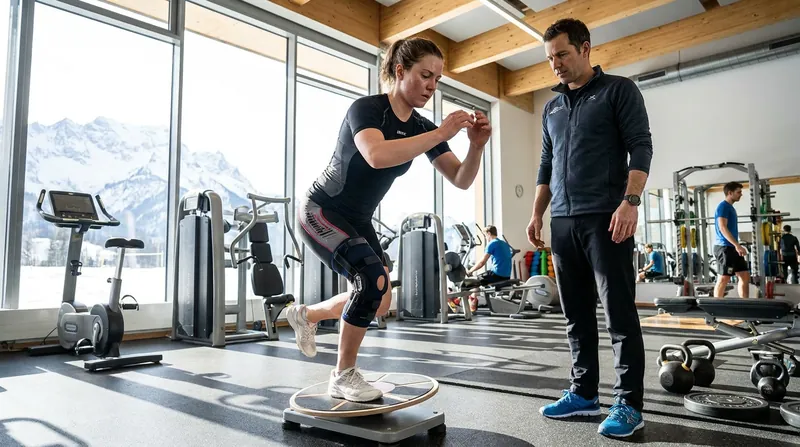
Moreno recently confirmed that she has resumed nearly full dryland training, incorporating heavy weightlifting, impact absorption work, and intense cycling sessions. Speaking to local media, she expressed profound relief at crossing a critical psychological threshold in her recovery, noting that she finally feels like an athlete again rather than a patient sidelined by trauma.[2]
Rather than rushing back for the earliest possible races, Moreno is adopting a measured approach. She anticipates her first contact with snow will occur in October during a controlled training camp in South America. This timeline places her slightly ahead of initial medical projections, largely due to the predictable surface conditions available in the Southern Hemisphere during the European autumn.[2]
Acknowledging that there are biological timelines to respect, Moreno has already ruled out competing in the World Cup speed opener in Beaver Creek, Colorado. Instead, she has circled December 18 and 19 on her calendar, targeting the races in Saint Moritz, Switzerland. The Swiss track is familiar territory where she has historically posted strong results, offering a comfortable environment for her first race back.
Moreno's cautious optimism stands in stark contrast to the harrowing scene in February. During the Olympic downhill on Cortina d'Ampezzo's notorious Olimpia delle Tofane piste, Moreno's left knee buckled upon landing a high-speed jump, sending her tumbling violently into the safety netting. The crash occurred shortly after American star Lindsey Vonn suffered a similarly severe fall, prompting a high-altitude helicopter evacuation by emergency crews.[1]
Moreno is not the only Andorran skier bouncing back from a physical setback. Slalom specialist Carla Mijares has successfully rehabilitated a left fibula stress fracture that disrupted her previous campaign. Following two rigorous pre-season camps on the glaciers of Les Deux Alpes, Mijares has returned to the snow without any lingering pain or mechanical issues.
Under the guidance of new head coach Pol Carreras, who recently succeeded Josh Alayrach, Mijares is focusing on broadening her technical range to handle deteriorating race conditions. Carreras has publicly confirmed that Mijares's injury is fully resolved, praising her early-season form and emphasizing a renewed focus on mental resilience as the team prepares for the upcoming World Championship season.
The successful rehabilitations of Moreno and Mijares coincide with a major sports-medicine initiative launched by the Andorran Ski Federation. In late June, the federation finalized a strategic partnership with bio-pharmaceutical firm Cellab CDMO to provide cutting-edge autologous therapies to ten of its elite athletes, including Moreno, Mijares, and giant slalom standout Joan Verdú.
The initiative centers on Celplat, a specialized treatment derived directly from the athletes' own blood platelets. Processed in a laboratory over roughly ten days, the concentrated plasma is reinjected into the athlete to accelerate the healing of cartilage, tendons, and ligaments. Because the therapy uses the athlete's own biological material, it bypasses the need for external pharmaceuticals while strictly adhering to anti-doping regulations.
Federation manager Carles Visa has underscored the dual purpose of the Cellab partnership: accelerating recovery times for acute injuries and serving as a preventative measure against the chronic joint wear-and-tear inherent to alpine skiing. Cellab's research and development head, Clara Boces, noted that the athletes' blood samples are already banked and ready for prompt processing the moment an injury occurs.
For a smaller national federation like Andorra, which relies heavily on a concentrated pool of elite talent, minimizing downtime is a competitive necessity. As Moreno builds her strength in the gym and Mijares carves through summer glacier snow, the integration of advanced orthobiologics signals a proactive shift in how the team protects its most valuable assets.
Key points
- Cande Moreno is targeting a December return to the FIS World Cup following reconstructive knee surgery.
- She plans to resume on-snow training in South America this October.
- Teammate Carla Mijares has fully recovered from a fibula fracture and is training in Les Deux Alpes.
- The Andorran Ski Federation has partnered with Cellab CDMO to provide autologous platelet therapy to 10 athletes.
- The treatment uses the athletes' own blood to accelerate cartilage and tissue healing without pharmaceuticals.
How we got here
Feb 8, 2026
Moreno suffers a severe knee and thumb injury during the Olympic downhill in Cortina d'Ampezzo.
Mid-March 2026
Moreno undergoes reconstructive surgery on her left knee.
June 2026
Carla Mijares returns to full on-snow training in Les Deux Alpes following a fibula fracture.
June 30, 2026
The Andorran Ski Federation finalizes its medical partnership with Cellab CDMO.
October 2026
Moreno's scheduled return to on-snow training in South America.
Dec 18, 2026
Moreno's targeted World Cup return date in Saint Moritz.
- Recovering Athletes
- Focused on respecting biological healing timelines and regaining physical confidence before returning to high-speed snow environments.
- Sports Medical Innovators
- Advocating for the use of autologous blood therapies to accelerate tissue repair and prevent long-term cartilage degradation.
- Emergency Rescue Operators
- Tasked with the high-stakes logistics of safely evacuating severely injured athletes from steep, icy alpine courses.
Perspectives this story doesn't cover
- FIS Medical Committee officials regulating the use of orthobiologics
- Independent orthopedic surgeons evaluating the efficacy of platelet therapies
Sources
Source coverage
2 outlets
3 viewpoints surfaced


- [1]ReutersEmergency Rescue Operators
Helicopter crew details Olympic rescue of Vonn and Moreno
Read on Reuters → - [2]El PeriòdicRecovering Athletes
Cande Moreno preveu tornar a la neu a l'octubre mentre l'evolució és favorable
Read on El Periòdic →
More in Sports
See all →Injury
Beyond Medical Clearance: How New 'Return to Snow' Protocols Are Revolutionizing Injury Recovery in Snow Sports
3 sources
Injury
Alpine Prodigy Lara Colturi Adds Super-G Back to World Cup Schedule in Final Phase of Injury Comeback
5 sources
Injury
Alpine Skiing Injury Report: Vonn Returns to the Gym as Kilde and Schwarz Eye 2026-27 Season
4 sources

Injury
Summer 2026 Snow Sports Injury Report: Sharpe, Milton, and Wendler Headline Off-Season Recoveries
3 sources

Comments
Every angle. Every day.
Get Sports stories with full source coverage and perspective breakdowns, free every day.