
GuideUranium Enrichment for Nuclear FuelRevision 1Updated
Uranium Enrichment for Nuclear Fuel
To power commercial nuclear reactors, natural uranium must undergo a massive industrial process to isolate the fissile uranium-235 isotope. This guide details the physics of gas centrifuges, the thermodynamics of separative work, and the infrastructure required to produce advanced reactor fuels.
By Layla Zaher

Share this story
In short
- Natural uranium contains only 0.711% of the fissile U-235 isotope, requiring enrichment to reach the 3-5% needed for commercial reactors.
- Modern enrichment relies on gas centrifuges spinning at over 90,000 RPM to separate isotopes based on a 1.26% mass difference.
- The effort required to enrich uranium is measured in Separative Work Units (SWU), an exponential metric of mechanical energy.
The entire architecture of global nuclear power rests on a microscopic physical discrepancy. Natural uranium extracted from the earth is overwhelmingly composed of the heavier isotope uranium-238, a stable material which cannot sustain a fission chain reaction on its own.[10]
The fissile isotope that commercial reactors actually require, uranium-235, makes up just 0.711 percent of natural uranium ore. Because the two isotopes are chemically identical, they cannot be separated through standard chemical reactions, smelting, or traditional industrial filtration.[1]
To function efficiently in the light-water reactors that dominate the current global fleet, the concentration of uranium-235 must be artificially increased to between 3 and 5 percent. This moderately concentrated product is universally known across the industry as low-enriched uranium, or LEU.[6]
Achieving that seemingly modest increase requires a massive, energy-intensive industrial intervention. The entire enrichment process must exploit the only meaningful physical difference that exists between the two isotopes: a remarkably tiny variation in their respective atomic masses.[2]
Uranium-235 is approximately 1.26 percent lighter than uranium-238. Isolating the lighter isotope demands converting the solid uranium metal into a gaseous form and subjecting it to extreme mechanical forces that push the absolute limits of modern materials science and precision engineering.[4]
The Physics of the Gas Centrifuge
Because centrifuges require a fluid medium to operate, the enrichment cycle begins with chemical conversion. Solid uranium oxide, commonly known as yellowcake, is reacted with hydrofluoric acid to create a compound called uranium hexafluoride.[1]
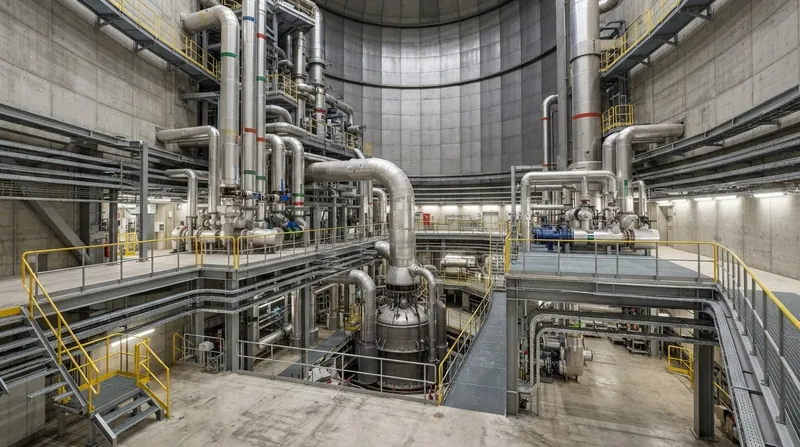
Uranium hexafluoride transitions into a gas at relatively low temperatures, making it the standard feedstock for enrichment facilities worldwide. Once vaporized, the gas is fed directly into the core of a tall, cylindrical centrifuge.[2]
Inside the centrifuge, a specialized, perfectly balanced rotor spins the gas at extraordinary speeds, often exceeding 90,000 revolutions per minute. This rapid rotation generates a centrifugal force thousands of times stronger than Earth's gravity.[4]
Under this immense pressure, the slightly heavier uranium-238 molecules are forced outward, compressing against the cylinder wall. Meanwhile, the lighter uranium-235 molecules tend to remain closer to the central vertical axis of the spinning rotor.[2]
This separation is incredibly slight. A single pass through one centrifuge only marginally increases the concentration of uranium-235, necessitating a highly repetitive, multi-stage process to reach the grades required for commercial nuclear fuel.[1]
Cascades and Countercurrent Flow
To achieve the 5 percent concentration required for commercial light-water reactors, enrichment plants link thousands of individual centrifuges together. This complex series-parallel architecture is known across the nuclear industry as a cascade.[1]
As gas is extracted from the center of the first centrifuge, it is fed forward into the next machine in the sequence for further enrichment. Simultaneously, the depleted gas from the outer wall is fed backward to be processed again.[4]
Modern Zippe-type centrifuges enhance this separation using a mechanically stimulated countercurrent flow. By heating the bottom of the cylinder and using a specialized scoop, operators create a vertical convection current inside the spinning rotor.[4]
This internal circulation multiplies the separation effect within a single machine, acting similarly to a chemical distillation column. The enriched fraction is continuously collected by a stationary scoop positioned behind a rotating baffle.[4]
At the end of the cascade, two distinct streams emerge. The product stream contains the enriched uranium gas, while the tails stream consists of depleted uranium, which is safely stored or utilized in specialized industrial applications.[6]
Separative Work Units (SWU)
The effort required to enrich uranium is quantified by a specialized metric known as the Separative Work Unit, or SWU. Introduced by physicist Paul Dirac in 1941, the SWU measures the mechanical work performed during isotope separation.[8]
A SWU is not a direct measure of energy or mass, but rather a function of the concentrations of the feedstock, the enriched output, and the depleted tails. It reflects the total enrichment services provided by a facility.[8]
The unit is strictly defined as a kilogram separative work unit. It calculates the effort needed to increase the value of a given amount of uranium when feed and product quantities are expressed in kilograms.[6]
For example, producing one kilogram of uranium enriched to 5 percent uranium-235 from natural uranium requires approximately 7.9 SWU. This calculation assumes the plant operates with a standard tails assay of 0.25 percent.[6]
Facility capacity is typically measured in thousands or millions of SWU per year. A large 1,300-megawatt nuclear power station requires about 120,000 SWU annually to produce the 25 tonnes of LEU needed for its fuel cycle.[8]
The Thermodynamics of Enrichment
The fundamental reason enrichment requires such immense effort lies in the second law of thermodynamics. The entropy, or disorder, of any isolated system naturally increases over time as elements mix.[9]
Separating mixed isotopes into distinct, concentrated streams represents a decrease in entropy and an increase in order. Reversing this natural thermodynamic tendency requires a massive, continuous input of mechanical energy.[9]
The energy cost of a SWU depends entirely on the efficiency of the separation technology. Older gaseous diffusion plants were notoriously inefficient, consuming roughly 2,500 kilowatt-hours of electricity for every single SWU produced.[6]
Modern gas centrifuge facilities are vastly more efficient, requiring only about 50 kilowatt-hours per SWU. This massive technological leap has made centrifuges the sole method of commercial uranium enrichment operating today.[6]
Despite this efficiency, enrichment remains a highly energy-intensive industry. The cost of separative work accounts for nearly half of the total expense of manufacturing nuclear fuel, making it a critical economic variable for power providers.[6]
The Shift to HALEU
While the existing fleet of commercial reactors relies on 5 percent LEU, the next generation of nuclear technology demands a more potent fuel. This requirement has driven the industry toward High-Assay Low-Enriched Uranium, or HALEU.[7]
HALEU is defined as uranium enriched to a concentration greater than 5 percent but less than the 20 percent threshold. That 20 percent mark legally defines highly enriched, weapons-grade material.
Advanced reactor developers require this higher assay to optimize their systems. HALEU contains significantly more fissile material per volume, fundamentally altering the engineering constraints and physical footprint of reactor design.[3]
"HALEU's higher enrichment level will enable smaller core designs, such as those for small modular reactors and microreactors, as well as greater fuel burnup and more time between refuelling periods," said Olena Mykolaichuk, Director of the IAEA's Division of Nuclear Fuel Cycle and Waste Technology.[5]
By extending the operating cycle, HALEU allows advanced reactors to run for years, or even decades, without needing to be refueled. This capability is essential for deploying microreactors in remote locations or industrial sites.[7]
The Non-Linear Cost of Higher Assays
Transitioning from standard LEU to HALEU is not a simple linear scale-up. Because the SWU value function is logarithmic, pushing the enrichment concentration higher requires exponentially more mechanical effort.[8]
While producing one kilogram of 5 percent LEU requires 7.9 SWU, enriching that same kilogram to 19.75 percent HALEU demands approximately 43.5 SWU. The energy and machine time required multiply dramatically at the upper end of the assay.[6]
This exponential curve means that HALEU production requires running larger centrifuge cascades with substantially higher energy expenditures. Facilities must dedicate significantly more separative capacity to yield a much smaller volume of product.[5]
Furthermore, operating at higher enrichment levels introduces stringent regulatory and safety requirements. Facilities must maintain broader criticality safety margins to prevent accidental chain reactions during the pressurized gas phase.[5]
The International Atomic Energy Agency also mandates more rigorous inspections for HALEU facilities. Because the material is closer to the 20 percent threshold, it could theoretically be enriched to weapons-grade on a much shorter timescale.[5]
Deconversion and Fuel Fabrication
Enrichment is only the middle step of the front-end fuel cycle. The enriched uranium hexafluoride gas that exits the centrifuge cascade cannot be placed directly into a commercial nuclear reactor.[10]
The gas must undergo a deconversion process to transform it back into a usable solid. At a specialized fuel fabrication facility, the enriched gas is chemically processed to form uranium dioxide powder.[10]
This powder is then compressed under high pressure and baked in a high-temperature furnace, often exceeding 2,550 degrees Fahrenheit. This sintering process creates small, highly durable ceramic fuel pellets.[10]
For advanced reactors using HALEU, the deconversion process may differ entirely. Some designs require metallic HALEU rather than ceramic oxides, necessitating specialized direct metallization pathways that bypass traditional chemical intermediates.[3]
Finally, the pellets are stacked and sealed into long metal tubes to form fuel rods. These rods are bundled together into precise geometric assemblies, ready to be transported to the power plant and loaded into the reactor core.[10]
Global Capacity and the Supply Chain
The global infrastructure for uranium enrichment is highly concentrated. Only a handful of commercial entities possess the specialized technology and regulatory approval to operate large-scale centrifuge cascades.[6]
Historically, the market has been dominated by state-backed enterprises in Russia and China, alongside Western consortiums like Urenco and Orano. This concentration has created significant supply chain vulnerabilities for emerging nuclear markets.[6]
The supply of HALEU is particularly constrained. Until recently, only Russia and China maintained the infrastructure to produce HALEU at a commercial scale, limiting the deployment options for Western advanced reactor developers.[6]
In response, Western governments have initiated massive funding programs to build domestic enrichment capacity. In 2026, the U.S. Department of Energy allocated $2.7 billion to accelerate domestic uranium enrichment and secure a reliable HALEU supply.[5]
The U.S. demand for HALEU is projected to rise to 50 metric tons per year by 2035. Hitting that target requires the rapid expansion of existing facilities and the construction of entirely new centrifuge plants.[5]
The Future of Enrichment Infrastructure
To meet this looming demand, commercial operators are aggressively scaling their operations. Urenco is currently developing a dedicated HALEU production facility at its Capenhurst site in the United Kingdom, targeting 10 tonnes of annual production by 2031.[5]
In the United States, Centrus Energy successfully produced over 1,900 kilograms of HALEU from a demonstration cascade in Ohio between 2023 and 2026, proving that domestic centrifuge technology can meet the higher assay requirements.[11]
Meanwhile, Orano is expanding its Georges Besse II enrichment plant in France, adding four new centrifuge cascades expected to come online by 2030, while also planning a major new facility in Tennessee.[5]
The industry is also exploring alternative enrichment technologies, such as laser isotope separation, which theoretically offers even greater efficiencies than centrifuges. However, gas centrifuges remain the undisputed standard for commercial production.[10]
As the world transitions toward carbon-free electricity, the microscopic separation of uranium isotopes remains the critical bottleneck. The expansion of enrichment infrastructure will ultimately dictate the pace at which the next generation of nuclear power can be deployed.
Comparison
| Assay Level | U-235 Concentration | Primary Application | SWU per kg Product |
|---|---|---|---|
| Natural Uranium | 0.711% | Heavy Water Reactors (CANDU) | 0 SWU |
| Low-Enriched Uranium (LEU) | 3–5% | Commercial Light-Water Reactors | ~7.9 SWU |
| High-Assay LEU (HALEU) | 19.75% | Advanced Microreactors / SMRs | ~43.5 SWU |
| Highly Enriched Uranium (HEU) | >90% | Naval Propulsion / Weapons | >200 SWU |
How we did this
- Method
- Factlen calculated the exponential increase in Separative Work Units (SWU) required to produce 1 kg of 19.75% HALEU compared to 5% LEU, using the standard SWU value function with a fixed 0.25% tails assay and natural uranium feed.
- What we found
- Producing 1 kg of 19.75% HALEU requires approximately 43.5 SWU, compared to just 7.9 SWU for 1 kg of 5% LEU. This demonstrates that enriching to HALEU demands over 5.5 times the mechanical effort and energy per kilogram of product, explaining the massive infrastructure bottleneck for advanced reactors.
- What we worked from
- Natural Uranium Feed Concentration: 0.711% — HowStuffWorks
- LEU Target Concentration: 5% — Urenco
- HALEU Target Concentration: 19.75% — Nusano
- Limits of this analysis
- This calculation assumes an idealized cascade with a fixed 0.25% tails assay; real-world facilities optimize tails assays dynamically based on the fluctuating spot prices of natural uranium feed versus electrical energy costs.
Jargon, explained
- Uranium-235
- The fissile isotope of uranium capable of sustaining a nuclear chain reaction, making up 0.711% of natural uranium.
- Uranium Hexafluoride (UF6)
- A chemical compound of uranium that becomes a gas at low temperatures, used as the standard feedstock for centrifuges.
- Separative Work Unit (SWU)
- A metric quantifying the mechanical effort and energy required to separate uranium isotopes during the enrichment process.
- Cascade
- A series-parallel arrangement of thousands of centrifuges linked together to progressively enrich uranium gas.
- HALEU
- High-Assay Low-Enriched Uranium, enriched between 5% and 20% U-235, required for next-generation advanced reactors.
Common questions
Can a nuclear reactor explode like a bomb?
No. Commercial light-water reactors use uranium enriched to only 5 percent, while a nuclear weapon requires highly enriched uranium concentrated to 90 percent or more. The physics of low-enriched fuel make a nuclear explosion impossible.
What happens to the depleted uranium?
The 'tails' left over from the enrichment process consist mostly of uranium-238. This depleted uranium is extremely dense and is safely stored or used in specialized applications like medical radiation shielding and aircraft counterweights.
Why not just use chemical separation?
Because uranium-235 and uranium-238 are isotopes of the exact same element, they share identical chemical properties. They can only be separated by exploiting their microscopic difference in atomic mass through mechanical means.
Competing readings
Advanced Reactor Developers
Argue that HALEU is essential for the next generation of nuclear energy.
Developers of small modular reactors (SMRs) and microreactors maintain that higher enrichment levels are non-negotiable for the future of the industry. By utilizing HALEU, these companies can design reactor cores that are a fraction of the size of traditional light-water facilities, allowing them to be factory-built and shipped to remote locations. They emphasize that the longer fuel cycles—often lasting over a decade without refueling—drastically improve the economic viability and operational safety of advanced nuclear power.
Non-Proliferation Advocates
Warn that scaling HALEU infrastructure increases the risk of nuclear weapons proliferation.
Security analysts and non-proliferation experts caution that enriching uranium to 19.75 percent brings the material dangerously close to the 20 percent threshold for highly enriched uranium (HEU). Because the separative work required to go from 20 percent to 90 percent weapons-grade is mathematically much smaller than going from natural uranium to 20 percent, they argue that widespread HALEU facilities could be rapidly repurposed for weapons programs. They advocate for stricter international safeguards and continuous monitoring of all new commercial centrifuge cascades.
What changed
- · Revision 1Published.
- Commercial Enrichers
- Focus on scaling cascade capacity and securing long-term contracts to justify the massive capital required for new SWU infrastructure.
- Advanced Reactor Developers
- View HALEU as a critical bottleneck and advocate for rapid government investment to secure a domestic fuel supply chain.
- Non-Proliferation Authorities
- Prioritize strict regulatory oversight and criticality safety margins as enrichment assays move closer to the 20 percent threshold.
Perspectives this story doesn't cover
- Local communities hosting new enrichment facilities
- Uranium mining operators supplying the natural feedstock
Sources
Source coverage
12 outlets
3 viewpoints surfaced








- [1]HowStuffWorks
What's a uranium centrifuge?
Read on HowStuffWorks → - [2]UrencoCommercial Enrichers
How does Urenco enrich uranium?
Read on Urenco → - [3]NusanoAdvanced Reactor Developers
High-Assay Low-Enriched Uranium (HALEU)
- [4]Wikipedia
Zippe-type centrifuge
Read on Wikipedia → - [5]IAEANon-Proliferation Authorities
Fuelling a nuclear future
Read on IAEA → - [6]World Nuclear Association
Uranium Enrichment
Read on World Nuclear Association → - [7]Department of Energy
What is High-Assay Low-Enriched Uranium (HALEU)?
Read on Department of Energy → - [8]Wikipedia
Separative work unit
Read on Wikipedia → - [9]Energy Education
Separative work unit
Read on Energy Education → - [10]EIA
The nuclear fuel cycle
Read on EIA → - [11]World Nuclear Association
High-assay low-enriched uranium (HALEU)
Read on World Nuclear Association → - [12]Factlen Editorial Team
Synthesis by Factlen editorial team
Read on Factlen Editorial Team →
More in Energy
See all →Reactor Physics
The 20% to 30% Power Reduction That Defines the Xenon-135 Reactor Poisoning Problem
6 sources
Nuclear Fuel Cycle
IAEA 'Red Book' Finds Uranium Minable at Reasonable Cost Is Shrinking Despite Growing Total Resources
5 sources
Nuclear Fuel Cycle
The 24,100-Year Half-Life of Plutonium-239 That Dictates the Proliferation Risk of Spent Nuclear Fuel
7 sources
Nuclear Physics
Why Commercial Nuclear Reactors Cannot Explode Like Atomic Bombs
3 sources
Comments
Every angle. Every day.
Get Energy stories with full source coverage and perspective breakdowns, free every day.