full timeline
Roman Space Telescope mission preparations
Follow Roman Space Telescope mission preparations in the Factlen app and get an alert when there is news. Get the app
Share this story
Latest
By 23:56 UTC on October 17, NASA engineers had successfully aligned the Nancy Grace Roman Space Telescope's mirrors, achieving an optical wavefront error of 63 nanometers RMS for the Wide Field Instrument. The adjustment of the secondary mirror by one-sixteenth the width of a human hair allowed the telescope to beat its 90-nanometer requirement by 30 percent.
This microscopic alignment ensures the primary instrument will deliver sharper images than initially predicted for its upcoming dark matter and dark energy surveys. The observatory's Coronagraph Instrument was also confirmed to meet expectations on October 17.
How the story developed
On August 26, the Nancy Grace Roman Space Telescope passed its final Flight Readiness Review. The flagship observatory was sealed inside a SpaceX Falcon Heavy rocket, cleared for an August 30 launch to the Sun-Earth Lagrange Point 2.
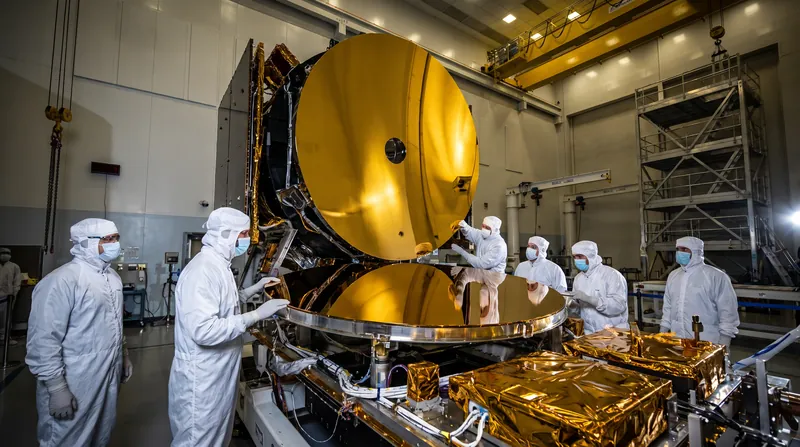
The telescope features a 2.4-meter mirror identical in size to Hubble's, but it captures a panoramic field of view 100 times larger. The observatory was built for a five-year primary mission to map the universe's expansion, track dark matter, map dark energy, and conduct a massive census to search for up to 200,000 exoplanets.
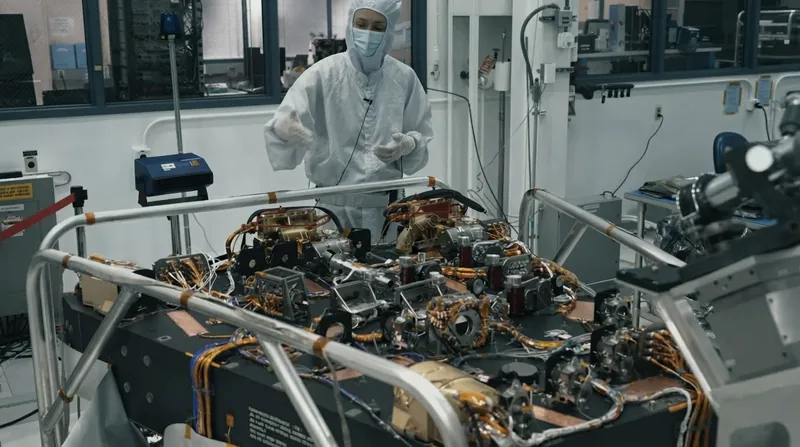
The spacecraft carries an experimental coronagraph to test new starlight-blocking technology for directly imaging distant worlds. The instrument uses active deformable mirrors to block a host star's glare, allowing the faint light of orbiting planets to become visible. This technology demonstration lays the groundwork for future flagship missions designed to search for biosignatures on Earth-like exoplanets.
On September 22, the coronagraph captured its first cosmic light during an exoplanet imaging test. The instrument observed a star in the Large Magellanic Cloud, proving it could achieve extreme pointing stability.
During the September 22 observation, the telescope's fine-guidance system held the observatory steady to within 1/100,000th of a degree. This stability is equivalent to aiming a laser at a dime from 150 miles away.
What to watch
- The Coronagraph Instrument will begin starlight-blocking tests in the coming weeks.
Key numbers
- 100x
- Field of view compared to Hubble
- 2.4 meters
- Primary mirror diameter
- 200,000
- Projected exoplanet discoveries
- 1 million miles
- Distance to L2 orbit destination
Charts, maps and images
Show 2 moreShow fewer
Timeline
October 2026
Roman Space Telescope's Wide Field Camera Beats Optical Targets by 30 Percent
NASA's Roman Space Telescope Coronagraph Captures First Light in Crucial Exoplanet Imaging Test
August 2026
NASA's Roman Space Telescope Cleared for Launch, Set to Begin New Era of Dark Energy and Exoplanet Mapping