
Why Casual Interactions With Weak Ties Boost Daily Happiness and Belonging
While we often prioritize deep relationships for emotional support, sociologists and psychologists find that casual interactions with acquaintances are surprisingly crucial for our daily well-being and sense of belonging.

Share this story
In short
- Casual acquaintances, known as 'weak ties,' provide a significant, measurable boost to daily happiness and a sense of belonging.
- Personalizing a routine transaction, like buying coffee, can increase positive emotions by up to 17% compared to an efficient exchange.
- Introverts experience the same emotional uplift from micro-interactions as extroverts, despite often predicting they will find it draining.
You do not need a deep, soul-baring conversation to feel less lonely today; you just need to talk to the barista. While we naturally prioritize our closest friends and family for emotional support, a growing body of sociological and psychological research reveals that our casual acquaintances—the neighbor walking their dog, the cashier at the grocery store, the familiar face at the gym—play a disproportionately large role in our daily happiness.
These micro-interactions, known in sociology as "weak ties," act as crucial anchors that tether us to our communities and reliably boost our mood.
The concept of the "weak tie" was first introduced in 1973 by Stanford sociologist Mark Granovetter. In a groundbreaking paper, Granovetter examined how people found jobs, discovering that it was rarely through their closest friends (their "strong ties").
Because our close friends tend to move in the same circles and share the same information we do, they rarely offer novel opportunities. Instead, it was the acquaintances—the weak ties—who bridged the gap to new networks, ideas, and resources. For decades, the strength of weak ties was viewed primarily as an economic and professional tool.[1]
Recently, however, psychologists have shifted the focus from how weak ties help our careers to how they help our minds. Dr. Gillian Sandstrom, a psychology researcher, began investigating the emotional weight of these casual interactions after noticing how much a simple, daily greeting from a local hot dog vendor improved her own mood during graduate school.
Her subsequent research revealed a striking pattern: on days when people engage in a higher number of casual interactions with acquaintances, they report significantly higher levels of happiness and a much stronger sense of belonging.[2]
To test this, Sandstrom and her colleagues designed a study around a daily ritual: buying coffee. They instructed one group of participants to make their transaction as efficient as possible, avoiding unnecessary conversation. They asked a second group to "personalize" the interaction by making eye contact, smiling, and exchanging a few genuine words with the barista. The results were definitive. The group that engaged in the personalized micro-interaction walked away feeling roughly 17% happier and more socially connected than the efficiency-focused group.[2]
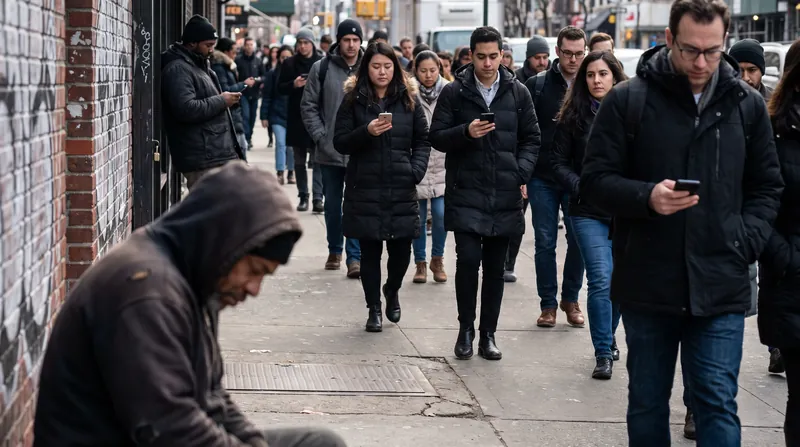
This finding exposes a modern trap. We increasingly design our days around frictionless efficiency—mobile ordering ahead of time, using self-checkout lanes, and wearing noise-canceling headphones on the commute. While these tools save us a few minutes, they actively strip our routines of the very micro-interactions that naturally regulate our mood. By optimizing for speed, we inadvertently starve ourselves of the low-stakes social friction that signals to our brains that we are part of a shared human environment.[2][4]
Part of the magic of weak ties is their emotional lightness. Deep relationships are vital, but they can also be exhausting. Conversations with close family members or lifelong friends often carry the weight of shared history, expectations, and emotional burdens. A conversation with the person next to you in a yoga class carries none of that baggage. It is a pure, low-demand exchange. You do not have to solve their problems, and they do not have to solve yours; you simply share a pleasant moment and move on.
Many people, particularly those who identify as introverts, hesitate to initiate these small conversations because they predict it will feel awkward or draining. However, the data contradicts this fear. When researchers test the "affective-reactivity hypothesis"—the idea that introverts will not enjoy casual social interactions—they find a massive gap between expectation and reality. Introverted participants consistently predict that talking to a stranger will leave them depleted, but after actually doing it, they report feeling happier and more energized, matching the mood boosts experienced by extroverts.[3]
This hesitation is further compounded by what psychologists call the "liking gap." We consistently underestimate how much other people enjoy our company and appreciate our attempts at connection. When we consider complimenting a stranger's coat or making a small joke in an elevator, we often hold back, assuming we will be perceived as a nuisance. In reality, studies show that the recipient of a micro-interaction almost always rates the exchange more positively than the initiator expected.[3]
Cultivating a robust network of weak ties does not require you to become the life of the party; it simply requires showing up consistently in shared spaces. Joining a local run club, attending the same fitness class every Tuesday, or simply walking your dog at the same time each morning naturally builds familiarity. Over time, strangers become familiar faces, and familiar faces become weak ties. The shared context provides a natural, unforced reason to interact, removing the awkwardness of cold-approaching a stranger.
The stakes of these small moments are surprisingly high. Chronic loneliness is now recognized as a public health crisis, carrying physical health risks comparable to smoking. While finding a new best friend as an adult is a daunting, time-consuming task, creating a new weak tie takes only seconds. A smile, a nod, or a brief comment about the weather serves as a micro-dose of social connection. These tiny, daily reminders that we exist in a shared world are not just pleasant—they are a fundamental requirement for our psychological health.[4]
How we did this
- Method
- Comparing the emotional yield of personalized micro-interactions against purely efficient transactions to derive the 'efficiency penalty' in modern daily routines.
- What we found
- The drive for frictionless, hyper-efficient daily routines (like mobile ordering and self-checkout) actively degrades baseline well-being by eliminating the 17% 'personalization premium' generated by weak-tie micro-interactions.
- What we worked from
- Happiness boost from personalized barista interaction: +17%
- Baseline emotional state of purely efficient transaction: Lower positive affect and belonging — Social Psychological and Personality Science
- Limits of this analysis
- The exact percentage boost may vary by individual baseline mood and cultural norms surrounding interactions with strangers.
Key terms
- Weak Ties
- Casual acquaintances or familiar strangers, such as a barista, a neighbor, or a coworker in a different department.
- Strong Ties
- Close, emotionally intimate relationships, typically consisting of family members and best friends.
- Affective-Reactivity Hypothesis
- The psychological theory that introverts will experience less enjoyment and more drain from social interactions than extroverts.
- Liking Gap
- The psychological phenomenon where individuals consistently underestimate how much their conversation partners enjoyed speaking with them.
Reader questions
Do I have to be an extrovert to benefit from weak ties?
No. Research shows that introverts experience the same boost in happiness and energy from casual micro-interactions as extroverts do, despite often predicting that the interaction will be draining.
Can weak ties replace my close friendships?
No. Weak ties provide a sense of broader community belonging and emotional lightness, but they do not offer the deep emotional support, crisis assistance, or intimate understanding provided by strong ties.
How can I build more weak ties if I work from home?
You can cultivate weak ties by establishing regular routines in public spaces, such as working from the same coffee shop once a week, joining a local hobby group, or taking daily walks at the same time to encounter familiar neighbors.
Where opinion splits
Sociologists & Network Theorists
Focus on how weak ties bridge distinct social groups and disseminate novel information.
From a structural perspective, sociologists view weak ties as the essential connective tissue of society. While strong ties form dense, insular clusters where everyone knows the same information, weak ties act as bridges between these isolated islands. This is why acquaintances are statistically more likely to introduce us to new career opportunities, diverse viewpoints, and novel ideas that our immediate circle cannot provide.
Behavioral Psychologists
Emphasize the emotional regulation and well-being benefits of low-stakes social friction.
Psychologists focus on the internal, emotional yield of these interactions. They argue that the modern pursuit of frictionless efficiency—self-checkouts, mobile ordering, and remote work—starves the human brain of the micro-doses of connection it evolved to expect. To a behavioral psychologist, a brief chat with a cashier is not an inefficiency to be optimized away, but a necessary psychological anchor that reinforces a sense of safety and belonging.
Public Health Advocates
View micro-interactions as a scalable intervention against the epidemic of chronic loneliness.
With loneliness now recognized as a severe health risk linked to cardiovascular disease and cognitive decline, public health experts view weak ties as a critical, low-barrier intervention. Because building deep friendships requires significant time and emotional energy—resources often depleted in isolated individuals—encouraging simple, daily micro-interactions offers an immediate, accessible way to combat social isolation on a population level.
- Behavioral Psychologists
- Emphasize the emotional regulation and well-being benefits of low-stakes social friction.
- Sociologists & Network Theorists
- Focus on how weak ties bridge distinct social groups and disseminate novel information.
- Public Health Advocates
- View micro-interactions as a scalable intervention against the epidemic of chronic loneliness.
Perspectives this story doesn't cover
- Urban planners designing public spaces to facilitate spontaneous interactions.
- Retail workers who bear the emotional labor of providing these micro-interactions.
Sources
Source coverage
4 outlets
3 viewpoints surfaced




- [1]American Journal of SociologySociologists & Network Theorists
The Strength of Weak Ties
Read on American Journal of Sociology → - [2]Social Psychological and Personality ScienceBehavioral Psychologists
Is Efficiency Overrated?: Minimal Social Interactions Lead to Belonging and Positive Affect
Read on Social Psychological and Personality Science → - [3]Gillian Sandstrom ResearchBehavioral Psychologists
Publications and Research on Social Interactions
- [4]Factlen Editorial Team
Synthesis by Factlen editorial team
Read on Factlen Editorial Team →

More in Lifestyle
See all →Dietary Science
Plant-Based Meat vs. Animal Meat: How the Nutritional Profiles Actually Compare
2 sources

Infant Skincare
Bathing Newborns Just Once a Week May Prevent Eczema, New Trial Finds
3 sources

Behavioral Economics
Why Sunk Costs Drive People to Double Down on Failing Projects
10 sources

Behavioral Psychology
Diffusion of Responsibility and Pluralistic Ignorance: The Two Psychological Mechanisms That Drive the Bystander Effect
7 sources
Comments
Every angle. Every day.
Get Lifestyle stories with full source coverage and perspective breakdowns, free every day.