
Visual Clutter Overloads the Brain's Visual Cortex and Spikes Cortisol
Neuroscience reveals that a messy home is more than just an eyesore—it actively overloads the brain's visual cortex and spikes stress hormones. Understanding the cognitive cost of clutter offers a new, evidence-based approach to reclaiming your space and your focus.

Share this story
In short
- Visual clutter directly competes for the brain's processing capacity, reducing working memory and focus.
- Living in disorganized spaces is linked to chronically elevated levels of the stress hormone cortisol.
- The brain views clutter as 'unfinished business,' triggering the Zeigarnik Effect and decision fatigue.
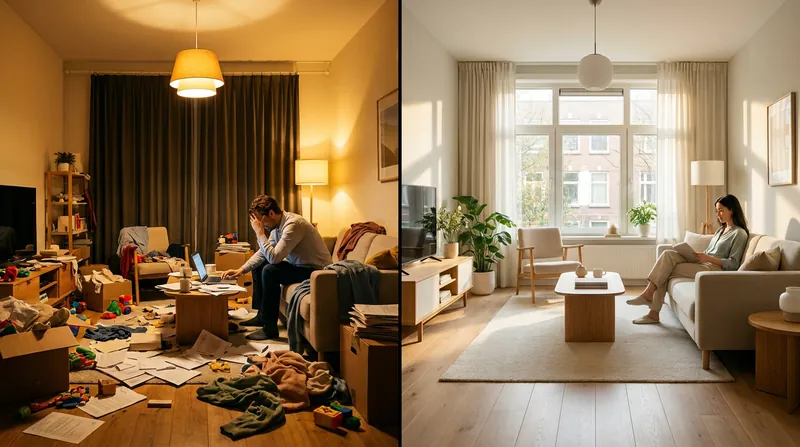
The pile of mail on the kitchen counter. The clothes draped over the bedroom chair. To the conscious mind, these are just harmless signs of a busy life. But to the human nervous system, they are something entirely different: a relentless stream of unfinished business.[5]
For decades, home organization was treated as a purely aesthetic pursuit or a matter of personal discipline. Today, a growing body of research reveals that the state of our physical spaces is intimately tied to our neurological health. Clutter is not just an eyesore; it is a measurable cognitive burden that alters how the brain processes information and regulates stress.[5]
The mechanism begins in the visual cortex. The human brain is an ancient survival machine, wired to constantly scan its environment for threats, resources, and unresolved problems. When a space is filled with excess items, the brain cannot simply ignore them. It must actively process every object, categorizing it and determining whether it requires action.[1]
Researchers at the Princeton Neuroscience Institute have spent years mapping this phenomenon. Their studies demonstrate that visual clutter directly competes for the brain's processing capacity. When multiple stimuli are present in the visual field, they essentially battle for neural representation, creating a mental traffic jam that reduces working memory and makes it significantly harder to focus on a single task.[1]
This constant background processing drains energy. It explains why sitting in a messy room can feel exhausting, even if you are just reading a book or watching television. The brain is burning through its limited daily reserves of cognitive fuel just to filter out the surrounding chaos.[1][5]
Beyond cognitive fatigue, visual clutter triggers a distinct physiological response. When the brain is overwhelmed by stimuli it cannot easily categorize or resolve, it interprets the environment as chaotic and potentially unsafe. This low-grade state of alert activates the body's stress circuitry.[5]
A landmark study by UCLA's Center on Everyday Lives of Families provided some of the most compelling evidence for this link. Researchers tracked the physiological responses of families in their homes and found a direct correlation between the density of household objects and the stress levels of the inhabitants. Women who described their homes as cluttered or full of unfinished projects exhibited chronically elevated levels of cortisol, the body's primary stress hormone.[2]
This cortisol spike does not just happen when you actively look at a mess; it persists as a baseline hum of anxiety throughout the day. Elevated cortisol is linked to a host of downstream effects, including irritability, weakened immune function, and a tendency to reach for unhealthy coping mechanisms, such as poor dietary choices or avoidance behaviors.[2][5]
More recent research continues to build on these findings. A 2024 study from Yale University revealed that visual clutter actually alters the flow of information in the brain's primary visual cortex, directly impairing the ability to filter out irrelevant details. The more items that crowd a space, the harder it becomes for the brain to prioritize what truly matters.[4]
The psychological toll is further compounded by a phenomenon known as the Zeigarnik Effect—the mind's tendency to fixate on interrupted or incomplete tasks. In a cluttered home, every misplaced item represents an unmade decision: Should I keep this? Where does it belong? When will I deal with it?[5]
This barrage of micro-decisions leads to decision fatigue. The prefrontal cortex, responsible for executive function and self-control, has a limited capacity for daily decision-making. When that capacity is depleted by navigating a disorganized environment, people often find themselves procrastinating on more important tasks or feeling paralyzed by simple choices.[3][5]
The impact of clutter is perhaps most destructive when it infiltrates spaces meant for rest. A study published in the Journal of Environmental Psychology highlighted the moderate but persistent link between cluttered environments and reduced psychological well-being, noting that people in disorganized spaces reported lower levels of happiness and increased negative emotions.[3]
Sleep researchers note that seeing a pile of laundry or a cluttered nightstand right before bed signals to the nervous system that work remains undone. This can delay the onset of sleep and reduce the overall quality of rest, creating a vicious cycle where fatigue makes it even harder to tackle the clutter the next day.[3][5]
Fortunately, understanding the neuroscience of clutter also provides a clear roadmap for fixing it. Because the issue is rooted in sensory overload rather than moral failing, the most effective solutions focus on reducing visual noise rather than achieving perfection. Professional organizers and psychologists advocate for a 'sensory reset' as the first step.[5]
This involves clearing just one highly visible surface—such as a nightstand or the kitchen island—and defending it ruthlessly. By ensuring that the first thing the eyes see in the morning is a clean, empty space, individuals can prevent the immediate cortisol spike that usually accompanies waking up in a chaotic environment.[5]
To maintain these clear zones, experts recommend implementing micro-habits, sometimes referred to as 'farm chores.' Dedicating just 15 minutes in the morning and 15 minutes in the evening to resetting the space—loading the dishwasher, clearing the mail, putting away stray items—prevents the accumulation of visual noise without requiring exhausting weekend-long cleaning marathons.[5]
Ultimately, organizing a home is not about achieving a magazine-perfect aesthetic; it is about protecting your cognitive resources. By intentionally curating our physical environments, we can quiet the brain's constant scanning, lower our baseline stress, and create the mental space needed to truly rest and focus.[1][2][5]
Jargon, explained
- Visual Cortex
- The part of the brain responsible for processing visual information, which can become overloaded by excessive stimuli.
- Cortisol
- A hormone released by the body in response to stress, which can remain chronically elevated in chaotic environments.
- Zeigarnik Effect
- A psychological tendency for the mind to become preoccupied with interrupted tasks or incomplete actions, often triggered by visible clutter.
- Decision Fatigue
- The deteriorating quality of decisions made by an individual after a long session of decision-making, exacerbated by having too many items to manage.
- Cognitive Load
- The total amount of mental effort being used in the working memory, which increases when surrounded by visual distractions.
Common questions
Why does a messy room make me feel tired?
Visual clutter forces your brain to constantly process irrelevant information. This drains cognitive resources and causes mental fatigue, even when you aren't physically active.
Where is the best place to start decluttering?
Experts recommend starting with a single, highly visible surface, such as a bedroom nightstand or a kitchen counter, to create an immediate 'sensory reset' that lowers cortisol.
Can digital clutter cause the same stress?
Yes. An overflowing inbox or a desktop covered in files triggers the same cognitive overload and low-grade stress response as physical mess.
Competing readings
Cognitive Researchers
Focus on the brain's processing limits and working memory.
Researchers emphasize that the human visual cortex has a finite capacity. When surrounded by excess stimuli, the brain is forced to constantly filter irrelevant information. This background processing drains working memory, impairs focus, and physically alters the flow of information in the brain, making it harder to concentrate on single tasks.
Behavioral Psychologists
Focus on the physiological stress response and emotional well-being.
Psychologists highlight the emotional toll of disorganized spaces, pointing to elevated cortisol levels and chronic low-grade anxiety. They argue that the brain interprets unresolved clutter as a constant stream of 'unfinished business,' which prevents true relaxation, disrupts sleep patterns, and lowers overall life satisfaction.
Organization Experts
Focus on practical, habit-based interventions to reclaim physical spaces.
Professional organizers advocate for behavioral solutions rather than purely aesthetic ones. They emphasize 'sensory resets'—clearing high-impact surfaces like nightstands—and establishing small daily maintenance habits to prevent cognitive overload before it starts, rather than relying on exhausting weekend cleaning marathons.
- Cognitive Researchers
- Focus on how clutter overloads the brain's processing capacity and working memory.
- Behavioral Psychologists
- Focus on the emotional and physiological toll, such as elevated cortisol and reduced well-being.
- Organization Experts
- Focus on practical interventions, micro-habits, and sensory resets to reclaim physical spaces.
Perspectives this story doesn't cover
- Interior Designers
- Neurodivergent Individuals
Sources
Source coverage
5 outlets
3 viewpoints surfaced





- [1]Princeton Neuroscience InstituteCognitive Researchers
Interactions of top-down and bottom-up mechanisms in human visual cortex
- [2]UCLA Center on Everyday Lives of FamiliesBehavioral Psychologists
Life at Home in the Twenty-First Century
- [3]Journal of Environmental PsychologyBehavioral Psychologists
The dark side of home: Assessing possession clutter on subjective well-being
Read on Journal of Environmental Psychology → - [4]Yale UniversityCognitive Researchers
Visual clutter alters information flow in the brain's primary visual cortex
- [5]Factlen Editorial TeamOrganization Experts
Synthesis by Factlen editorial team
Read on Factlen Editorial Team →

More in Home
See all →Wellness Science
Household Clutter Blunts Cortisol Decline and Overwhelms the Visual Cortex
6 sources
Decluttering Frameworks
The Psychology of Clutter and the 'Container Concept' That Solves It
2 sources

Home Psychology
The Neuroscience of Decluttering: How 'Visual Noise' Impacts Cortisol and Focus
3 sources

Organizational Psychology
Why Household Clutter Raises Cortisol and How Micro-Decluttering Reduces Visual Noise
3 sources

Comments
Every angle. Every day.
Get Home stories with full source coverage and perspective breakdowns, free every day.