
Biomechanical Study of 162 Elite Fencers Reshapes Training and Injury Prevention
A landmark 2026 sports medicine study tracking elite fencers is reshaping how athletes train, highlighting weapon-specific recovery protocols and equipment innovations that promise to extend careers.
By Xia Wu

Share this story
To the untrained eye, fencing is a sport of aristocratic grace, defined by tactical wit and the elegant clash of steel. But beneath the pristine white uniforms lies a brutal biomechanical reality. Fencing is a game of explosive, asymmetrical violence. Athletes launch themselves forward in rapid lunges, accelerating and decelerating with forces that place immense, repetitive strain on their joints, ligaments, and tendons.[1][2]
Historically, fencers wore their physical asymmetries almost as a badge of honor. The dominant leg, responsible for the explosive forward thrust of the lunge, would develop massive quadriceps and glutes, while the non-dominant leg, acting as the anchor, developed entirely different muscle groups. For decades, the culture of the sport accepted chronic pain, joint degradation, and severe muscular imbalances as the inevitable, quiet cost of competing at the highest levels.
In 2026, that archaic mindset is undergoing a radical, data-driven paradigm shift. Sports medicine has finally caught up to the piste. Driven by a new wave of comprehensive biomechanical research and advanced injury surveillance, the global fencing community is fundamentally rethinking how athletes train, recover, and equip themselves.[3]
The catalyst for this modern approach is a landmark prospective cohort study published in The Physician and Sportsmedicine in April 2026. Conducted by researchers tracking athletes at a high-performance training facility in South Korea, the study provides the most granular, comprehensive look ever recorded at how elite fencers sustain injuries.[1]
Over a 12-month period, the South Korean research team meticulously tracked 162 elite fencers across all three weapon disciplines. They recorded every acute trauma and overuse injury sustained during training, calculating the exact incidence rates per 1,000 hours of exposure. This rigorous methodology stripped away the anecdotal assumptions that had long governed fencing training.[1]
The headline finding revealed an overall incidence of 3.22 injuries per 1,000 training hours, with overuse injuries significantly outpacing acute trauma. The data definitively proved what many sports physiotherapists had long suspected: the lower extremities bear the brunt of the sport's physical toll, accounting for a staggering 57.5 percent of all recorded injuries.[1]
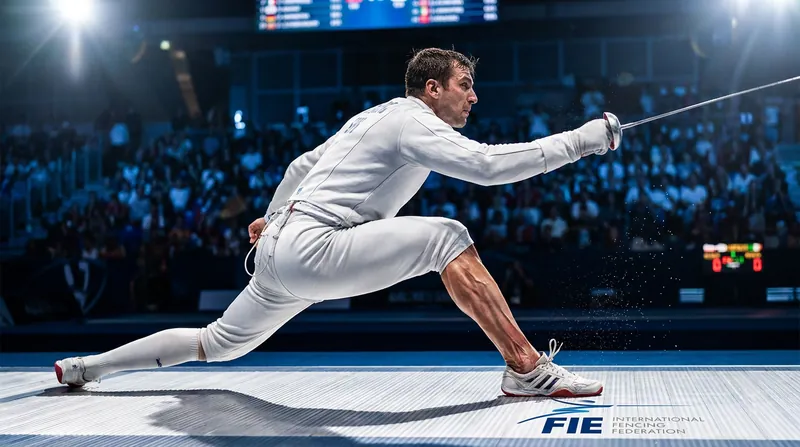
The biomechanics of the lunge explain this intense concentration of damage. When a fencer executes an attack, the front knee and ankle absorb massive deceleration forces upon impact with the piste, while the rear thigh and hip endure extreme tension. Over thousands of repetitions, this localized stress degrades the extensor mechanisms, leading to chronic conditions like patellofemoral pain and Achilles tendinopathy.[1]
The data also highlighted fascinating biomechanical differences between the disciplines. Sabre fencers, whose bouts rely on rapid, slashing attacks and explosive footwork across the entire length of the piste, exhibited the highest injury incidence of any weapon category.[1]
Epee and foil fencers followed, each presenting unique stress patterns based on their respective target areas and movement economies. Because epee allows target hits anywhere on the body, the footwork is often more cautious and vertical, whereas foil requires deep, sustained lunges to reach the opponent's torso, creating distinct wear patterns on the athletes' joints.[1]
Beyond the immediate trauma to the legs, the research illuminated the hidden danger of the sport: asymmetrical muscle development and core strain. The unilateral nature of fencing creates profound muscular imbalances that ripple upward through the athlete's kinetic chain.[2]
This unilateral stance pulls the spine and pelvis out of alignment. As the dominant side overdevelops, the non-dominant side compensates, placing unnatural rotational stress on the lower back. Recent epidemiological data has even identified cases of spondylolysis in fencers, a stress fracture in the spine caused by the repetitive hyperextension required to recover from a deep lunge.[2]
Recognizing these structural threats, the fencing industry is turning to advanced equipment engineering to mitigate the forces that physical therapy alone cannot solve. The focus is shifting toward intercepting kinetic energy before it enters the athlete's body.[3]
Specialized footwear is leading this charge. Modern fencing shoes are now being engineered with advanced shock-absorbing foams specifically concentrated in the heel of the dominant foot, designed to dissipate the violent impact of the lunge strike while maintaining the rigid lateral support required for rapid direction changes.
The push for injury prevention is driving even more remarkable innovations in the realm of adaptive sports, where the intersection of engineering and biomechanics is solving complex, career-threatening physical challenges for Paralympic athletes.
A prime example is the recent collaboration between Nike engineers and Italian wheelchair fencing champion Bebe Vio. Vio, who competes in the foil category using prosthetic arms, was experiencing severe, acute pain from the intense vibrations generated by foil-on-foil contact, which shot directly down the blade and into her sensitive amputated arm.
To solve this, the engineering team completely reimagined the architecture of the prosthetic-foil interface. By splitting the prosthetic into two distinct parts and utilizing a 3D-printed nylon base material, they created a custom dampening system that successfully absorbed the violent vibration energy, eliminating her chronic pain and allowing her to maintain elite training volumes.
Back on the able-bodied piste, the 2026 cohort data is fundamentally reshaping Return-to-Sport protocols. Researchers found that ligament injuries require the longest recovery durations, and that these timelines differ significantly based on the athlete's sex and specific weapon category.[1]
Medical professionals are moving away from generalized athletic rehab in favor of highly specific recovery timelines. A sabreur recovering from an ankle sprain now follows a fundamentally different physical therapy progression than an epeeist, focusing on the specific lateral deceleration forces required for their unique discipline.[1][3]
This data-driven approach is rapidly trickling down from elite national training centers to local clubs. Coaches are increasingly mandating bilateral strength training, yoga, and targeted rest days to counteract the sport's inherent asymmetries, treating recovery as a metric just as important as bout victories.[3]
Ultimately, the integration of advanced biomechanics, targeted sports medicine, and adaptive engineering is securing a healthier future for fencing. By prioritizing athlete longevity over immediate results, the sport is ensuring that its competitors can continue to chase perfection on the piste without sacrificing their bodies in the process.[3]
Key points
- A 2026 South Korean cohort study reveals elite fencers suffer 3.22 injuries per 1,000 training hours.
- Nearly 60% of all fencing injuries affect the lower extremities, driven by the deceleration forces of the lunge.
- Sabre fencers exhibit the highest injury incidence among the three weapon disciplines.
- Fencing's unilateral stance causes severe muscular imbalances, prompting a shift toward bilateral strength training.
- Equipment manufacturers are developing specialized footwear to absorb heel-strike impacts.
- Adaptive engineering, such as 3D-printed nylon prosthetics, is successfully dampening vibration energy to prevent nerve pain.
How we got here
2016-2020
Early epidemiological studies begin highlighting the high prevalence of lower extremity and asymmetrical injuries in elite fencing.
August 2024
Nike engineers debut a custom 3D-printed vibration-dampening prosthetic for Paralympic champion Bebe Vio.
January 2026
Equipment manufacturers launch new lines of fencing-specific footwear designed to absorb lunge impact.
April 2026
A landmark South Korean cohort study is published, providing definitive data on weapon-specific injury rates and return-to-sport timelines.
- Sports Medicine Researchers
- Argue that granular, weapon-specific biomechanical data is essential for developing targeted injury prevention protocols.
- Equipment Innovators
- Focus on the role of specialized gear in mitigating the physical toll of the sport's extreme impact forces.
- High-Performance Analysts
- Emphasize translating clinical data into practical, daily training regimens that prioritize bilateral strength and career longevity.
Perspectives this story doesn't cover
- Amateur and youth fencers who lack access to elite sports medicine and custom equipment.
- Traditional fencing masters who prioritize classical technique over modern biomechanical intervention.
Sources
Source coverage
3 outlets
3 viewpoints surfaced



- [1]The Physician and SportsmedicineSports Medicine Researchers
Training-related injury patterns and return-to-sports in elite fencing athletes: a prospective cohort study
Read on The Physician and Sportsmedicine → - [2]Annals of Applied Sport ScienceSports Medicine Researchers
The musculoskeletal pain and injury of a fencer: A systematic review
Read on Annals of Applied Sport Science → - [3]Factlen Editorial TeamHigh-Performance Analysts
Synthesis by Factlen editorial team
Read on Factlen Editorial Team →
More in Sports
See all →Standings
Kazakhstan Surges to World No. 1 in Men's Team Épée Standings After Historic Gold
6 sources
Standings
Sebastien Patrice Holds Firm at World No. 1 in Men's Sabre Standings as Oh Sanguk Closes the Gap
6 sources
Sports Marketing
Global Superstar Jackson Wang Named FIE's First Global Ambassador for LA28 Push
6 sources

Injury
From Marine to Paralympian: How Jataya Taylor Turned a Life-Altering Injury Into a Global Fencing Mission
2 sources
Comments
Every angle. Every day.
Get Sports stories with full source coverage and perspective breakdowns, free every day.