
The Radiant Heat Thresholds That Control the Maillard Reaction in Grilling
While grill grates provide localized conduction, edge-to-edge browning relies on a narrow band of infrared radiation between 280°F and 330°F. Understanding this thermal gradient explains why the Maillard reaction accelerates over hot coals and how to prevent bitter pyrolysis.
By Lan Xu

Share this story
In short
- The Maillard reaction accelerates rapidly between 280°F and 330°F, creating complex roasted flavors.
- Temperatures above 390°F trigger pyrolysis, leading to burnt, bitter compounds.
- Thermal radiation (infrared heat) is the primary mechanism for edge-to-edge surface browning.
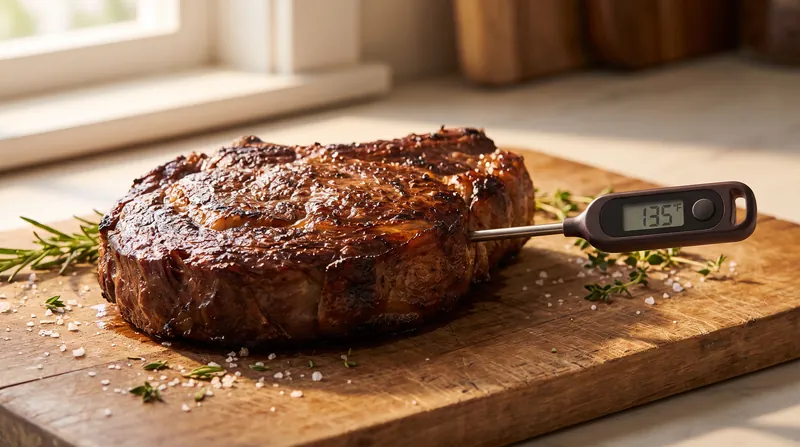
At exactly 280°F (140°C), the amino acids and reducing sugars on the surface of a steak begin to rapidly recombine. This chemical cascade, known as the Maillard reaction, is the singular process responsible for the savory, mouth-watering crust and complex roasted aromas that drift across a backyard during a weekend cookout.[1]
While culinary publications frequently celebrate the results of high-heat searing—from saucy pork chops to regional upstate barbecue specialties—the underlying physics of how heat transforms raw ingredients is rarely detailed in standard recipes. The difference between a pale, steamed surface and a rich, mahogany crust comes down to managing three distinct mechanisms of heat transfer: conduction, convection, and thermal radiation.[2][3][4][5]
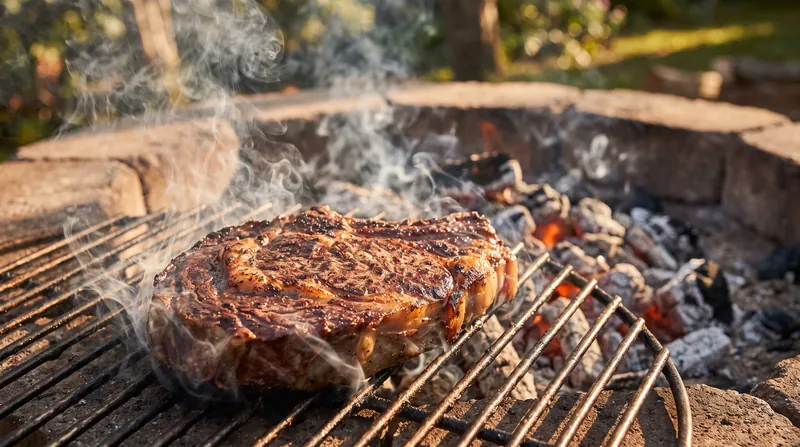
Conduction is the most visible form of heat transfer on a grill. When raw meat touches the heated metal gridiron, thermal energy moves directly from the hotter surface to the cooler food. This direct contact creates the distinct, dark sear marks prized in outdoor cooking, but it only affects the fraction of the meat actually touching the metal, leaving the spaces between the grates untouched.[3]
To achieve that coveted edge-to-edge browning, the cooking process relies heavily on thermal radiation. All matter with a temperature above absolute zero emits electromagnetic waves, and glowing coals or gas burners project intense infrared radiation directly onto the food. Unlike convection, which requires circulating air to carry the heat, thermal radiation travels directly from the heat source to the meat's surface, driving the temperature up rapidly and evenly.[2]
The Maillard reaction operates within a remarkably narrow thermal window. Below 280°F, the surface moisture evaporates, but the proteins and sugars remain largely unchanged, leaving the meat pale. Once the surface crosses the 280°F threshold, the reaction accelerates, producing hundreds of new flavor compounds, including pyrazines and melanoidins, which give the food its characteristic deep, savory taste.[1]
However, pushing the temperature too high introduces new chemical risks to your dinner. As the surface temperature approaches 390°F (200°C), the Maillard browning gives way to pyrolysis—the final breakdown of organic material that leads to burning and the development of acrid, bitter flavors. Managing the infrared radiation to keep the meat's surface within the optimal 280°F to 330°F range is the central challenge of live-fire cooking.[1]
This thermal reality explains the necessity of the two-zone grilling method. By banking coals to one side or leaving a gas burner off, cooks create a gradient of radiant heat. The meat can be seared directly over the intense infrared emission to trigger the Maillard reaction, then moved to the cooler zone where gentle convection finishes the internal cooking without pushing the surface into bitter pyrolysis.[3]
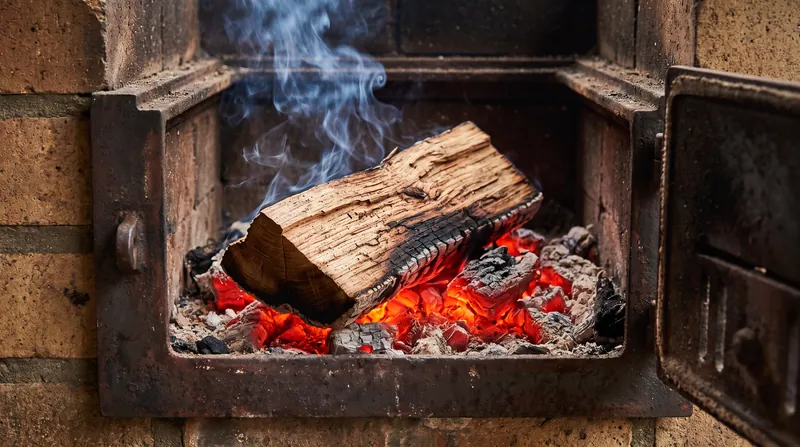
Ultimately, the visual cues of a glowing fire are direct indicators of its thermal output. At room temperature, thermal emission is entirely in the invisible infrared spectrum, but as the heat source surpasses 977°F (525°C), the radiation shifts into the visible light spectrum, creating the familiar red incandescence of hot coals. Reading that glow allows a cook to gauge the intensity of the infrared energy before the meat ever touches the grate, ensuring the surface hits the exact temperature required for a perfect, flavorful crust.[2]
Terms to know
- Maillard reaction
- A chemical reaction between amino acids and reducing sugars at high heat that creates browned colors and savory flavors.
- Thermal radiation
- The emission of electromagnetic waves, primarily in the infrared spectrum, from a heated surface directly to the food.
- Conduction
- The direct transfer of heat between two objects in physical contact, such as a hot metal grate and a piece of meat.
- Pyrolysis
- The thermal decomposition of organic material at extremely high temperatures, resulting in burning and bitter flavors.
- Incandescence
- The visible glow emitted by an object, such as a charcoal briquette, when it reaches temperatures above 977°F.
Questions readers ask
Why doesn't boiled meat turn brown?
Boiling water cannot exceed 212°F (100°C) at sea level. The Maillard reaction requires temperatures of at least 280°F (140°C) to accelerate, meaning wet cooking methods will never trigger the browning process.
What is the difference between direct and indirect grilling?
Direct grilling places the food immediately over the heat source to maximize thermal radiation and conduction for searing. Indirect grilling places the food away from the heat, relying on the convection of hot air to gently cook the interior.
Do grill marks mean the meat is perfectly cooked?
No. Grill marks are simply the result of localized conduction from the hot metal grate. A truly flavorful crust requires edge-to-edge browning achieved through sustained thermal radiation.
Different angles
Culinary Scientists
Focus on the precise chemical thresholds required for optimal flavor development.
Food scientists emphasize that the Maillard reaction is a predictable, non-enzymatic browning process that requires specific conditions to thrive. They point out that surface moisture is the primary enemy of a good sear, as water's evaporation limit of 212°F (100°C) prevents the meat from reaching the 280°F threshold required for amino acid and sugar recombination. For this camp, perfect grilling is an exercise in moisture management and thermal control.
Live-Fire Chefs
Prioritize the experiential management of radiant heat and fire building.
Professional grillmasters view the fire as a dynamic, living heat source rather than a static temperature dial. They rely on the visual incandescence of the coals—the shift from black to glowing red to white ash—to gauge the intensity of the thermal radiation. By manipulating the physical distance between the food and the coals, they continuously adjust the infrared exposure to maintain the Maillard reaction without crossing into bitter pyrolysis.
- Culinary Scientists
- Focus on the precise chemical thresholds required for optimal flavor development.
- Live-Fire Chefs
- Prioritize the experiential management of radiant heat and fire building.
Perspectives this story doesn't cover
- Equipment Manufacturers
- Thermodynamics Engineers
Sources
Source coverage
6 outlets
2 viewpoints surfaced




- [1]WikipediaCulinary Scientists
Maillard reaction
Read on Wikipedia → - [2]WikipediaCulinary Scientists
Thermal radiation
Read on Wikipedia → - [3]WikipediaCulinary Scientists
Grilling
Read on Wikipedia → - [4]Bon AppétitLive-Fire Chefs
Saucy Pork Chops With Coconut Crisp
Read on Bon Appétit → - [5]EaterLive-Fire Chefs
Steal My Food Itinerary: A Long Weekend in Upstate New York
Read on Eater → - [6]Factlen Editorial TeamCulinary Scientists
Synthesis by Factlen editorial team
Read on Factlen Editorial Team →
More in Food & Drink
See all →Meat Processing
USDA Directs $50 Million to State Meat Inspection Programs to Ease Local Processing Bottlenecks
6 sources
Culinary Chemistry
The 300°C Fat Pyrolysis Threshold: How Dripping Fat Creates Polycyclic Aromatic Hydrocarbons on a Grill
6 sources
Meat Supply
USDA Lowers 2026 Beef and Pork Production Forecasts on Slower Slaughter and Lighter Weights
3 sources

Smoke Chemistry
The Guaiacol-Syringol Balance: How Hardwood Pyrolysis Temperatures Dictate Barbecue Flavor
7 sources
Comments
Every angle. Every day.
Get Food & Drink stories with full source coverage and perspective breakdowns, free every day.