
The Man in Black No More: The Evolution of the World Cup Referee
From gentlemen in blazers wielding pocket watches to elite athletes equipped with biometric sensors and augmented reality, the role of the World Cup referee has been completely transformed over the last century.
By Xia Wu

Share this story
When Belgian referee John Langenus walked onto the pitch to officiate the first-ever FIFA World Cup final in 1930, he did so wearing a collared shirt, a tie, a tailored blazer, and knickerbockers. Armed only with a whistle and a pocket watch, he was the sole arbiter of a volatile clash between Uruguay and Argentina, managing the game through sheer authority and gentlemanly presence.
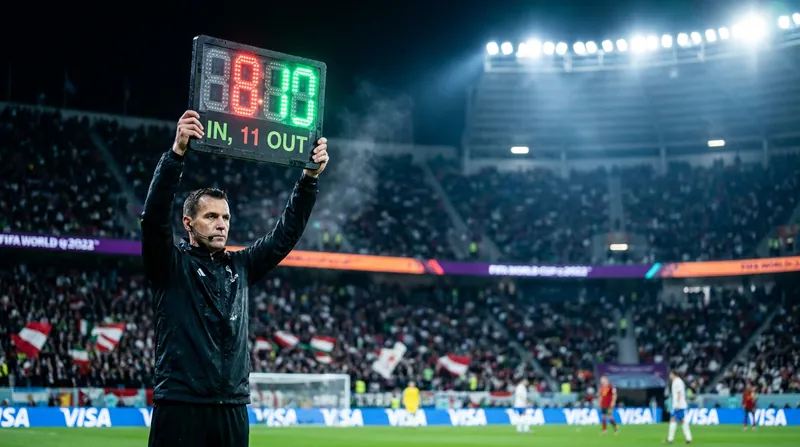
Nearly a century later, the officials taking the pitch at the 2026 World Cup look less like magistrates and more like fighter pilots. Wired with biometric sensors, earpieces, and head-mounted cameras, today's referee is the central node in a vast, real-time data network. The evolution from the "Man in Black" to the modern technological manager is a story of football desperately trying to keep pace with its own explosive growth.[1][3]
In the tournament's early decades, the referee was an isolated figure of absolute authority. There were no video replays, no sideline monitors, and no communication with assistants beyond eye contact and raised flags. The job relied entirely on positioning, instinct, and the respect of the players.
During that 1930 final, Langenus was so concerned about the thousands of armed fans who had traveled across the Rio de la Plata that he demanded a guaranteed escape route to a ship waiting in the harbor before agreeing to blow the opening whistle. He managed the game verbally, a system that worked reasonably well when football was a slower, more localized sport.[1][3]
But as the World Cup expanded into a truly global spectacle, the verbal system began to fracture. The breaking point arrived at the 1966 World Cup in England, during a notoriously physical quarter-final between the hosts and Argentina.
German referee Rudolf Kreitlein attempted to send off Argentine captain Antonio Rattín, but a lack of a shared language—and Rattín's refusal to understand the official's gestures—led to a chaotic standoff. Rattín remained on the pitch for nearly ten minutes, requiring police intervention and the involvement of Ken Aston, the English head of tournament referees, to finally escort him away.[2]
The incident convinced Aston that international football urgently needed a universal language of discipline. The inspiration struck him on his drive home from Wembley Stadium. Stopped at a traffic light on Kensington High Street, Aston realized that the universal color-coding of traffic signals—yellow for caution, red for stop—could transcend linguistic barriers. He returned home, where his wife Hilda cut two pieces of colored construction paper to fit into a referee's shirt pocket.[2]
Aston's invention made its debut at the 1970 World Cup in Mexico, fundamentally altering the visual language of the sport. The yellow and red cards provided instant, unambiguous communication to players, managers, and the tens of thousands of fans in the stadium. It was the first major structural change to the referee's toolkit, acknowledging that the official was no longer just managing the players, but also managing the spectacle for a global television audience.[2][3]
For decades, referees were universally known as the "Men in Black," wearing austere, unbranded uniforms that reinforced their role as impartial judges. But the commercial explosion of the 1990s shattered that tradition. At the 1994 World Cup in the United States, FIFA and Adidas introduced brightly colored referee kits for the first time.
Officials took the field in vibrant magenta, gold, and silver jerseys featuring bold checkerboard patterns. The visual overhaul signaled a new era: the referee was no longer a shadowy arbiter, but a highly visible participant in the entertainment product.[3]
As the 21st century dawned, the physical demands of the sport skyrocketed. Tactical innovations and improved sports science made players faster and pressing systems more relentless. To keep up, referees had to transform from part-time officials into elite, full-time athletes. Modern World Cup referees undergo rigorous biometric testing, specialized high-intensity interval training, and strict nutritional regimens to ensure they can cover up to 12 kilometers a match while maintaining the cognitive clarity to make split-second decisions.
Yet, human fitness alone could not overcome the limitations of the human eye. The 2010s marked the beginning of the digital revolution in officiating. Following several high-profile controversies regarding goals that crossed the line unseen, FIFA introduced Goal-Line Technology and vanishing spray at the 2014 tournament in Brazil. These were the first cracks in the referee's absolute on-field autonomy, delegating specific factual decisions to automated systems.[3][4]
The true paradigm shift occurred in 2018 with the introduction of the Video Assistant Referee (VAR). For the first time in history, the referee was no longer alone. Connected via headset to a team of video officials in a remote bunker, the on-field referee became the visible frontman of a collective decision-making process. While VAR promised to eradicate "clear and obvious errors," it also introduced new philosophical debates about the flow of the game and the subjective nature of football's laws.[3][4]
By the 2026 World Cup, the integration of technology reached unprecedented levels. FIFA deployed Semi-Automated Offside Technology (SAOT), utilizing artificial intelligence and connected ball sensors to map player limbs in real-time, effectively automating the sport's most complex spatial ruling. Furthermore, referees were equipped with head-mounted "Ref Cams," broadcasting their first-person perspective directly to global television feeds.[3]
The "Ref Cam" was designed to foster empathy, showing fans exactly what the official sees during chaotic goal-mouth scrambles or high-speed tackles. It represents the ultimate evolution of transparency. The referee's every breath, word, and line of sight is now recorded, analyzed, and broadcast. The solitary gentleman in the blazer has been replaced by a cyborg-like manager, tethered to a network of cameras and algorithms.[3]
Despite the sweeping technological and aesthetic changes, the core burden of the World Cup referee remains remarkably unchanged from John Langenus's day. They are still tasked with maintaining order, fairness, and safety among 22 highly emotional athletes operating under unimaginable pressure. Technology has provided them with better tools, but the ultimate responsibility—the courage to blow the whistle when the whole world is watching—still rests squarely on human shoulders.[1][3]
Key points
- Early World Cup referees wore formal attire and managed games verbally without technological aid.
- The 1966 World Cup highlighted language barriers, leading to the invention of the red and yellow card system.
- The 'Man in Black' tradition ended in 1994 when Adidas introduced brightly colored referee jerseys.
- Modern referees are elite athletes who cover up to 12 kilometers per match.
- The introduction of VAR in 2018 and Semi-Automated Offside Technology transformed officiating into a collective, data-driven process.
How we got here
1930
John Langenus officiates the first World Cup final wearing a blazer and tie.
1966
A chaotic England-Argentina match inspires the need for a universal disciplinary language.
1970
Ken Aston's invention of the red and yellow cards makes its World Cup debut.
1994
Adidas introduces brightly colored referee jerseys, ending the 'Man in Black' era.
2018
The Video Assistant Referee (VAR) system is introduced, fundamentally changing officiating.
2026
Referees are equipped with head-mounted cameras to broadcast their first-person perspective.
- The Match Officials
- Emphasize that the modern game is too fast for the human eye alone, requiring technological support.
- Technological Advocates
- Believe that fairness and absolute accuracy are paramount, and that technology protects the integrity of the sport.
- Football Traditionalists
- Argue that over-reliance on technology disrupts the natural flow and emotional spontaneity of the game.
Perspectives this story doesn't cover
- Lower-league referees who must manage games without any technological safety nets
- Stadium-going fans who experience confusion during lengthy VAR reviews
Sources
Source coverage
4 outlets
3 viewpoints surfaced




- [1]FIFAThe Match Officials
Quirky stories from World Cup finals
Read on FIFA → - [2]The FAThe Match Officials
Ken Aston: The Inventor of Red and Yellow Cards
Read on The FA → - [3]Factlen Editorial TeamTechnological Advocates
Synthesis by Factlen editorial team
Read on Factlen Editorial Team → - [4]ReutersTechnological Advocates
The evolution of VAR in modern football
Read on Reuters →
More in Sports
See all →History
The Giant-Killers: The Anatomy and Evolution of the World Cup Upset
5 sources

History
The Tactical Metamorphosis: How the World Cup Forged Football's Greatest Formations
7 sources
History
The Canvas of Commerce: How the World Cup Mascot Evolved from a Five-Minute Sketch to a Billion-Dollar Empire
5 sources
History
The Athletic Arbiters: How the World Cup Referee Evolved from Amateur to Elite Athlete
3 sources
Comments
Every angle. Every day.
Get Sports stories with full source coverage and perspective breakdowns, free every day.