
The 16-Player Chess Match: How Substitutions Transformed the FIFA World Cup
From the grueling era of zero replacements to the modern five-substitution rule, the evolution of the bench has fundamentally altered the physical and tactical landscape of the FIFA World Cup.
By Xia Wu

Share this story
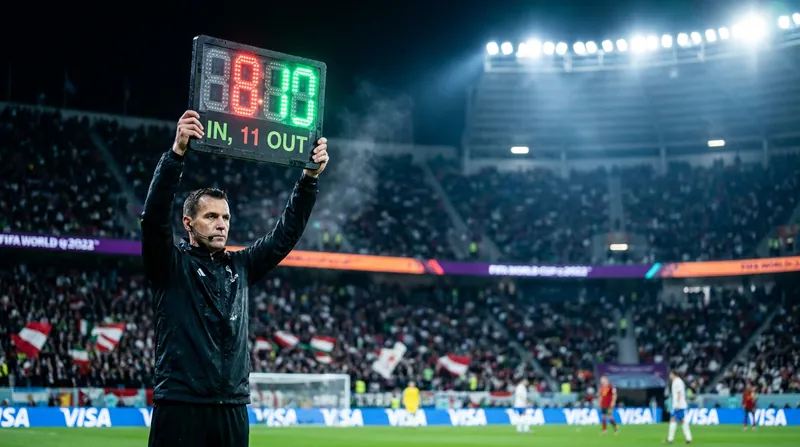
When a modern manager looks down the touchline at the FIFA World Cup, they survey a bustling village of tactical potential. With expanded 26-man rosters and the ability to make five substitutions per match, the dugout has transformed into a laboratory of in-game adjustments, fresh legs, and specialized roles. A manager can seamlessly replace nearly half of their outfield players to chase a goal, lock down a lead, or inject a burst of pressing energy. But for the first half of the tournament's storied history, this luxury was entirely unimaginable.[2][3]
For the first eight editions of the FIFA World Cup, from its inception in 1930 through the 1966 tournament in England, the starting whistle was a point of no return. The eleven men who walked onto the pitch were the only eleven men who could participate in the match. There were no tactical changes, no fresh legs for extra time, and crucially, no replacements for injured players. The World Cup was as much a brutal test of physical survival as it was a showcase of footballing skill.[1]
The absence of substitutions meant that injuries fundamentally altered the competitive balance of the sport's biggest matches. If a player suffered a sprained ankle, a torn muscle, or a concussion, the team faced a grim choice: play with ten men, or leave the hobbled player on the pitch as a static spectator. Often, injured forwards were instructed to stand near the opponent's corner flag, serving as little more than a distraction while their ten teammates fought on through exhaustion.
This harsh reality reached a breaking point during the 1966 World Cup. The tournament was marred by aggressive tackling, culminating in Brazil's group-stage match against Portugal. The legendary Pelé was repeatedly fouled and eventually hacked down, leaving him limping heavily for the remainder of the game. Because Brazil could not replace him, they were effectively reduced to ten fully functioning players and were subsequently eliminated. The global outcry over the world's greatest player being neutralized by injury without recourse forced the sport's lawmakers to reconsider their rigid stance.[1]
The catalyst for permanent change arrived ahead of the 1970 World Cup in Mexico. Faced with the daunting combination of high altitude and searing midday heat, the International Football Association Board (IFAB) and FIFA finally relented, introducing a rule that allowed teams to make two substitutions per match. The intention was primarily medical—to protect players from heat exhaustion and allow injured athletes to be safely removed from the pitch without condemning their team to a numerical disadvantage.[1][2]
History was quietly made on May 31, 1970, during the tournament's opening match between the Soviet Union and the host nation, Mexico. At halftime, Soviet manager Gavril Kachalin withdrew midfielder Viktor Serebryanikov and sent on Anatoliy Puzach. Puzach stepped onto the pitch at the Estadio Azteca and became the first substitute in the history of the FIFA World Cup. While the match ended in a scoreless draw, the tactical landscape of the sport had been irrevocably altered.[1]
Initially, managers were hesitant to use their new power for anything other than emergencies. The cultural mindset of the era dictated that starting players should finish the job, and withdrawing a healthy player was often viewed as an insult to their stamina. Throughout the 1970s and 1980s, substitutions remained relatively rare unless forced by injury or extreme fatigue. However, visionary coaches slowly began to realize that a fresh pair of legs against a tiring defense could be a devastating weapon.
The concept of the 'super sub' began to take root, peaking in the global consciousness during the 1990 World Cup when 38-year-old Roger Milla repeatedly came off the bench to score crucial goals for Cameroon.
Recognizing the evolving tactical nature of the game, IFAB expanded the rule ahead of the 1994 World Cup in the United States, allowing teams to make two outfield substitutions plus one specific change for a goalkeeper. By 1998 in France, the rule was simplified to allow three substitutions of any kind, aligning with the tournament's expansion to 32 teams.[2]
The three-substitution era, which spanned from 1998 to 2018, coincided with a massive increase in the physical demands of elite football. As sports science advanced, players became faster, stronger, and capable of covering vastly more ground. Tactical systems evolved to rely on high-intensity pressing, requiring forwards and midfielders to sprint relentlessly to win back possession. The three available substitutions became critical tools for managers to maintain this physical intensity into the final stages of a match.[3]
The next great leap forward was born out of global necessity. When the COVID-19 pandemic disrupted the football calendar in 2020, IFAB introduced a temporary amendment allowing teams to make five substitutions to protect player welfare during a congested schedule. What began as an emergency health measure quickly revealed itself to be a profound tactical upgrade. Managers overwhelmingly praised the flexibility it offered, and in 2022, IFAB permanently codified the five-substitution rule into the Laws of the Game.[2]
The 2022 World Cup was the first to feature this new reality, fundamentally changing how matches were managed. With the ability to replace half their outfield squad, managers no longer needed to pace their players for a full 90 minutes. Teams could deploy a high-energy pressing system, knowing that when the starting attackers exhausted themselves by the 60th minute, an entirely fresh forward line could be introduced to maintain the pressure. The game became faster, more relentless, and heavily reliant on squad depth.
To accommodate this new tactical paradigm, FIFA also expanded World Cup squad sizes from the traditional 23 players to 26. This shift has birthed a new vocabulary within national team camps. The traditional binary of 'starters' and 'benchwarmers' has been replaced by the concept of 'finishers'—specialized players whose specific role is to enter the match in the final thirty minutes to exploit tired legs, lock down a defense, or execute a specific tactical shift.[3]
However, the evolution of the bench has also introduced new challenges. Managing the egos and expectations of a 26-man squad requires exceptional psychological acumen from a head coach. Keeping 15 substitutes engaged, motivated, and match-ready during a month-long tournament is often cited as the hardest part of modern international management. A fractured dressing room can derail a campaign just as quickly as a tactical error on the pitch.[3]
Furthermore, the five-substitution rule has subtly shifted the geopolitical balance of the tournament. Nations with deep, world-class talent pools—such as France, Brazil, and Argentina—can bring international stars off the bench without suffering a drop in quality. Conversely, smaller nations with a brilliant starting eleven but a shallower talent pool often struggle to match the relentless waves of fresh elite players introduced by the traditional powerhouses in the final stages of a match.[3]
As the World Cup continues to expand and evolve, the bench will only grow in importance. What began in 1930 as a rigid test of eleven men's endurance has transformed into a highly choreographed, 16-player orchestration. The modern World Cup is no longer just about who has the best starting lineup; it is about who has the tactical foresight, the squad depth, and the specialized personnel to win the chess match that unfolds after the 60th minute.[3]
Key points
- For the first 40 years of the World Cup, substitutions were banned, forcing injured players to stay on the pitch or leave their team a man down.
- The 1970 World Cup in Mexico introduced two substitutions per team, primarily to protect players from heat and altitude.
- The rule expanded to three substitutions in 1998, ushering in the era of the 'super sub' and highly tactical in-game management.
- The COVID-19 pandemic catalyzed the shift to five substitutions, which IFAB made a permanent rule ahead of the 2022 tournament.
- Modern 26-man squads allow managers to replace nearly half their outfield players, fundamentally changing the physical limits of a match.
- The expanded bench disproportionately benefits deeper, talent-rich nations that can deploy elite replacements against tiring opponents.
How we got here
1930–1966
Zero substitutions are allowed; teams must play with ten men if a player is severely injured.
1970
FIFA introduces two substitutions per match to combat the heat and altitude of the Mexico World Cup.
1994
The rule is expanded to allow two outfield substitutions plus one specific change for a goalkeeper.
1998
The substitution law is simplified to allow three changes of any kind per match.
2020
IFAB introduces a temporary five-substitution rule to protect player welfare during the congested pandemic calendar.
2022
The five-substitution rule is permanently codified and makes its World Cup debut alongside expanded 26-man squads.
- Tactical Innovators
- Argue that expanded substitutions allow for higher-quality, faster-paced football and intricate in-game adjustments.
- Player Welfare Advocates
- Emphasize that the modern calendar demands larger squads and more substitutions to protect athletes from injury and burnout.
- Traditionalists and Underdogs
- Contend that the five-substitution rule disproportionately benefits wealthier footballing nations with deeper talent pools, altering the sport's original endurance-based nature.
Perspectives this story doesn't cover
- Referees managing the increased stoppage time caused by more substitutions
Sources
Source coverage
3 outlets
3 viewpoints surfaced



- [1]FIFA Official Archive
The History of the FIFA World Cup: Rules and Regulations
Read on FIFA Official Archive → - [2]The IFABPlayer Welfare Advocates
History of the Laws of the Game
- [3]Factlen Editorial TeamTraditionalists and Underdogs
Synthesis by Factlen editorial team
Read on Factlen Editorial Team →

More in Sports
See all →History
The Bench Revolution: How Substitutions Transformed from a World Cup Afterthought to the Ultimate Tactical Weapon
4 sources
History
The Giant-Killers: The Anatomy and Evolution of the World Cup Upset
5 sources
History
The Tactical Metamorphosis: How the World Cup Forged Football's Greatest Formations
7 sources

History
The Canvas of Commerce: How the World Cup Mascot Evolved from a Five-Minute Sketch to a Billion-Dollar Empire
5 sources

Comments
Every angle. Every day.
Get Sports stories with full source coverage and perspective breakdowns, free every day.