
Breakdown of Moisture Recycling Pushes the Amazon Toward Large-Scale Collapse by 2050
A major scientific synthesis warns that unprecedented heat, prolonged droughts, and deforestation are driving the Amazon rainforest toward an irreversible tipping point, threatening to transform the vital carbon sink into a degraded savanna.

Share this story
In short
- Up to 47% of the Amazon is exposed to stressors that could trigger an ecological collapse by 2050.
- Rising temperatures and deforestation are breaking the forest's ability to generate its own rainfall.
- Parts of the southeastern Amazon have already flipped from absorbing carbon to emitting it.
For decades, climate models have warned of a theoretical threshold where the Amazon rainforest could lose its ability to sustain itself. According to a comprehensive new synthesis of satellite data, ecological modeling, and ground-level observations, that threshold is no longer a distant abstraction. The latest assessment from the Science Panel for the Amazon, alongside peer-reviewed research published in Nature, indicates that up to 47 percent of the Amazon basin is now exposed to compounding disturbances that could trigger a large-scale ecosystem collapse by 2050.[3]
The central claim advanced by earth system scientists is that the Amazon is approaching a critical "tipping point"—a state change where lush, closed-canopy rainforest rapidly degrades into an open, dry savanna. This process, known as savannization, is driven by a breakdown in the forest's internal moisture recycling system. Unlike temperate forests, the Amazon generates up to half of its own rainfall through transpiration, with billions of trees pumping deep soil moisture into the atmosphere to form rain clouds.[4]
The evidence for this mechanism's failure is mounting in real-time. Data from Brazil's National Institute for Space Research (INPE) reveals that the dry season in the southern and eastern Amazon has lengthened by nearly a month over the past four decades. As global temperatures rise, the atmosphere demands more moisture, stressing the trees. When the dry season exceeds three to four months, the forest can no longer maintain its canopy, leading to widespread tree mortality and a cascading failure of the rain-making pump.[4]
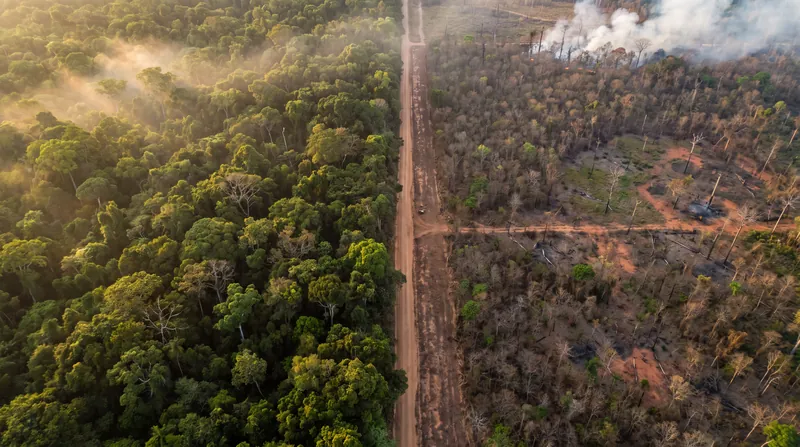
This hydrological breakdown is not occurring in a vacuum; it is being violently accelerated by human activity. Reuters reports that the compounding stressors of global climate change and local deforestation are pushing the ecosystem beyond its evolutionary limits. When loggers and ranchers clear land, they fragment the forest, exposing the edges of the remaining jungle to hotter, drier winds. This edge effect dries out the understory, making the normally fire-resistant rainforest highly flammable.[1]
Fire acts as the catalyst for rapid transition. The Amazon did not evolve with fire, and its trees lack the thick bark necessary to survive blazes. The Guardian highlights that recent mega-droughts—exacerbated by severe El Niño events and anomalous warming in the tropical North Atlantic—have turned vast swaths of the basin into a tinderbox. Once a section of the forest burns, it is often replaced by invasive grasses and scrub, which burn even more easily in subsequent years, locking the landscape into a degraded state.[2][3]
The strength of the evidence supporting this tipping point hypothesis is robust, anchored by decades of continuous satellite monitoring and carbon flux measurements. INPE's 2026 anomaly data confirms that parts of the southeastern Amazon have already flipped from being a net carbon sink to a net carbon source. These regions are now emitting more carbon dioxide through decay and fires than they absorb through photosynthesis, a stark empirical validation of the models' most pessimistic projections.[4]
However, transparent uncertainty remains regarding the speed and uniformity of this collapse. The Nature study emphasizes that the Amazon is not a monolith, and the tipping point will likely not manifest as a single, basin-wide cliff. Instead, researchers anticipate a mosaic of localized collapses. The western Amazon, which receives abundant rainfall from the Andes, exhibits significantly higher resilience than the heavily deforested "Arc of Deforestation" in the south and east.
Scientists are also debating the exact temperature threshold that guarantees irreversible decline. While earlier models suggested a global warming threshold of 3°C to 4°C might be required to trigger basin-wide dieback, the new synthesis warns that the synergistic effects of deforestation and warming mean regional tipping points are already being crossed at the current 1.2°C to 1.5°C of global warming. If deforestation exceeds 20 percent of the original forest cover—it currently sits at roughly 17 percent—the entire moisture recycling system could fatally fracture.[3]
The global stakes of this transition are difficult to overstate. The Amazon basin stores an estimated 150 to 200 billion tons of carbon in its biomass and soils. If a significant portion of the forest degrades into savanna, the resulting carbon emissions would consume a massive fraction of the world's remaining carbon budget, making the Paris Agreement's climate targets mathematically impossible to achieve. This would trigger a vicious cycle, where Amazon dieback accelerates global warming, which in turn drives further dieback.[1][3]
Beyond carbon, the collapse of the Amazon's hydrological pump would severely disrupt weather patterns across the Western Hemisphere. The moisture generated by the forest feeds the "flying rivers" that deliver essential rainfall to the agricultural heartlands of South America, including the La Plata basin. A reduction in this rainfall would devastate crop yields in Brazil, Argentina, and Paraguay, sending shockwaves through global food supply chains and commodity markets.[2][4]
Despite the grim trajectory, the evidence pack also points to a clear, albeit narrowing, window for mitigation. The Science Panel for the Amazon asserts that halting deforestation immediately and aggressively restoring degraded areas could pull the ecosystem back from the brink. Because the forest's moisture recycling is a localized phenomenon, local interventions—such as enforcing protected areas and supporting Indigenous land rights—can yield immediate ecological dividends, even as the world struggles to curb global greenhouse gas emissions.[3][4]
Ultimately, the data presents a stark binary: the Amazon will either remain a vital planetary life-support system or become a massive liability in the climate crisis. The scientific consensus, synthesized across multiple disciplines and decades of observation, confirms that the buffer of resilience the forest once possessed has been exhausted. The transition from a theoretical warning to an observable, real-time ecological shift marks a critical juncture in the Earth's climate history.[4]
Key terms
- Savannization
- The ecological process where a dense, closed-canopy rainforest degrades into an open, drier landscape dominated by grasses and fire-adapted scrub.
- Moisture Recycling
- The mechanism by which trees pump water from deep in the soil into the atmosphere through their leaves, generating the clouds and rainfall that sustain the forest.
- Tipping Point
- A critical threshold in an Earth system where a small change pushes the system into a completely new, often irreversible state.
- Carbon Sink
- A natural environment, like a forest or ocean, that absorbs more carbon dioxide from the atmosphere than it releases.
Reader questions
What is the Amazon tipping point?
It is a critical threshold where the rainforest loses its ability to generate its own rainfall, causing it to rapidly degrade into a dry, grassy savanna.
Will the entire Amazon collapse at once?
No. Scientists expect a mosaic of localized collapses, with the heavily deforested southern and eastern regions degrading first, while the western Amazon remains more resilient.
Can the savannization process be stopped?
Yes, but the window is closing. Halting deforestation, restoring degraded land, and reducing global greenhouse gas emissions can prevent the forest from crossing the threshold.
How does this affect the rest of the world?
The Amazon stores up to 200 billion tons of carbon. Its collapse would release massive amounts of CO2, accelerating global warming and disrupting rainfall patterns essential for agriculture in the Americas.
Where opinion splits
Earth System Scientists
Focus on the irreversible nature of the tipping point and the urgent need for global emission reductions.
Researchers in this camp argue that the Amazon cannot be viewed in isolation. They point to data showing that even if local deforestation is completely halted, unchecked global warming will still push the forest past its thermal limits. They advocate for treating the Amazon as a critical piece of global infrastructure, requiring both immediate local conservation and aggressive international decarbonization to maintain the moisture recycling pump.
Indigenous & Conservation Coalitions
Emphasize that empowering local communities and enforcing land rights are the most effective immediate defenses.
This perspective highlights that the most intact and resilient areas of the Amazon are those managed by Indigenous peoples. They argue that abstract climate modeling often ignores the reality on the ground, where illegal logging, mining, and land-grabbing are the immediate catalysts for forest degradation. For these groups, the solution to the tipping point is fundamentally a matter of human rights and strict law enforcement against environmental crimes.
Agricultural & Economic Interests
Argue for a balance between conservation and the economic realities of South American developing nations.
Voices from the agribusiness sector and regional development advocates often caution against 'climate alarmism.' They argue that while the forest needs protection, the models predicting imminent collapse are sometimes overly pessimistic and fail to account for the economic necessity of agriculture in the region. This camp advocates for sustainable intensification—producing more food on already cleared land—rather than locking away the entire basin from economic use.
- Earth System Scientists
- Argue that the compounding effects of heat and deforestation are pushing the forest past an imminent, irreversible tipping point.
- Indigenous & Conservation Coalitions
- Emphasize that immediate enforcement of land rights and halting local deforestation are the most effective ways to build forest resilience.
- Agricultural & Economic Interests
- Acknowledge climate risks but often argue that ecological models are overly pessimistic and must be balanced with regional economic development.
Perspectives this story doesn't cover
- Local Amazonian municipalities reliant on agribusiness
- Global commodities traders
Sources
Source coverage
4 outlets
3 viewpoints surfaced




- [1]ReutersAgricultural & Economic Interests
Amazon rainforest approaches critical tipping point, new study warns
Read on Reuters → - [2]The GuardianIndigenous & Conservation Coalitions
Venezuela quake death toll passes 4,000 as scale of recovery effort looms large
Read on The Guardian → - [3]Science Panel for the AmazonEarth System Scientists
2026 Assessment Report: The State of the Amazon Basin
Read on Science Panel for the Amazon → - [4]Factlen Editorial TeamEarth System Scientists
Synthesis by Factlen editorial team
Read on Factlen Editorial Team →

More in Science
See all →Amazon Tipping Point
Amazon Found More Resilient Than Feared, But Tipping Point Still Looms By 2040
5 sources
Climate Metrics
Earth's Energy Imbalance Reaches Record High, Signaling Accelerated Global Warming
5 sources

Climate Models
New Ocean Methane Feedback Loop Discovered, Threatening Accelerated Warming
6 sources

Global Warming
Intensifying El Niño and Record Ocean Temperatures Put 2026 on Track to Become Hottest Year Ever
3 sources

Comments
Every angle. Every day.
Get Science stories with full source coverage and perspective breakdowns, free every day.