
The Engineering of Silence: How Ultra-Long-Range Jets Erase Cabin Noise at Mach 0.90
Modern flagship business jets utilize hundreds of pounds of acoustic insulation and aerodynamic shaping to drop cabin noise below 50 decibels, fundamentally altering the physiological toll of long-haul travel.
By Irina Belova

Share this story
The Rolls-Royce Phantom achieves its legendary silence by rolling over smooth asphalt at 70 miles per hour. An ultra-long-range business jet must achieve that exact same acoustic environment while tearing through the stratosphere at Mach 0.90, bombarded by minus-60-degree aerodynamic friction and the low-frequency mechanical violence of twin turbofan engines. The engineering required to bridge that gap is one of the most expensive and secretive disciplines in modern aviation.[1]
Historically, private flight was a loud endeavor. The sheer thrust required to lift a heavy airframe meant that passengers traded commercial airline crowds for a different kind of fatigue: the relentless, droning resonance of the engines. In 2026, the metric of ultimate luxury in the sky is no longer just legroom or leather; it is absolute, engineered silence.[1]
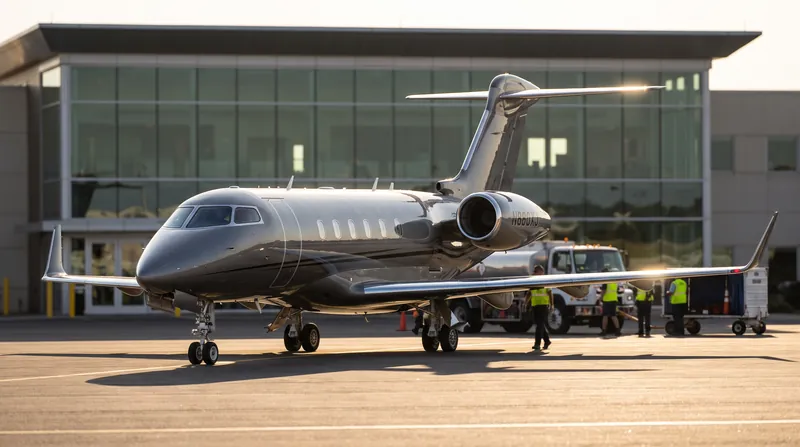
The newest generation of flagship aircraft—led by the Gulfstream G700, the Bombardier Global 7500, and the Dassault Falcon 10X—have pushed cabin noise below 50 decibels. To understand that achievement, one must look at the baseline. A standard commercial airliner cabin operates between 75 and 85 decibels during cruise.
"Because the decibel scale is logarithmic, a sound with an intensity that is twice that of a reference sound corresponds to an increase of little more than 3 decibels," according to Merriam-Webster's acoustic definitions. The 30-decibel chasm between a commercial economy seat and a Gulfstream G700 means the private cabin is subjected to roughly one-eighth the perceived acoustic violence, fundamentally altering the physical toll of the journey.[3][4]
Achieving this requires mitigating three distinct sound vectors. The first is aerodynamic friction, generated by high-speed airflow tearing across the fuselage skin and wing roots. The second is mechanical vibration, transmitting from the engine mounts directly through the airframe's skeleton. The third is the environmental control system—the hum of internal air circulation.[2]
Manufacturers attack the aerodynamic noise first. Gulfstream's G700, which currently holds the industry benchmark at 47.6 decibels during high-speed cruise, relies heavily on aerodynamic design refinements. By smoothing the airflow over the wing roots and utilizing triple-pane acoustic window assemblies, engineers prevent high-frequency wind shear from penetrating the pressure vessel.
Mechanical vibration requires a heavier hand. Soundproofing an ultra-long-range jet involves installing up to 600 pounds of specialized, multi-density acoustic foam and constrained layer vibration damping materials. Companies engineer proprietary thermal-acoustic blankets that fill the voids between the interior cabin walls and the exterior fuselage.[1]
These materials, such as graphitized polyurethane foams and Kevlar-reinforced composites, are designed to absorb specific frequencies without adding catastrophic weight. Every pound of soundproofing reduces the aircraft's maximum payload and range, forcing a brutal compromise between silence and performance.[1]
Bombardier's Global 7500, which registers around 49 to 50 decibels in cruise, pairs these heavy-density structural dampeners with active acoustic management. The aircraft utilizes tuned mass dampers placed strategically along the fuselage bulkheads to absorb low-frequency engine resonance before it can vibrate the cabin floor.
Furthermore, Bombardier isolates the interior shell from the exterior frame. The seats themselves are mounted on vibration-isolated tracks, ensuring that the mechanical hum of the General Electric Passport engines does not travel up through the furniture into the passenger's body.
Dassault takes a structural approach with its Falcon series. Leveraging its military aerospace heritage, the Falcon 8X and the upcoming 10X utilize a tri-jet configuration or highly swept wings to alter the acoustic propagation paths. By mounting the engines further aft of the pressurized vessel, Dassault physically distances the primary noise source from the forward passenger zones.
The final frontier in acoustic engineering is the environmental control system. As the airframe and engines become quieter, the sound of air conditioning becomes the loudest remaining irritant. Modern environmental systems are designed to diffuse air through wider, low-velocity vents, eliminating the hiss of traditional gaspers while maintaining a constant flow of fresh air.[1]
The result of these combined technologies is a cabin environment that fundamentally alters the physiology of travel. Prolonged exposure to high-decibel noise elevates cortisol levels, increases heart rate, and accelerates travel fatigue. By dropping the ambient noise to the level of a quiet library, these aircraft allow executives to arrive after a 14-hour flight without the neurological exhaustion traditionally associated with global transit.[1]
The pursuit of silence is far from over. As materials science advances, engineers are experimenting with metamaterials and active noise-canceling frequencies broadcast through the cabin's audio system. Yet, the current generation of ultra-long-range jets has already achieved something remarkable: they have made the violent, explosive act of supersonic-adjacent flight sound like nothing at all.[2]
Analysis by camp
Aerospace Engineers
Focus on the structural and aerodynamic interventions required to mitigate noise.
For the engineers designing these airframes, silence is a physics problem that directly opposes performance. Every pound of multi-density acoustic foam or constrained layer damping material added to the fuselage is a pound of fuel or payload that cannot be carried. They advocate for aerodynamic solutions—such as smoothing wing roots and relocating engines further aft—because these interventions reduce noise at the source without adding catastrophic weight to the aircraft.
Aviation Physiologists
Emphasize the health and cognitive benefits of low-decibel travel.
Medical professionals and aviation physiologists view acoustic engineering through the lens of human performance. Prolonged exposure to the 80-decibel environment of a commercial airliner triggers a low-grade stress response, elevating cortisol and accelerating dehydration and fatigue. By dropping the cabin environment below 50 decibels, physiologists argue that ultra-long-range jets transition from being merely a mode of transport to a restorative environment, allowing executives to arrive neurologically rested.
Charter Operators
View cabin noise as a primary, quantifiable differentiator for luxury clients.
For the companies selling fractional ownership or charter hours, decibel levels have replaced legroom as the ultimate marketing metric. Operators use the specific Speech Interference Level (SIL) ratings of aircraft like the G700 and Global 7500 to justify premium pricing. They note that high-net-worth clients are increasingly educated on acoustic specifications and will specifically request aircraft that guarantee a 'quiet office' environment for overnight flights.
- Aerospace Engineers
- Focus on the structural and aerodynamic interventions required to mitigate noise.
- Aviation Physiologists
- Emphasize the health and cognitive benefits of low-decibel travel.
- Charter Operators
- View cabin noise as a primary, quantifiable differentiator for luxury clients.
- Acoustic Lexicographers
- Define the mathematical realities of sound measurement and logarithmic scaling.
Sources
Source coverage
4 outlets
4 viewpoints surfaced



- [1]Factlen Editorial TeamAviation Physiologists
Synthesis by Factlen editorial team
Read on Factlen Editorial Team → - [2]WikipediaAerospace Engineers
Acoustical engineering
Read on Wikipedia → - [3]WikipediaAerospace Engineers
Decibel
Read on Wikipedia → - [4]Merriam-WebsterAcoustic Lexicographers
Decibel Definition & Meaning
Read on Merriam-Webster →

More in Travel
See all →Private Aviation
The 7.5% Surcharge and the Deadhead Multiplier: How Private Jet Charter Pricing Is Actually Calculated
10 sources
Visa Wait Times
GAO Report Finds US Visitor Visa Interview Wait Time Surged to 201 Days, Costing Billions in Tourism Revenue
6 sources

Luxury Cruising
Silversea Overhauls Luxury Suite Categories and Adds Private Chef Consultations for 2027 Voyages
4 sources

Hospitality Standards
The 5-Year Threshold: How the Les Clefs d'Or Actually Certifies Luxury Hotel Concierges
4 sources

Comments
Every angle. Every day.
Get Travel stories with full source coverage and perspective breakdowns, free every day.