
The Economics and Reach of Audio-Only vs. Video Podcasts
As YouTube and Spotify push visual formats, the $40 billion podcast industry is fracturing into two distinct consumption models. While video podcasts drive higher engagement and discoverability, traditional audio retains a massive advantage in mobile, multitasking environments.

Share this story
In short
- YouTube has overtaken Apple Podcasts as the top platform for podcast consumption, capturing 33% of weekly listeners.
- Audio podcasts dominate multitasking environments, with 78% of listeners tuning in during hands-busy moments like commuting or chores.
- Video podcasts are capturing the living room, with YouTube reporting 700 million hours of podcasts watched on TVs in a single month.
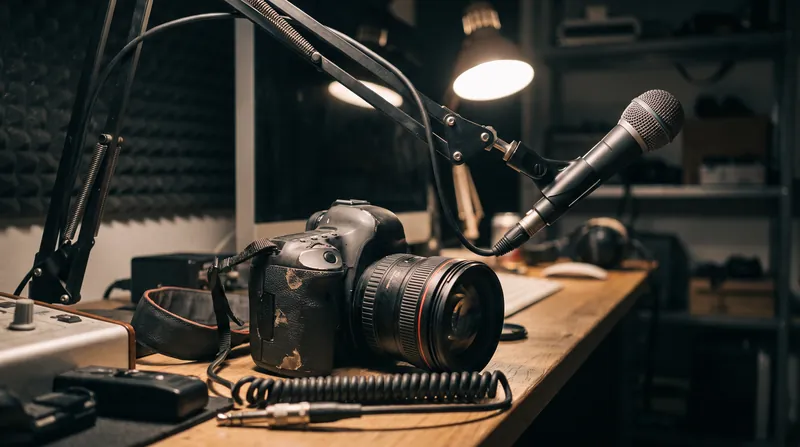
If you want to start a podcast today, you don't just need something to say—you need to know how to light a set. For the first two decades of the medium's existence, a podcast studio was little more than a quiet room, a dynamic microphone, and a laptop. It was the ultimate democratized platform.
Today, the top-tier podcast setup looks indistinguishable from a late-night television broadcast, complete with multi-camera infrastructure and cinematic lighting grids. For listeners, this means your favorite ambient commute companion is increasingly being designed as a visual spectacle meant for your living room TV. This visual arms race isn't an accident; it is the direct result of the world's largest tech platforms deciding that the future of audio is actually video.
The $40 billion podcast industry is currently fracturing into two distinct consumption models, driven by a massive shift in where audiences discover content. YouTube has officially overtaken Apple Podcasts as the dominant platform for podcast consumption, capturing roughly 33% of weekly listeners in the United States.
Spotify, originally built as a pure-play audio streamer, has aggressively pivoted to match, boasting over 300,000 video podcasts on its platform as of late 2025. With 51% of Americans having now watched a podcast video, the format is no longer an experimental add-on—it is the primary engine for industry growth.[2]
This shift has forced creators into a high-stakes strategic decision: stick to the low-friction intimacy of traditional audio, or invest heavily in video production to chase algorithmic discoverability. The choice dictates not just the budget, but the fundamental nature of the show. An audio podcast is ambient companionship; a video podcast is a visual performance. As platforms increasingly prioritize video in their recommendation engines, creators who refuse to turn on a camera risk being left behind in the battle for new listeners, even as they maintain their core, loyal audience.
Yet the data reveals that audio and video podcasts are not actually competing for the same moments in a listener's day. Traditional audio absolutely dominates the 'hands-busy' segments of daily life. According to 2026 data from Sounds Profitable, 78% of listeners consume audio while commuting, exercising, or doing household chores.
Audio leads video significantly during workouts (46% to 22%) and commutes (38% to 20%). It is the only medium that can seamlessly integrate into a busy routine without demanding the user's eyes, making it an irreplaceable utility for millions of multitasking adults.
Video podcasts, by contrast, are capturing the living room and competing directly with linear television. YouTube reported that viewers watched over 700 million hours of podcasts on television screens in a single month in late 2025, a massive jump from the previous year.
This format demands dedicated, lean-back attention. Deloitte research indicates that 44% of vodcast watchers say they never multitask while watching, compared to just 29% of audio listeners. When a consumer puts a podcast on their television, they are treating it as a primary entertainment event, not background noise.[1]
For creators who can afford the production overhead, the engagement metrics heavily favor video. Spotify's internal data shows that video podcast audiences consume 1.5 times more content than users who only listen, and they are 1.3 times more likely to retain month over month.
The visual layer allows for physical comedy, facial expressions, and visual aids that deepen the parasocial connection between host and audience. Furthermore, the video format allows for the creation of short-form social media clips, which remain the single most effective marketing tool for discovering new shows in a saturated market.
Despite the algorithmic advantages of video, traditional audio retains a distinct and powerful advantage in audience trust. The intimacy of a voice speaking directly into a listener's ears without the distraction of a screen creates a unique bond. According to Barrett Media's analysis, audio podcasts rate highest for being 'accurate and factual' at 58%, edging out video's 55% and easily beating visual social platforms like TikTok and Instagram. For news, deep-dive journalism, and highly personal narratives, the lack of visual polish actually enhances the perceived authenticity of the content.
Ultimately, the podcast medium is no longer a monolith. The industry has bifurcated into two parallel tracks that share a name but serve entirely different consumer needs. Creators must now decide at the outset whether they are producing ambient audio for the morning commute, or visual entertainment for the evening couch.
While the hybrid approach—recording in video and distributing everywhere—offers the best of both worlds, it requires a television-scale budget. For the independent creator, the choice between audio and video is no longer just a technical specification; it is the defining strategic decision of their brand.
How we did this
- Method
- Comparing and cross-tabulating audience engagement metrics, platform market share, and environmental consumption habits between audio-only and video-first podcast formats to determine the optimal deployment strategy for creators.
- What we found
- While video podcasts offer superior algorithmic discoverability and a 1.3x retention boost on platforms like Spotify, they forfeit the 'hands-busy' utility that defines traditional podcasting, effectively competing with linear television for dedicated screen time rather than ambient audio.
- What we worked from
- YouTube weekly listener market share: 33% — Teleprompter.com
- Audio hands-busy consumption rate: 78%
- Video podcast retention multiplier: 1.3x
- Limits of this analysis
- Audience overlap is significant, and the data does not fully isolate hybrid consumers who seamlessly switch between audio and video for the exact same show depending on their immediate environment.
Different angles
The Case for Audio-Only
Optimized for ambient utility, high trust, and low production friction.
Audio-only podcasts dominate the 'hands-busy' segments of the day. According to Sounds Profitable data, 78% of listeners consume audio while commuting, exercising, or doing chores. This ambient utility creates a deeply intimate, high-trust relationship with the host—audio rates highest for being 'accurate and factual' at 58%, edging out video's 55%. For creators, the barrier to entry remains incredibly low, requiring only a good microphone and a quiet room. **Fits well when:** The content is highly narrative, deeply intimate, or targeted at commuters. **Does not fit when:** The creator relies heavily on social media algorithms for organic discovery, as static audio clips notoriously underperform on TikTok and Instagram Reels.
The Case for Video Podcasts
Optimized for algorithmic discoverability, social sharing, and dedicated screen time.
Video podcasts (vodcasts) have transformed the medium into a visual spectacle, capturing the living room. YouTube reported over 700 million hours of podcasts watched on televisions in a single month in late 2025. Video demands dedicated attention—44% of vodcast watchers say they never multitask while watching. The visual format allows for micro-content distribution (Shorts, Reels), which is currently the primary engine for podcast discovery. Furthermore, Spotify data indicates video audiences are 1.3x more likely to retain than audio-only listeners. **Fits well when:** The show relies on host chemistry, physical reactions, or visual aids, and the creator has the budget for multi-camera setups. **Does not fit when:** The target audience primarily listens during workouts or commutes, where screen time is impossible.
The Hybrid Approach
Recording in video but optimizing distribution for both active and ambient consumption.
The current industry standard for top-tier shows is a hybrid model: recording a high-fidelity video production but distributing the audio feed to Apple Podcasts and Spotify, while pushing the full video to YouTube and short clips to social media. This captures the 50% of audiences relaxing with dedicated attention, while still servicing the 46% who listen while exercising. However, this approach significantly inflates production costs, requiring lighting, set design, and video editing, effectively turning podcasters into television producers. **Fits well when:** A show has established monetization to support a production crew and wants to maximize its total addressable market. **Does not fit when:** A solo creator is just starting out and risks burnout from the technical overhead of video production.
- Video-First Creators
- Prioritize algorithmic discoverability, social clips, and higher audience retention.
- Audio Traditionalists
- Value the intimacy, low production cost, and multitasking utility of ambient audio.
- Platform Aggregators
- Push hybrid models to capture both ambient and active attention across all devices.
Perspectives this story doesn't cover
- Independent creators priced out of high-end video production
- Visually impaired audiences who rely exclusively on audio
Sources
Source coverage
3 outlets
3 viewpoints surfaced



- [1]YouTube BlogPlatform Aggregators
How podcasts took over the living room in 2025
Read on YouTube Blog → - [2]Teleprompter.comVideo-First Creators
Podcast Statistics 2025: Global Listener Growth and Trends
Read on Teleprompter.com → - [3]Factlen Editorial TeamPlatform Aggregators
Synthesis by Factlen editorial team
Read on Factlen Editorial Team →
More in Entertainment
See all →Creator Economy
Why Podcasters Are Shifting From Programmatic CPMs to Host-Read Ads and Subscriptions
8 sources
Creator Economy
Spotify and Netflix Strike $100 Million Joint Deal for Jay Shetty's 'On Purpose' Podcast
6 sources
Creator Economy
The Video-First Era: How YouTube and Spotify Transformed Podcasting into Television
5 sources
Media Ethics
Gaza Photojournalist Motaz Azaiza Admits Withholding October 7 Hostage Footage
5 sources
Comments
Every angle. Every day.
Get Entertainment stories with full source coverage and perspective breakdowns, free every day.