
The Core Mechanics of Sim-to-Real Transfer: How AI Robots Learn in the Matrix
By training artificial intelligence in randomized digital simulations, engineers are successfully deploying complex robotic behaviors into the physical world without requiring years of real-time trial and error.
By Ishani Patel

Share this story
In short
- Reinforcement learning requires millions of trial-and-error iterations, making real-world robotic training dangerously slow and expensive.
- Simulators solve the speed bottleneck but introduce a reality gap between perfect digital physics and noisy real-world environments.
- Domain randomization bridges this gap by wildly varying simulated lighting, textures, and physics, forcing the AI to generalize.
The promise of general-purpose physical artificial intelligence is currently bottlenecked by a simple, unavoidable constraint: the physical world operates at a painfully slow speed. While large language models can ingest the entire internet in a matter of months across massive data centers, physical robots are bound by the laws of real-time physics.
They cannot speed up time to learn faster. If a robotic arm needs to practice grasping a delicate object, it must physically move its joints, make contact, and reset, over and over again. This fundamental speed limit has historically kept robotics confined to rigid, pre-programmed industrial tasks rather than adaptable, intelligent behaviors.[5]
To learn complex, dynamic behaviors—such as how to walk on uneven terrain, grasp irregular objects, or assemble intricate gears—modern artificial intelligence relies heavily on reinforcement learning. This algorithmic approach requires the AI to learn through massive amounts of trial and error, receiving mathematical rewards for successful actions and penalties for failures. For a bipedal robot to simply learn how to balance and transition between different walking gaits, the underlying neural network might require millions of iterative attempts to map the correct motor commands to its sensor inputs.[3]
Attempting to execute this volume of trial-and-error learning directly on physical hardware is practically impossible. Doing so means subjecting highly expensive robotic arms and bipedal chassis to continuous failure. Robots would repeatedly smash into tables, drop heavy objects, and burn out their internal motors as the untrained AI flails unpredictably. Beyond the catastrophic hardware damage, the sheer time required to collect months or years of real-time physical data makes the process economically unviable for developing general-purpose physical AI.[2]
The industry's solution to this data bottleneck is simulation. By placing a mathematically precise digital twin of a robot inside a high-fidelity physics engine, developers can escape the constraints of real-time physics. In the digital realm, engineers can spin up thousands of parallel simulation instances simultaneously across massive GPU clusters. This allows the artificial intelligence to experience the equivalent of thousands of years of trial-and-error learning in just a few hours of wall-clock compute time, rapidly converging on a successful behavioral policy.[5]
However, this simulation-first approach introduces a massive new hurdle known as the reality gap. Simulators, no matter how advanced, are ultimately perfect, frictionless, and mathematically precise environments. The real world, by contrast, is infinitely noisy and unpredictable. Lighting conditions change dynamically, camera sensors suffer from grain and glare, and physical gears possess microscopic variations in wear and tear. When an AI model trains exclusively in a pristine digital matrix, it overfits to that perfection.[1]
Consequently, when a behavioral policy trained in a perfect simulation is finally downloaded into a real physical robot, it typically fails immediately. The AI encounters sensor noise or friction it has never seen before, panics, and executes erratic movements. This phenomenon has plagued the field of robotics for decades, creating a frustrating paradigm where algorithms that look flawless on a computer screen become entirely useless the moment they are asked to interact with physical matter.[2]
The foundational mechanism developed to cross this visual and physical divide is a technique called Domain Randomization. Instead of embarking on the impossible task of making the simulation perfectly match the complexities of reality, engineers take the exact opposite approach: they make the simulation wildly and aggressively unpredictable. By intentionally degrading the perfection of the digital environment, they force the neural network to focus only on the core mechanics of the task.[1]
During the training process, the physics engine continuously randomizes the environment's parameters. The lighting shifts drastically from pitch black to blindingly bright. The colors and textures of the objects, the tables, and the robot itself are swapped with chaotic, abstract patterns. The simulated gravity might be slightly increased, and the friction coefficients of the floor might fluctuate between the slickness of ice and the grip of sandpaper. The AI is subjected to a relentless barrage of environmental chaos.[1]
By forcing the neural network to succeed across thousands of these bizarre, randomized environments, the model learns a highly robust and generalized policy. It learns to ignore irrelevant visual details like shadows or table colors, focusing entirely on the geometric structure of the objects it needs to manipulate. When this hardened policy is finally placed in the real world, the robot simply treats reality as just one more variation of the chaotic simulation it has already mastered.[1]
The effectiveness of this approach has been rigorously quantified in recent years. By systematically optimizing these visual domain randomization parameters through off-line proxy tasks, researchers have demonstrated remarkable success rates. In complex robotic manipulation tasks—such as locating and grasping specific objects amidst clutter—policies trained entirely in randomized simulations have achieved up to a 93 percent success rate when transferred directly to real hardware, outperforming models trained on limited real-world data.[1]
However, visual randomization is only half the battle in bridging the reality gap. While domain randomization excels at teaching a robot to see in the real world, the physical dynamics—how heavy an object actually is, or how much a specific joint resists movement due to internal friction—are much harder to transfer. When a robot makes physical contact with its environment, even a millimeter of discrepancy between the simulated physics and the real physics can cause a catastrophic failure.[2]
Historically, roboticists relied on position control, an approach where the AI commands a joint to reach an exact geometric angle. While this is highly sample-efficient in simulation, it requires intense parameter tuning to work in reality. If the real-world table is slightly higher than the simulated table, a position-controlled arm will blindly try to push through the solid wood to reach its target coordinate, often damaging itself or the object in the process.[2]
To mitigate this, the field has increasingly shifted toward torque control. Instead of telling the robot exactly where its arm should be in space, the AI commands how much rotational force—or torque—a specific motor should apply. This fundamental shift in the action space takes advantage of the robot's inherent physical compliance. If the torque-controlled arm hits an unexpected obstacle, the motors simply yield to the resistance rather than fighting it to the point of destruction.[2]
This torque-based approach has proven critical for complex, dynamic movements. It enabled some of the first successful sim-to-real transfers of deep reinforcement learning policies for human-sized bipedal robots. By relying on the hardware's physical compliance rather than rigid geometric positioning, the bipedal robots were able to absorb the microscopic errors between the simulation's gravity models and the real world's physics, allowing them to balance and walk without requiring extensive real-world fine-tuning.[2]
More recently, the sim-to-real pipeline has evolved into a continuous, iterative Real-to-Sim-to-Real loop. Rather than treating the transfer as a one-time event, engineers now reconstruct real-world scenes inside the simulator using advanced spatial mapping. They then utilize Vision-Language Models to automatically generate dynamic reward functions based on natural language instructions from humans, allowing the AI to practice multi-step, complex tasks in a digital replica of its actual workspace.[4]
The artificial intelligence practices the multi-step task in this simulated replica, refining its strategy through iterative feedback. Once the policy is robust, it is deployed back into the physical world. Because the reward functions were dynamically shaped by the Vision-Language Model, the resulting physical policy is highly adaptable, capable of spontaneous error recovery and on-the-fly strategy adjustments when the real-world environment inevitably deviates from the digital replica.[4]
As simulation engines become increasingly sophisticated and compute power continues to scale, the reality gap is steadily closing. The ability to train complex behaviors entirely in the digital realm and deploy them seamlessly into the physical one is the core mechanism that will finally allow robotics to scale at the speed of software. By mastering sim-to-real transfer, the industry is unlocking a future where physical AI can be developed, tested, and deployed safely and efficiently across the globe.[5]
How we did this
- Method
- Compared the evolution of sim-to-real methodologies across four years of robotics research, tracing the shift from visual domain randomization to torque-based compliance and VLM-guided iterative reward loops.
- What we found
- The primary bottleneck in sim-to-real transfer has shifted from overcoming visual discrepancies to bridging dynamic physical interactions, making torque-based compliance the mandatory bridge between perfect simulation data and noisy real-world execution.
- What we worked from
- Visual domain randomization success rate: 93% success rate on manipulation tasks — arXiv
- Torque-based compliance framework: Mitigation of reality gap via torque action spaces — IEEE Xplore
- VLM-generated reward loop: Real-to-sim-to-real multi-step task execution — IEEE Xplore
- Limits of this analysis
- This analysis relies on published academic benchmarks, which often represent controlled laboratory conditions rather than unstructured, real-world deployment environments.
Key terms
- Sim-to-Real Transfer
- The process of training an artificial intelligence model inside a computer simulation and successfully deploying it onto physical hardware.
- Domain Randomization
- A training technique that wildly varies the visual and physical parameters of a simulation to force an AI to learn robust, generalized behaviors.
- Reinforcement Learning
- A machine learning method where an AI learns by trial and error, receiving rewards for successful actions and penalties for failures.
- Zero-Shot Transfer
- Deploying an AI model into a new environment where it succeeds on the first try without needing any additional training data.
- Torque Control
- A method of operating a robot by commanding the rotational force of its motors rather than the exact geometric position of its joints.
Frequently asked
What is the reality gap in robotics?
The reality gap is the discrepancy between a perfect, frictionless computer simulation and the noisy, unpredictable physical world, which often causes AI models to fail when transferred to real robots.
How does domain randomization work?
Engineers intentionally randomize the lighting, textures, and physics in a simulation so the AI learns to ignore irrelevant details, treating the real world as just another variation.
Why not just train robots in the real world?
Training in the real world is slow, expensive, and dangerous. A robot might need millions of attempts to learn a task, which would take years and cause severe hardware damage.
What is torque control?
Instead of telling a robot joint exactly what angle to reach, torque control tells the motor how much force to apply, allowing the robot to physically yield if it hits an unexpected obstacle.
Viewpoints in depth
Simulation-First Advocates
Argue that scaling compute and synthetic data will solve physical AI.
This camp, heavily populated by AI labs and GPU manufacturers, believes the reality gap is fundamentally a data problem. By building higher-fidelity physics engines and running millions of parallel environments, they argue that robots can learn everything they need in the matrix. For them, collecting real-world teleoperation data is a temporary crutch that will soon be entirely replaced by synthetic generation.
Real-World Purists
Maintain that contact-rich manipulation requires physical experience.
Roboticists focused on tactile feedback and fine manipulation argue that simulation can never perfectly model the microscopic complexities of friction, deformation, and wear-and-tear. They emphasize that while sim-to-real works well for locomotion and basic grasping, tasks like threading a needle or handling soft materials will always require policies fine-tuned on actual physical hardware.
Industrial Automation Engineers
Focus on safety, reliability, and torque compliance over pure AI scaling.
For engineers deploying robots in factories and warehouses, the priority is ensuring the system doesn't destroy itself or its environment when the simulation inevitably proves slightly wrong. This camp champions torque-based control and compliance, ensuring that when the AI makes a millimeter error in its spatial reasoning, the physical motors yield gracefully rather than snapping a gear.
- Simulation-First Advocates
- Argue that scaling compute and synthetic data will solve physical AI.
- Real-World Purists
- Maintain that contact-rich manipulation requires physical experience.
- Industrial Automation Engineers
- Focus on safety, reliability, and torque compliance over pure AI scaling.
Perspectives this story doesn't cover
- Hardware Manufacturers
- Factory Floor Workers
Sources
Source coverage
5 outlets
3 viewpoints surfaced



- [1]arXivReal-World Purists
Robust Visual Sim-to-Real Transfer for Robotic Manipulation
Read on arXiv → - [2]IEEE XploreIndustrial Automation Engineers
Torque-Based Deep Reinforcement Learning for Task-and-Robot Agnostic Learning on Bipedal Robots Using Sim-to-Real Transfer
Read on IEEE Xplore → - [3]IEEE XploreIndustrial Automation Engineers
Sim-to-Real Reinforcement Learning for Bipedal Locomotion
Read on IEEE Xplore → - [4]IEEE XploreIndustrial Automation Engineers
A Real-to-Sim-to-Real Approach to Robotic Manipulation with VLM-Generated Iterative Keypoint Rewards
Read on IEEE Xplore → - [5]Factlen Editorial TeamSimulation-First Advocates
Synthesis by Factlen editorial team
Read on Factlen Editorial Team →
More in Artificial Intelligence
See all →Factory Automation
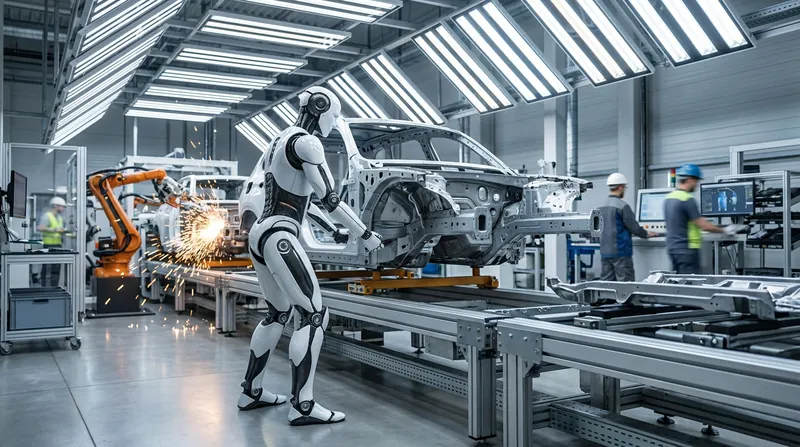
Toyota Commits ¥1 Trillion Annually to Deploy 400,000 Factory Robots Without Replacing Human Workers
6 sources
Zero-Shot Robotics
Figure's Helix 2.5 Robot Achieves 56% Success Rate in Unseen Homes Without Prior Mapping
6 sources
Algorithm Mechanics
How Monte Carlo Tree Search Balances Exploration and Exploitation Using the UCB1 Formula
3 sources
Sim-to-Real Transfer
How Domain Randomization Bridges the Reality Gap in AI Robotics
5 sources
Comments
Every angle. Every day.
Get Artificial Intelligence stories with full source coverage and perspective breakdowns, free every day.