
Swiss Epee Star Ian Hauri Mounts Impressive Comeback to Claim Bronze at Budapest Grand Prix
After battling shoulder injuries that sidelined him from the podium for a year, 23-year-old Swiss fencer Ian Hauri returned to top form with a third-place finish at the Budapest Grand Prix.
By Jackson Reed

Share this story
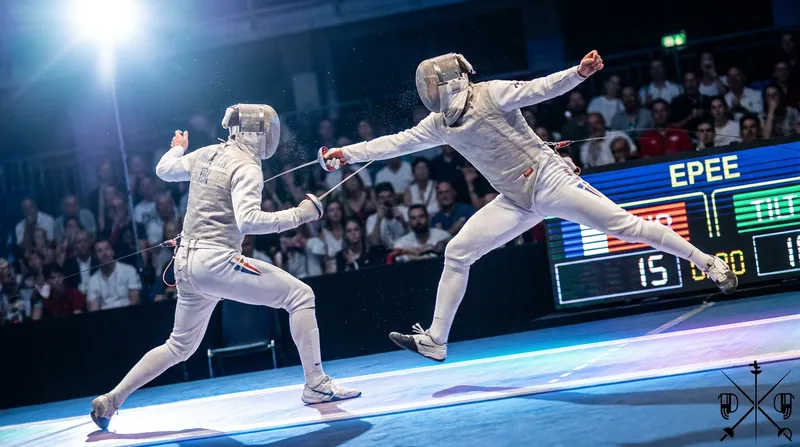
Ian Hauri, the 23-year-old Swiss epee sensation, has officially announced his return to the elite ranks of global fencing with a gritty, hard-fought performance in Hungary. After a grueling year marred by persistent shoulder problems that kept him from performing at his peak, Hauri captured the bronze medal at the prestigious FIE Epee Grand Prix in Budapest.
The podium finish marks his first individual World Cup medal in twelve months, signaling that his extensive rehabilitation has successfully restored his competitive edge. For a fencer who had previously claimed bronze at the 2024 European Championships and team gold at the U23 level, the prolonged absence from the senior podium was a frustrating hurdle. Now, with his shoulder holding up to the intense demands of international competition, Hauri has re-established himself as a formidable threat on the global circuit.[1][3][6]
The path back to the piste was far from guaranteed, as upper-body injuries pose a unique existential threat to epee fencers. The discipline relies heavily on explosive arm extensions, precise blade control, and rapid deceleration to land touches on the opponent's target area. A compromised shoulder not only diminishes a fencer's attacking speed but also destabilizes their defensive parries.
For Hauri, the recovery process required stepping back from the relentless pace of the international circuit to focus on targeted physical therapy, biomechanical adjustments, and gradual strength building. Supported by his club, the Société d'escrime de Genève (SEG), and his sponsors, Hauri meticulously rebuilt his physical foundation. His ability to return to a Grand Prix—an event worth 1.5 times the points of a standard World Cup—and immediately secure a medal underscores both his exceptional talent and his disciplined approach to recovery.[4][5]
His return to the Hungarian capital carried significant emotional and psychological weight. Budapest was the site of his last major individual triumph on the global stage, where he secured a silver medal at the Grand Prix in March 2025 after a spectacular run that included defeating world-class opponents like Egypt's Mohamed Elsayed.
Stepping back onto the same illuminated pistes a year later, Hauri faced the ultimate test: proving that his shoulder could withstand the grueling, all-day physical toll of a senior Grand Prix. The tournament format demands immense stamina, requiring fencers to navigate a gauntlet of direct elimination bouts against the world's top-ranked athletes. Hauri's ability to compartmentalize his past injury and trust his body in high-stakes moments was just as critical as his technical execution.[1][2][5]
The competition began with a severe test of endurance that immediately evaluated his physical readiness. In the opening round of 64, Hauri faced Spain's Manuel Bargues in a tense, drawn-out bout that pushed the Swiss fencer to the absolute brink. Rather than overpowering his opponent with sheer force, Hauri had to rely on his tactical patience, distance management, and the newly rehabilitated strength in his arm.
In a nail-biting finish, he narrowly edged out the Spaniard with a 15-14 victory. That single-point margin set the tone for the rest of the day, proving to Hauri that he could survive the high-pressure, sudden-death moments that define elite epee fencing. Surviving the early scare seemingly unlocked his rhythm, allowing him to fence with greater freedom and fluidity in the subsequent rounds.[1][3]
As the tournament progressed into the later stages, Hauri's confidence visibly surged, and his trademark style returned to the forefront. The French-Swiss athlete, who impressively balances his rigorous athletic career with economics studies at the University of Geneva, began to systematically dismantle his opponents. His signature counter-attacks, precise blade work, and explosive lunges looked as sharp as they had prior to his injury, effectively silencing any lingering doubts about his physical condition.
He navigated the rounds of 32 and 16 with a commanding presence, showcasing a mature tactical awareness that forced his opponents into making critical errors. By the time he reached the quarter-finals, it was clear that Hauri was not just participating in the tournament as a recovery milestone—he was actively hunting for the gold.[1][4]
Hauri's impressive run ultimately brought him to the semi-finals, where he squared off against Kazakhstan's Yerlik Sertay, a rising star making his own deep tournament run. The bout evolved into a highly tactical and cautious chess match, with both fencers probing for weaknesses and hesitant to commit to overly aggressive attacks. Sertay managed to dictate the distance effectively, using his footwork to neutralize Hauri's preferred counter-attacking zones.
Despite a valiant effort to close the gap, Hauri was eventually overcome by a score of 15-12, sending the Kazakh fencer to the final. However, in fencing, reaching the semi-finals guarantees a bronze medal, ensuring that Hauri would leave Budapest with tangible proof of his successful comeback. The loss did little to dampen the significance of his achievement.[1][2]
The result rippled through the Swiss fencing community, which has long viewed Hauri as a foundational pillar of its national team's future. His performance in Budapest served as an inspiring catalyst for the entire squad, which enjoyed a remarkably strong showing across the board. Hauri's podium finish was complemented by excellent results from his compatriots, with Hadrien Favre finishing 12th and Alexis Bayard taking 20th in the highly competitive men's event.
Meanwhile, Angeline Favre secured an impressive 6th place in the women's competition, highlighting the overall depth and rising trajectory of Swiss epee fencing. For the national coaches and supporters, Hauri's healthy return is the final piece of the puzzle as they prepare for the remainder of the Olympic cycle.[1][3]
Looking ahead, Hauri's successful comeback sets the stage for a highly anticipated home-soil advantage in the coming weeks. The international fencing elite is scheduled to converge in Bern, Switzerland, from May 22 to 24 for the next major leg of the World Cup circuit.
Looking ahead, Hauri's successful comeback sets the stage for a highly anticipated home-soil advantage in the coming weeks.
With his shoulder fully healed, his competitive rhythm restored, and a fresh Grand Prix medal around his neck, Hauri is perfectly positioned to lead the Swiss contingent in front of a passionate local crowd. The Budapest bronze is not just a return to form; it is a declaration that Ian Hauri has overcome his physical setbacks and is ready to challenge for the top step of the podium once again.[1][4][6]
Key points
- Swiss fencer Ian Hauri won the bronze medal at the FIE Epee Grand Prix in Budapest.
- The 23-year-old had been sidelined from top podium finishes for a year due to persistent shoulder injuries.
- Hauri narrowly won his opening bout 15-14 before dominating the middle rounds of the tournament.
- He was eventually defeated 15-12 in the semi-finals by Kazakhstan's Yerlik Sertay.
- The successful comeback positions Hauri as a key leader for the Swiss team ahead of the upcoming Bern World Cup.
How we got here
June 2024
Wins individual bronze at the European Fencing Championships in Basel.
March 2025
Secures a silver medal at the Budapest Epee Grand Prix.
April 2025
Wins team silver and individual gold at the U23 European Championships in Tallinn.
Late 2025 - Early 2026
Sidelined from top podium finishes due to persistent and debilitating shoulder problems.
April 2026
Returns to form, winning bronze at the Budapest Grand Prix.
- Swiss Fencing Community
- Celebrates Hauri's return as a vital boost to the national team's momentum and future prospects.
- Sports Medical Analysts
- Focuses on the biomechanical triumph of rehabilitating a fencing-specific shoulder injury.
- International Competitors
- Acknowledges Hauri as a renewed and unpredictable tactical threat on the global piste.
Perspectives this story doesn't cover
- Youth fencers looking up to Hauri's career path
- Tournament organizers managing medical timeouts
Sources
Source coverage
6 outlets
3 viewpoints surfaced






- [1]Blue NewsSwiss Fencing Community
Fencing: Ian Hauri on the podium at the Grand Prix in Budapest
Read on Blue News → - [2]FIE Fencing ChannelInternational Competitors
Highlights of Yerlik SERTAY (KAZ) - Ian HAURI (SUI) Semi Final FIE Budapest Epee Grand Prix 2026
- [3]Keystone-SDASwiss Fencing Community
Ian Hauri makes an impressive comeback at the Grand Prix in Budapest
- [4]Ian Hauri OfficialSports Medical Analysts
Ian Hauri - Escrimeur
- [5]WikipediaInternational Competitors
Ian Hauri
Read on Wikipedia → - [6]International Fencing FederationInternational Competitors
HAURI Ian
Read on International Fencing Federation →
More in Sports
See all →Injury
Global Fencing Injury Report: Lowthian's Post-Surgery Return, BenAvram's Wrist Battle, and the Toll of Overuse
4 sources
Standings
The Brutal Cutline: The High-Stakes Standings Race for Men's Epee Top 16 Seeding Ahead of Hong Kong
7 sources
Injury
Biomechanical Study of 162 Elite Fencers Reshapes Training and Injury Prevention
3 sources
Standings
Koki Kano and Mate Tamas Koch Locked in High-Stakes Battle for Men's Epee World No. 1
6 sources
Comments
Every angle. Every day.
Get Sports stories with full source coverage and perspective breakdowns, free every day.