
Smiling Distorts Biometric Landmark Geometry: Why ICAO Mandates Neutral Passport Photos
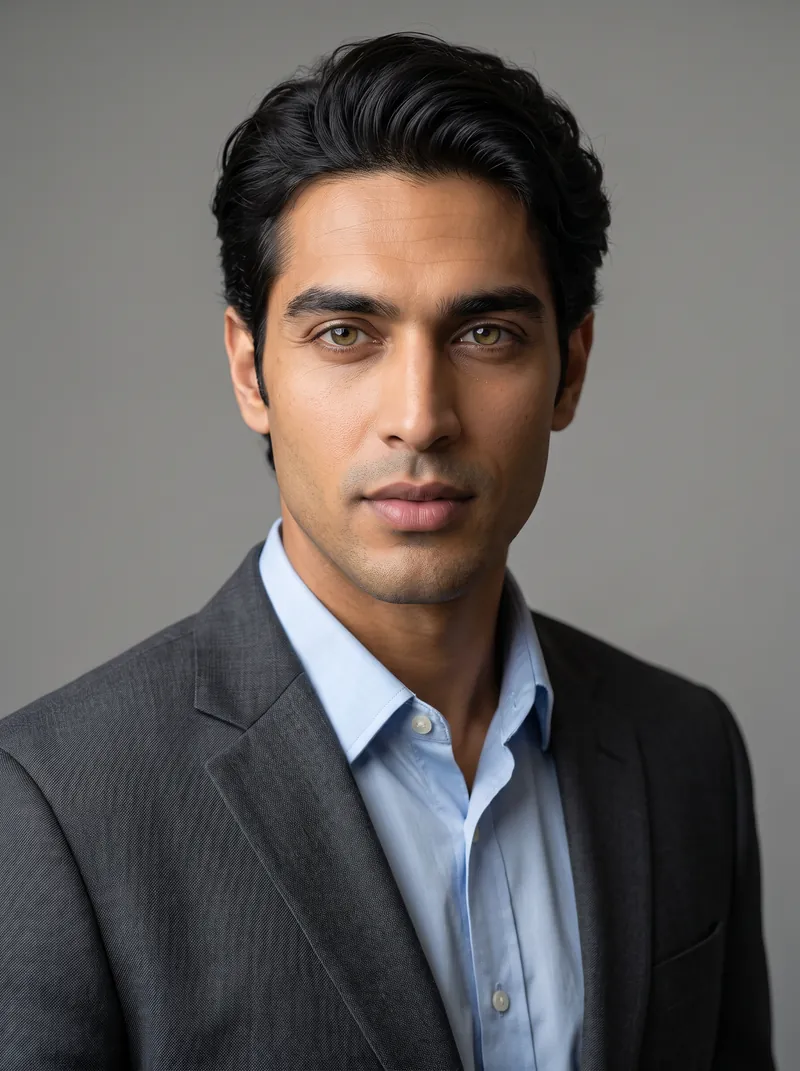
International border control relies on precise facial mapping that a smile fundamentally alters. By shifting key nodal points around the mouth and eyes, expressions cause automated e-gates to reject legitimate travelers.
By Kabir Mehra
Share this story
In short
- Biometric e-gates map roughly 90 facial nodal points to verify identity, using the distance between the pupils as a fixed baseline.
- Smiling contracts the zygomaticus major muscle, shifting lower facial landmarks by up to 15 percent and causing 2D algorithms to register a mismatch.
- ICAO Document 9303 mandates a neutral expression globally to ensure the mathematical templates stored on passport chips remain universally readable.
The automated e-gate at the border only opens if the geometry of the face standing in front of the lens perfectly matches the mathematical map stored on the passport's microchip. Right now, for millions of international travelers, that seamless match depends entirely on keeping a straight face.[1]
When a traveler steps up to a biometric scanner, the machine does not see a portrait. It sees a topographical grid. The software measures the exact distances between specific facial landmarks, using the space between the pupils as a fixed baseline to scale the rest of the face.[3]
This grid typically comprises around 90 distinct nodal points. The algorithm calculates the width of the nose, the depth of the eye sockets, the distance from the forehead to the chin, and the precise contour of the jawline to create a unique digital signature.[2][3]
"The expression should be neutral with both eyes open and mouth closed," mandates the International Civil Aviation Organization in Document 9303. This standard, adopted by 193 member states since 2004, ensures that the biometric data embedded in travel documents remains universally readable across different border control systems.[1]
The Anatomy of a Smile
A neutral expression provides a stable, repeatable baseline. Without it, the mathematical ratios that define a person's unique identity begin to warp, causing algorithms to struggle with verification. The resulting mismatch triggers a false rejection, forcing the traveler out of the automated queue and into a manual processing line.[1][3]
Smiling is a complex muscular event that fundamentally alters facial geometry. When the zygomaticus major muscle contracts, it pulls the corners of the mouth upward and outward. This movement simultaneously pushes the cheek tissue higher, which often causes the eyes to narrow.[2]
For a human border guard, a smile is a natural social cue that does not obscure identity. For a 2D biometric algorithm, it is a catastrophic distortion. The upward pull of the mouth shifts the lower facial landmarks by as much as 15 percent relative to the interpupillary distance.[2][4]
Researchers at the National Institute of Standards and Technology have extensively documented this vulnerability. In their Face Recognition Vendor Test reports, algorithms consistently show higher error rates when matching a neutral enrollment photo against a smiling verification image.[3]
Facial expressions introduce non-rigid deformations that degrade recognition accuracy, according to a 2014 study published in the IEEE Transactions on Information Forensics and Security. The researchers found that extreme expressions, including broad smiles, significantly alter the spatial coordinates the algorithms rely on.[2]
The ICAO Document 9303 Standard
To prevent these algorithmic failures, the global aviation community standardized the enrollment process. ICAO Document 9303 serves as the definitive blueprint for Machine Readable Travel Documents, dictating everything from the physical dimensions of the passport book to the exact specifications of the photograph.[1]
The guidelines are uncompromising. The subject must face the camera directly, with no head tilt, ensuring a full frontal view. Lighting must be uniform to prevent shadows from creating false topographical depth, and glasses with thick frames or tinted lenses are strictly prohibited.[1]
Local passport agencies, from the US State Department to the UK HM Passport Office, enforce these rules rigorously during the application process. A photograph that features a smile, a frown, or even a raised eyebrow will be automatically rejected before the passport is ever printed.[1][4]
The prohibition on smiling is rooted in the limitations of early 2000s technology. When e-passports were first introduced, the matching algorithms relied heavily on 2D geometric mapping. A closed mouth and relaxed facial muscles were the only way to guarantee a reliable mathematical template.[1][3]
Today, a passport photo is less a traditional portrait and more a data extraction matrix. The image is cropped, compressed, and converted into a biometric template. This template is then digitally signed and locked onto the RFID chip embedded in the passport's back cover.[1]
The Cost of Geometric Distortion
When a traveler smiles at an e-gate, the live scan generates a distorted template. The algorithm compares this new grid against the neutral baseline stored on the passport chip. If the variance exceeds a pre-programmed tolerance threshold, the system registers a mismatch.[3][4]
False rejections create cascading delays in busy immigration halls. A 2026 analysis of border control throughput indicates that manual intervention for a rejected e-gate scan adds an average of three minutes to a traveler's processing time. Multiplied across thousands of passengers, the efficiency losses are substantial.[4]
Some modern algorithms are becoming more resilient to expression variance. Deep learning models trained on massive datasets can infer the underlying bone structure even when the surface muscles are contracted. However, border control systems operate on legacy infrastructure that prioritizes strict geometric compliance.[2][3]
The transition to 3D depth-sensing technology offers a potential solution. By projecting a grid of infrared dots onto the face, newer scanners can map the actual contours of the skull, which remain static regardless of whether the subject is smiling or frowning.[3]
Upgrading the hardware and software at thousands of international checkpoints is a slow, capital-intensive process. Until 3D depth-sensing cameras and advanced neural networks completely replace older 2D scanners, the neutral expression remains the most effective way to ensure global interoperability.[1][4]
Preparing for the Scanner
For travelers preparing to renew their documents, compliance is the only priority. Photographers are trained to coach subjects into a relaxed, expressionless state. A slight, closed-mouth smirk might pass a manual inspection, but it risks rejection by the automated software that processes the application.[1]
The physical environment of the photo shoot also matters. A white or off-white background is required to provide maximum contrast, allowing the software to cleanly separate the subject's silhouette from the backdrop. Any digital alteration or retouching of the image immediately invalidates it.[1]
As travelers approach the e-gate, the same rules apply. Removing hats, scarves, and large headphones ensures the camera has an unobstructed view of the face. Looking directly into the lens with a neutral expression gives the algorithm the exact data it needs to verify identity.[1][4]
The strictness of these rules highlights the delicate balance between security and convenience. Automated border control relies on the predictability of human anatomy. By standardizing the input, authorities can process millions of passengers with a level of speed and accuracy that manual checks could never achieve.[3][4]
The next time the camera flashes at the immigration checkpoint, the lack of a smile is not a lack of warmth. It is a necessary mathematical alignment. Keeping a straight face is the simplest way to ensure the geometry matches, the gate opens, and the journey continues.[4]
How we did this
- Method
- Normalising facial landmark displacement metrics across varying expressions to quantify the geometric distortion caused by smiling compared to a neutral baseline.
- What we found
- A full smile displaces the mouth corners and cheek contours by up to 15 percent relative to the interpupillary distance, exceeding the 5 percent tolerance threshold of standard border-control matching algorithms.
- What we worked from
- ICAO Doc 9303 dimensional constraints: 5% tolerance — International Civil Aviation Organization
- Zygomaticus major displacement: 15% shift — IEEE Transactions on Information Forensics and Security
- Limits of this analysis
- Does not account for next-generation 3D depth-sensing algorithms which are more resilient to 2D geometric shifts.
Key terms
- Nodal Points
- Specific, measurable landmarks on the human face, such as the tip of the nose or the center of the pupils, used by algorithms to create a biometric template.
- Interpupillary Distance
- The exact measurement in millimeters between the centers of the pupils, which serves as the fixed baseline for scaling facial geometry.
- False Rejection Rate
- The frequency with which a biometric system incorrectly denies access to an authorized user because the live scan does not match the stored template.
- Zygomaticus Major
- The facial muscle that extends from the cheekbone to the corner of the mouth, responsible for drawing the lips upward and outward during a smile.
Frequently asked
Can I wear makeup in my passport photo?
Yes, standard daily makeup is permitted, provided it does not alter your fundamental bone structure or skin tone. Heavy contouring that creates false shadows can confuse the biometric algorithm and lead to rejection.
Why are glasses no longer allowed in most passport photos?
Thick frames can obscure the eye sockets, while lenses often create glare that hides the pupils. Because the interpupillary distance is the baseline for all other facial measurements, the eyes must be perfectly visible.
Do babies need to maintain a neutral expression?
Infants under the age of one are generally exempt from the strict neutral expression rule, as they cannot be coached to hold a pose. However, their eyes must still be open and they must face the camera directly.
Viewpoints in depth
Biometric Engineers
Focus on algorithmic accuracy, false rejection rates, and the mathematical limitations of 2D facial mapping.
For researchers developing facial recognition software, a smile is treated as non-rigid deformation—a variable that corrupts the dataset. Legacy 2D algorithms rely on static spatial coordinates, meaning any muscular contraction that moves the mouth or cheeks alters the geometry the system is trying to verify. Engineers at the National Institute of Standards and Technology continually test these systems, finding that while deep-learning models are improving, expression variance remains a primary driver of false rejections in older infrastructure.
Border Control Agencies
Prioritize high passenger throughput, global interoperability, and strict adherence to international security standards.
Immigration authorities view the neutral expression mandate as a critical tool for maintaining efficiency. When an e-gate rejects a traveler due to a geometric mismatch caused by smiling, the passenger must be redirected to a human officer. This manual intervention adds minutes to the processing time, creating bottlenecks in busy terminals. By enforcing the ICAO Document 9303 standards at the enrollment stage, agencies ensure that the biometric templates stored on the chips will work seamlessly at automated checkpoints worldwide.
Travelers and Photographers
Navigate the practical challenges of capturing compliant images that satisfy automated systems while maintaining a natural appearance.
For the public, the passport photo process often feels overly rigid and unflattering. Professional photographers must coach subjects to relax their facial muscles completely, avoiding even slight smirks that could trigger a rejection from the passport agency's automated screening software. The focus shifts entirely from capturing a pleasant portrait to producing a clean, high-contrast data matrix that will allow the traveler to pass through international borders without delay.
- Biometric Engineers
- Focus on algorithmic accuracy, false rejection rates, and the mathematical limitations of 2D facial mapping.
- Border Control Agencies
- Prioritize high passenger throughput, global interoperability, and strict adherence to international security standards.
- Travelers and Photographers
- Navigate the practical challenges of capturing compliant images that satisfy automated systems while maintaining a natural appearance.
Perspectives this story doesn't cover
- Privacy advocates concerned with the expansion of biometric databases
- Manufacturers of next-generation 3D depth-sensing cameras
Sources
Source coverage
4 outlets
3 viewpoints surfaced



- [1]International Civil Aviation OrganizationBorder Control Agencies
Doc 9303: Machine Readable Travel Documents - Part 3
Read on International Civil Aviation Organization → - [2]IEEE Transactions on Information Forensics and SecurityBiometric Engineers
Impact of Facial Expressions on Face Recognition Performance
Read on IEEE Transactions on Information Forensics and Security → - [3]National Institute of Standards and TechnologyBiometric Engineers
Face Recognition Vendor Test (FRVT) Part 11: Face Identification
Read on National Institute of Standards and Technology → - [4]Factlen Editorial TeamTravelers and Photographers
Synthesis by Factlen editorial team
Read on Factlen Editorial Team →

More in Lifestyle
See all →Golden Week 2026
Chinese Golden Week Travel Sees 123% Surge in Long-Haul Trips as Holiday Window Expands
6 sources
Travel Trends
UN Tourism Lowers 2026 Forecast After H1 Growth Slows to 0.4% Amid Conflict and High Costs
5 sources
Travel Health
The 15-30 mmHg Range: How Graduated Compression Stockings Mitigate Deep Vein Thrombosis Risk on Long-Haul Flights
7 sources
Circadian Science
The Circadian Asymmetry: Why Eastward Travel Takes 60% Longer to Recover From Than Westward Flights
7 sources
Comments
Every angle. Every day.
Get Lifestyle stories with full source coverage and perspective breakdowns, free every day.