
New Study Finds Antarctic Ice Sheet Hit Ancient Tipping Point, Making It Hyper-Sensitive to CO2
Researchers have discovered that Antarctica's ice sheet underwent a dramatic, non-linear shift one million years ago, becoming highly reactive to small changes in carbon dioxide. The findings suggest the continent's ice may respond to modern warming with sudden, rapid melting rather than gradual decline.
By Harper Lane

Share this story
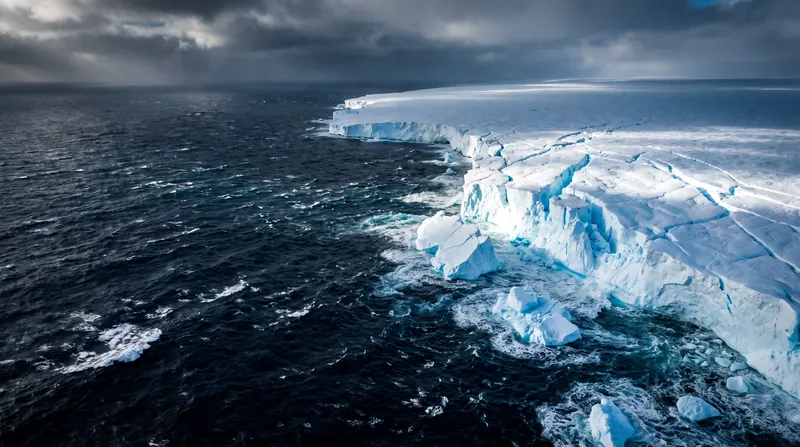
For decades, the prevailing assumption in many climate models has been that the world's largest ice sheets will melt at a relatively gradual, predictable pace as global temperatures rise. However, a landmark study has fundamentally challenged this linear view of planetary physics. According to new research, the Antarctic ice sheet is capable of sudden, violent shifts in behavior once specific atmospheric thresholds are crossed.[1][2]
The study, published in the journal Nature Geoscience, reveals that Antarctica underwent a dramatic "regime shift" approximately one million years ago. Led by researchers at the IBS Center for Climate Physics (ICCP) at Pusan National University in South Korea, the findings provide the most detailed look yet at how massive glacial systems react to long-term climate forcing. The core discovery is that ice sheets do not simply scale their mass in a 1-to-1 ratio with temperature; instead, they harbor hidden tipping points.[1][2]
The research focused on a pivotal era in Earth's history known as the Mid-Pleistocene Transition. During this period, the planet's natural ice age cycles underwent a mysterious transformation, becoming significantly longer, colder, and more intense. While scientists have known about this transition for years, the exact mechanics of how the Antarctic ice sheet responded to the shifting climate remained a major blind spot in paleoclimatology.[2]
To solve the mystery, the ICCP team utilized an advanced paleoclimate simulation that reconstructed global temperature and precipitation patterns over the past three million years. This massive dataset was then fed into a highly sophisticated ice-sheet model originally developed at Pennsylvania State University. The combined simulations were processed on one of South Korea's fastest supercomputers dedicated entirely to basic science and climate research.[2][3]
The computational results revealed a stark and previously hidden threshold. The researchers identified a critical atmospheric carbon dioxide (CO2) boundary of approximately 240 parts per million (ppm). Before the Mid-Pleistocene Transition, the ice sheet's response to environmental changes was relatively muted. But once CO2 levels dropped below that 240 ppm mark, the system's behavior fundamentally changed.[1]
"After this transition, the Antarctic ice sheet reacts much more strongly to changes in climate forcing," explained lead author Yun Kyung-Sook in the study's accompanying release. The data indicates that once the CO2 threshold was breached, the ice volume began responding dramatically to even minor fluctuations in atmospheric and ocean temperatures. Small environmental nudges suddenly resulted in massive glacial expansions.[2]
The mechanics behind this hyper-sensitivity involve a complex interplay of oceanography and bedrock geology. The simulations showed that as the climate cooled and CO2 dropped, ocean temperatures plummeted, which significantly reduced the melting of ice shelves from below. Simultaneously, as global sea levels fell, the hydrostatic pressure on the bedrock beneath the coastal ice was relieved, allowing the ice sheet to thicken and advance rapidly.
This interconnected feedback loop is what scientists refer to as a "non-linear response." In a linear system, a 10 percent change in input yields a 10 percent change in output. In a non-linear system, a 10 percent change in input might yield a 2 percent change—until a tipping point is reached, at which point the same 10 percent input could trigger a massive, disproportionate change. The Mid-Pleistocene Transition proves that Antarctica operates on the latter set of rules.[1]
The implications of this ancient regime shift for modern climate policy are profound. If the Antarctic ice sheet was capable of a hyper-sensitive, non-linear reaction to cooling, the fundamental physics suggest it is equally capable of a non-linear reaction to rapid warming. This shatters the comfort of gradual sea-level rise projections, introducing the very real possibility of abrupt, catastrophic ice loss.
Current atmospheric CO2 levels are climbing at unprecedented rates, recently surpassing 420 ppm—a concentration not seen in millions of years, and vastly higher than the 240 ppm threshold that triggered the ancient sensitivity shift. Because modern anthropogenic warming is pushing the climate system so far outside its historical baseline, researchers warn that the ice sheet is being forced toward a new, modern tipping point.
"Our findings suggest that the Antarctic ice sheet was more sensitive to external forcings than previously assumed," noted Axel Timmermann, a co-author of the study. This heightened sensitivity means that the buffer protecting coastal cities from catastrophic sea-level rise may be thinner than previously calculated. If a modern threshold is crossed, the resulting ice discharge could accelerate rapidly, outpacing current infrastructure adaptation plans.
Despite the clarity of the supercomputer simulations, the researchers maintain transparent uncertainty regarding the exact location of the modern tipping point. The paleoclimate models perfectly reconstruct the physics of the past, but they cannot pinpoint the precise CO2 concentration or temperature anomaly that will trigger an irreversible collapse of the West Antarctic Ice Sheet today.[1][2]
This uncertainty is compounded by the speed of modern emissions. The Mid-Pleistocene Transition played out over tens of thousands of years, allowing the ice sheet to adjust to gradual orbital and atmospheric shifts. Today, human activity has spiked CO2 levels in barely two centuries. The ice sheet is currently experiencing a "shock" rather than a gradual transition, making its near-term behavior incredibly difficult to model with absolute certainty.[1]
Furthermore, paleoclimate proxies—the chemical signatures in ancient ice cores and ocean sediments used to reconstruct past CO2 levels—carry inherent margins of error. While the 240 ppm threshold is robust within the simulation, translating that exact numerical boundary to the modern, rapidly warming ocean involves complex variables, including the changing topography of the Antarctic bedrock and the shifting currents of the Southern Ocean.[1][3]
What is no longer uncertain, however, is the fundamental nature of the ice sheet itself. The evidence pack assembled by the ICCP team confirms that Antarctica is a highly reactive system. It is not a static block of ice that will slowly melt away over millennia; it is a dynamic, interconnected engine that can shift gears violently when pushed too far.[2]
For global policymakers, this research serves as a stark warning against complacency. The assumption that we have centuries to prepare for a gradual, linear rise in sea levels is directly contradicted by the geological record. By proving that Antarctica has crossed catastrophic tipping points in the past, this study demands that we take the threat of sudden, non-linear climate shifts seriously in the present.[1]
Key points
- A new study reveals the Antarctic ice sheet crossed a critical tipping point one million years ago.
- During the Mid-Pleistocene Transition, atmospheric CO2 dropping below 240 ppm triggered a hyper-sensitive state.
- The findings prove that the ice sheet is capable of sudden, non-linear responses to climate forcing.
- Researchers warn that modern CO2 levels, now exceeding 400 ppm, could trigger a similarly abrupt reaction.
What we don’t know
- The exact atmospheric CO2 concentration that would trigger a modern, irreversible collapse of the West Antarctic Ice Sheet.
- How the unprecedented speed of modern anthropogenic warming will alter the ice sheet's response compared to the gradual shifts of the Mid-Pleistocene Transition.
- The precise timeline over which a non-linear rapid melt would unfold once a modern tipping point is crossed.
How we got here
3 Million Years Ago
The starting point of the paleoclimate simulations used to reconstruct Earth's ancient climate patterns.
1.2 Million Years Ago
The onset of the Mid-Pleistocene Transition, a period where Earth's ice age cycles began to lengthen and intensify.
1 Million Years Ago
Atmospheric CO2 dropped below 240 ppm, triggering a non-linear regime shift in the Antarctic ice sheet.
May 2026
Researchers publish findings in Nature Geoscience detailing the ancient tipping point and its modern implications.
- Paleoclimate Researchers
- Focus on using ancient geological records to understand the fundamental physics of ice sheet behavior.
- Climate Risk Analysts
- Focus on the implications of non-linear sea-level rise for modern coastal infrastructure and policy.
- Ice-Sheet Modelers
- Focus on the computational mechanics and uncertainties of simulating massive glacial systems.
Perspectives this story doesn't cover
- Indigenous Coastal Communities
- Global South Policymakers
Sources
Source coverage
3 outlets
3 viewpoints surfaced



- [1]Nature GeosciencePaleoclimate Researchers
Increased sensitivity of the Antarctic Ice Sheet to decreasing CO2 across the Mid-Pleistocene Transition
Read on Nature Geoscience → - [2]Institute for Basic SciencePaleoclimate Researchers
Antarctica's Ice Crossed a Critical Threshold One Million Years Ago
- [3]Pennsylvania State UniversityIce-Sheet Modelers
Advanced ice-sheet model helps uncover ancient Antarctic climate shift
Read on Pennsylvania State University →
More in Science
See all →Marine Chemistry
The pH 8.2 to 8.1 Drop: How Anthropogenic CO2 Reduces Carbonate Ions and Threatens Calcifying Organisms
7 sources

Climate Forcing
The -0.7 W/m² Radiative Forcing: Why Aerosols Currently Mask a Quarter of Greenhouse Gas Warming
7 sources

Energy Balance
Quantifying Earth's Energy Imbalance: The Radiative Forcing Metric That Defines Climate Models
4 sources
Ocean Chemistry
The Core Chemistry of Ocean Acidification: How Rising CO2 Lowers pH and Impacts Marine Life
11 sources
Comments
Every angle. Every day.
Get Science stories with full source coverage and perspective breakdowns, free every day.