
Molecular Charge, Not Suds, Dictates Laundry Detergent and Fabric Softener Performance
The cleaning power of household detergents relies entirely on the electrical charge of their surfactant molecules. Understanding the difference between anionic, nonionic, and cationic formulas explains why mixing certain products neutralizes their effectiveness and leaves residue on clothes.

Share this story
In short
- The cleaning power of a detergent is determined by the electrical charge of its surfactant molecules, not the amount of foam it produces.
- Anionic (negative) surfactants lift dirt but react poorly with hard water, while nonionic (neutral) surfactants cut grease and resist mineral interference.
- Cationic (positive) surfactants are used in fabric softeners to coat fibers and reduce static cling.
Detergent brands routinely market high-sudsing formulas as the ultimate visual proof of cleaning power, encouraging buyers to judge a wash cycle by the volume of foam it produces in the drum. But chemical engineers and appliance manufacturers point to a different reality: foam is merely a byproduct of negatively charged molecules, and in modern high-efficiency machines, excessive suds actually cushion fabrics and prevent the mechanical agitation required to remove dirt.[7]
The engine of any cleaning product is the surfactant—a portmanteau of surface-active agent. According to a foundational text from the Universidad de Los Andes, these molecules are defined by their ability to "adsorb at interfaces," featuring a hydrophilic (water-loving) head and a lipophilic (oil-loving) tail. This dual nature allows them to surround oil and grease, lift them from fabric fibers, and suspend them in the wash water so they can be rinsed away.[3]
The specific behavior of a surfactant is dictated by the electrical charge of its hydrophilic head. Anionic surfactants carry a negative charge. A 2008 review published by Elsevier notes that these are the most widely used class in detergent formulations because they excel at lifting particulate soils from natural fabrics like cotton. They are also responsible for the heavy lather consumers historically associate with being clean.[1]
However, that negative charge comes with a significant vulnerability for the average homeowner: hard water. The negatively charged heads of anionic surfactants readily bind with positively charged calcium and magnesium ions present in hard water. When this reaction occurs, the surfactant is neutralized, forming an insoluble soap scum rather than cleaning the clothes. In homes with water hardness exceeding 7 to 10 grains per gallon, buyers often find themselves using double the recommended detergent just to overcome this mineral interference.[1][7]
To solve the hard water problem, formulators turn to nonionic surfactants, which carry no electrical charge. Because they are neutral, they do not react with calcium or magnesium, making them highly effective in hard water conditions. A 2020 optimization study published in the National Center for Biotechnology Information analyzed a "binary mixture of anionic-nonionic surfactants," demonstrating that combining the two classes provides the heavy-duty soil lifting of anionics with the hard-water resilience of nonionics.[6]
Nonionic surfactants are also exceptionally good at removing oily and greasy stains, particularly from synthetic fabrics like polyester. Furthermore, they produce very little foam. This low-sudsing profile is exactly what modern high-efficiency washing machines require, as these appliances use significantly less water—often just 13 to 15 gallons per load compared to the 40 to 45 gallons used by older top-loading models.[6][7]
The third major category, cationic surfactants, carry a positive charge. While anionics and nonionics are built to remove substances from fabric, cationics are designed to leave something behind. Because wet fabrics naturally carry a slight negative charge, the positively charged cationic molecules are strongly attracted to the fibers. They coat the textile, lubricating the surface to reduce static cling and create a softer feel.[2]
This chemical reality explains the fundamental conflict in the laundry aisle: you cannot mix anionic detergents and cationic fabric softeners in the same water. If a buyer pours both liquids into the drum simultaneously, the negatively charged detergent and the positively charged softener will immediately attract one another. They bind together to form an insoluble precipitate, neutralizing both the cleaning power of the detergent and the softening capability of the quat.[1][2][7]
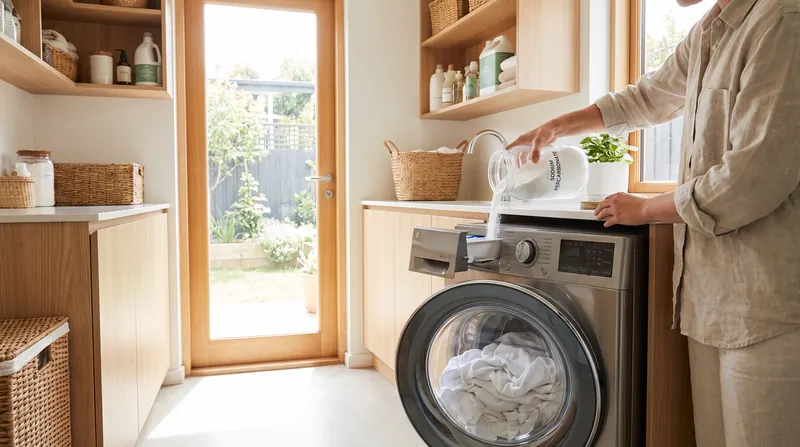
Appliance manufacturers solve this molecular clash through mechanical timing. The washing machine's dispenser drawer is designed to release the anionic and nonionic detergent during the initial wash cycle, flush the drum with clean water, and only then release the cationic fabric softener during the final rinse. This ensures the opposing charges never meet in high concentrations.[7]
For single-dose laundry pods that claim to clean and soften simultaneously, chemical engineers have to rely on physical barriers. A 2010 patent filed by Procter & Gamble details a "water-soluble film having improved dissolution and stress properties." By compartmentalizing the incompatible chemistries in separate polyvinyl alcohol chambers that dissolve at different rates, manufacturers can delay the release of the cationic agents until the anionic surfactants have already done their work.[5]
The specific type of cationic surfactant used in homes is also undergoing a massive shift. Historically, fabric softeners relied on traditional quaternary ammonium compounds, which are highly stable but persist in the environment. According to a review in the Journal of Oleo Science, the industry has largely transitioned to ester quats. These molecules were introduced as a "novel class of cationic fabric softeners" because they contain weak ester bonds that allow them to rapidly biodegrade in wastewater treatment plants.[2]
Formulators are also pushing the boundaries of neutral molecules. A 2022 study in the NCBI explored the "HLDN approach with extended surfactant structure," showing that adding intermediate polarity groups can increase oil solubilization by up to 30 percent without adding charge. For the renter or homeowner staring at a wall of laundry products, the chemistry dictates the purchase.
Formulators are also pushing the boundaries of neutral molecules.
If the home has hard water, a formula heavy in nonionic surfactants will perform better than a purely anionic one. The next verifiable checkpoint for this chemistry will be the Environmental Protection Agency's upcoming 2027 review of surfactant biodegradability standards, which may force formulators to develop entirely new molecular structures for the laundry aisle.[4][7]
Jargon, explained
- Surfactant
- A surface-active agent that lowers the surface tension of water, allowing it to mix with oil and grease to lift dirt from fabrics.
- Anionic Surfactant
- A cleaning molecule with a negatively charged head that excels at lifting particulate dirt but creates high amounts of foam and reacts poorly with hard water.
- Nonionic Surfactant
- A cleaning molecule with no electrical charge that is highly effective at removing grease, produces low foam, and remains stable in hard water.
- Cationic Surfactant
- A positively charged molecule used primarily in fabric softeners to coat textile fibers, reducing static cling and improving feel.
Common questions
Can I mix laundry detergent and fabric softener in the same dispenser?
No. Most detergents use negatively charged anionic surfactants, while softeners use positively charged cationic surfactants. Mixing them causes the molecules to bind together, neutralizing both products and leaving a sticky residue on clothes.
Why does my detergent not foam as much as it used to?
Modern detergents are formulated with more nonionic (neutral) surfactants, which clean effectively without producing excess suds. This is necessary for high-efficiency washing machines, which use less water and rely on clothes tumbling against each other to remove dirt.
What is the best detergent for hard water?
Formulas that are heavy in nonionic surfactants perform best in hard water. Because they carry no electrical charge, they do not react with the calcium and magnesium minerals that typically neutralize standard anionic detergents.
Competing readings
Chemical Formulators
Focus on balancing surfactant blends to achieve maximum soil removal across varying water temperatures and hardness levels.
For chemical engineers designing detergents, the goal is to create a universally effective product despite vastly different household conditions. Because they cannot control whether a consumer has hard well water or soft municipal water, formulators increasingly rely on binary mixtures of anionic and nonionic surfactants. This ensures the product still foams enough to satisfy consumer expectations (via anionics) while maintaining actual cleaning power in mineral-heavy water (via nonionics).
Appliance Engineers
Prioritize low-sudsing formulas and mechanical separation of incompatible chemicals to protect machine sensors.
Washing machine manufacturers view surfactants primarily as a mechanical variable. High-efficiency machines rely on the physical tumbling of clothes against one another to dislodge dirt. If a detergent produces too much foam, it creates a cushion that prevents this necessary friction. Furthermore, appliance engineers must design complex, timed dispenser drawers specifically to keep anionic detergents and cationic softeners separated until the final rinse, preventing the formation of insoluble precipitates that can clog machine pumps.
Environmental Regulators
Advocate for the transition away from persistent quaternary ammonium compounds toward rapidly biodegradable alternatives.
Environmental scientists and regulators focus on what happens after the wash cycle ends. Traditional cationic surfactants, while excellent at softening clothes, are highly toxic to aquatic life and break down very slowly in the environment. This has driven the regulatory push toward ester quats, which contain intentional weak points in their molecular structure that allow them to be rapidly dismantled by bacteria in wastewater treatment plants before they reach open waterways.
- Chemical Formulators
- Focus on balancing surfactant blends to achieve maximum soil removal across varying water temperatures and hardness levels.
- Appliance Engineers
- Prioritize low-sudsing formulas and mechanical separation of incompatible chemicals to protect machine sensors and ensure proper agitation.
- Environmental Scientists
- Advocate for the transition away from persistent quaternary ammonium compounds toward rapidly biodegradable ester quats.
Perspectives this story doesn't cover
- Textile Manufacturers
- Wastewater Treatment Operators
Sources
Source coverage
7 outlets
3 viewpoints surfaced






- [1]ElsevierChemical Formulators
Development of Surfactants and Builders in Detergent Formulations
Read on Elsevier → - [2]J-StageEnvironmental Scientists
Ester Quats: The Novel Class of Cationic Fabric Softeners
Read on J-Stage → - [3]Universidad de Los AndesEnvironmental Scientists
SURFACTANTS Types and Uses
Read on Universidad de Los Andes → - [4]PMCChemical Formulators
Formulation Improvements in the Applications of Surfactant–Oil–Water Systems Using the HLDN Approach with Extended Surfactant Structure
Read on PMC → - [5]Google PatentsAppliance Engineers
Water-soluble film having improved dissolution and stress properties, and packets made therefrom
Read on Google Patents → - [6]PMCChemical Formulators
Design and performance optimisation of detergent product containing binary mixture of anionic-nonionic surfactants
Read on PMC → - [7]Factlen Editorial Team
Synthesis by Factlen editorial team
Read on Factlen Editorial Team →
More in Home
See all →Appliance Science
The Air Watt Measurement: How the Combination of Airflow and Suction Actually Dictates a Vacuum Cleaner's Deep-Cleaning Power
2 sources
Indoor Air Quality
The Chemistry of Clean: How Pine and Citrus Scents Actually Generate Indoor Air Pollution
3 sources
Cleaning Chemistry
The 0-to-14 Scale: How pH Actually Dictates Whether a Cleaner Dissolves Mineral Deposits or Breaks Down Grease
4 sources
Fabric Chemistry
Oxygen vs. Chlorine: How Different Bleaches Actually Break Down Stains Without Destroying Fabric
5 sources
Comments
Every angle. Every day.
Get Home stories with full source coverage and perspective breakdowns, free every day.