
Loudest Gravitational Wave Ever Detected Reveals the Edge of a Black Hole
An exceptionally clear gravitational wave signal has allowed physicists to isolate the 'direct wave' from a newly formed black hole, confirming Stephen Hawking's area theorem and providing the most stringent test yet of Einstein's general relativity.
By Sofia Matos

Share this story
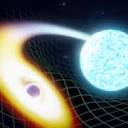
On January 14, 2025, the fabric of spacetime rippled with unprecedented violence, delivering a signal that has now unlocked the immediate vicinity of a black hole's event horizon. The Laser Interferometer Gravitational-Wave Observatory (LIGO) and its international partners captured GW250114, a signal generated by the collision of two massive black holes.
Today, a landmark paper published in the journal Nature details how researchers used this exceptionally clear signal to isolate the "direct wave"—the very first gravitational radiation emitted by the newly formed black hole as it settled into its final shape.[1][2]
The discovery marks a turning point in observational astrophysics. For decades, the event horizon has been a theoretical boundary, a point of no return that conventional telescopes cannot pierce. Gravitational waves provide a different messenger, generated by the movement of spacetime itself. By isolating the direct wave, scientists now have empirical signatures directly tied to the post-merger horizon, allowing them to probe the extreme physics of surface gravity in ways that were previously impossible.[1][3]
The primary claim anchoring this breakthrough is that GW250114 is the clearest gravitational wave ever recorded, a fact supported by robust detector data from facilities in Washington and Louisiana. According to the LIGO-Virgo-KAGRA collaboration, the signal-to-noise ratio (SNR) reached approximately 80. To put that in perspective, the historic first detection in 2015 had an SNR of 24, and the previous record holder stood at 42.[2]
Researchers described the leap in clarity as a "whisper becoming a shout." This high fidelity is crucial because gravitational waves are incredibly faint by the time they reach Earth, typically altering the length of LIGO's laser arms by a fraction of the width of a proton. The sheer loudness of GW250114 provided the resolution needed to test physics that were previously buried in background noise.
The progenitor black holes weighed in at roughly 34 and 32 times the mass of our Sun. When they collided, they formed a single, highly deformed daughter black hole that violently vibrated—or "rang"—as it stabilized. The clarity of this ringdown phase allowed physicists to validate a second major claim: the empirical confirmation of Stephen Hawking's 1971 Area Theorem.[3]
Hawking postulated that the total surface area of a black hole's event horizon can never decrease over time, even during a violent collision. While previous detections hinted at this, the data from GW250114 provides the strongest evidence yet that Hawking's mathematics hold true in reality. The high signal-to-noise ratio severely shrank the margin of error that plagued earlier, fainter measurements.
Before the merger, the two original black holes had a combined surface area of roughly 93,000 square miles—a footprint comparable to the size of the United Kingdom. Following the merger, the resulting daughter black hole expanded to a surface area of 154,000 square miles, roughly the size of Sweden. The area grew exactly as the theorem demanded, confirming that the universe strictly enforces this thermodynamic law of black holes.
Beyond the area theorem, the Nature study led by Neil Lu and colleagues introduces a novel analytical technique to parse the chaotic ringdown phase. The ringdown is the period where the new black hole sheds its deformities by emitting gravitational waves. The researchers successfully extracted the weak initial component of this phase, known as the direct wave, separating it from the "late-time tails" that echo through the curved spacetime.[1][3]
Isolating this direct wave provides a new observational channel to measure "frame-dragging," a bizarre phenomenon predicted by general relativity. In a Kerr black hole—one that is spinning—the intense gravity literally drags the fabric of spacetime around with it, forcing everything in its vicinity to rotate. No object or reference frame can remain stationary relative to a distant observer when caught in this ergosphere.[1][3]
By analyzing the direct wave, astrophysicists can now measure the strength of this frame-dragging effect and the surface gravity at the horizon directly from the gravitational radiation. This represents a massive leap forward; researchers are no longer relying solely on theoretical models or indirect electromagnetic observations of accretion disks, but are reading the properties of the horizon directly from the ripples it creates.[1][3]
This level of detail enables a technique called "black hole spectroscopy," which serves as the most stringent test of Albert Einstein's general relativity to date. Just as a struck bell emits a fundamental pitch and several overtones, a ringing black hole emits gravitational waves at specific frequencies and damping rates.
If you measure just one tone, you can calculate the black hole's mass and spin. But if you measure multiple tones independently, you can test whether they all align with the strict rules of Einstein's equations. Because GW250114 was so exceptionally loud, the collaboration clearly measured two distinct tones and constrained a third.
All measurements agreed perfectly with Einstein's predictions. The evidence here is overwhelmingly strong: at the current limits of human instrumentation, in the most extreme gravitational environments in the universe, general relativity remains undefeated. The clarity of the signal leaves virtually no room for alternative theories of gravity at this level of precision.[2]
Despite this perfect match, transparent uncertainty remains regarding the ultimate nature of gravity. Physicists know that general relativity is fundamentally incomplete because it cannot be reconciled with quantum mechanics. The mathematics of relativity still break down at the singularity inside the black hole, and the theory fails to explain dark matter or dark energy.
Quantum gravity theorists view the GW250114 results not as the end of the story, but as a highly precise baseline. The hope within the physics community is that future, even louder signals might finally reveal subtle deviations from Einstein's predictions—the "edges" where relativity finally breaks down and quantum effects take over.[3]
Until that day comes, however, GW250114 stands as a monumental triumph of observational science. It proves that humanity's gravitational wave observatories have matured from merely hearing collisions in the dark to mapping the precise contours of the cosmic abyss, setting the stage for the next decade of precision astrophysics.[2]
Key points
- The LIGO-Virgo-KAGRA collaboration detected GW250114, the clearest gravitational wave signal ever recorded, with an SNR of 80.
- The collision of two massive black holes provided the strongest empirical confirmation of Stephen Hawking's 1971 Area Theorem.
- A new study in Nature successfully isolated the 'direct wave' emitted by the newly formed black hole.
- This isolation allows scientists to directly measure frame-dragging and surface gravity at the event horizon.
Open questions
- Where exactly general relativity breaks down and quantum mechanics takes over in extreme gravitational environments.
- Whether future, even louder gravitational wave signals will reveal subtle deviations from Einstein's predictions.
- How the internal singularity of the newly formed black hole behaves, as the event horizon still obscures it from observation.
Timeline
September 2015
LIGO detects the first gravitational wave (GW150914), proving Einstein's century-old prediction.
January 14, 2025
LIGO and Virgo observatories detect GW250114, the loudest gravitational wave signal ever recorded.
September 2025
Initial papers confirm the signal's unprecedented clarity and validate Hawking's Area Theorem.
June 24, 2026
Researchers publish a breakthrough in Nature, isolating the 'direct wave' to probe the black hole's event horizon.
- Observational Astrophysicists
- Focused on the new analytical tools that allow direct measurement of the event horizon.
- General Relativity Traditionalists
- Focused on the enduring accuracy of Einstein's and Hawking's foundational theories.
- Quantum Gravity Theorists
- Focused on finding the limits of general relativity to reconcile it with quantum mechanics.
Perspectives this story doesn't cover
- Alternative Gravity Theorists
Sources
Source coverage
3 outlets
3 viewpoints surfaced


- [1]NatureObservational Astrophysicists
GW250114 reveals signatures of post-merger black-hole horizon
Read on Nature → - [2]LIGO Scientific CollaborationGeneral Relativity Traditionalists
Detecting the GW250114 Signal
Read on LIGO Scientific Collaboration → - [3]INAFObservational Astrophysicists
GW250114 reveals signatures of post-merger black-hole horizon
Read on INAF →

More in Science
See all →Quantum Materials
Sliding Bilayer Graphene Between Crystal Alignments Triggers Switchable Magnetic States
5 sources
Organometallic Chemistry
Chemists Isolate Elusive Uranium Sandwich Complex After Half-Century Search
5 sources

Glacier Dynamics
Marine-Terminating Glaciers Drive Over Half of Global Ice Loss Despite Comprising 3 Percent of Total
7 sources

Marine Ecosystems
IUCN Red List Classifies 96 Percent of Shallow Coral Reefs as Critically Endangered
6 sources

Comments
Every angle. Every day.
Get Science stories with full source coverage and perspective breakdowns, free every day.