
Architecture of the US NC3 System Linking Presidential Authority to the Nuclear Triad
The US Nuclear Command, Control, and Communications (NC3) network is the critical link between presidential authority and the nuclear triad. As the system undergoes a $946 billion modernization, its focus is shifting from Cold War physical survivability to space-based resilience in contested electromagnetic environments.
By Layla Zaher

Share this story
In short
- The NC3 network is the operational prerequisite for the US nuclear triad, connecting presidential authority to the physical weapons.
- The system is undergoing a massive modernization effort as part of a broader $946 billion overhaul of the US nuclear enterprise.
- Defense planners are shifting focus from Cold War-era physical survivability to space-based resilience against cyber and anti-satellite threats.
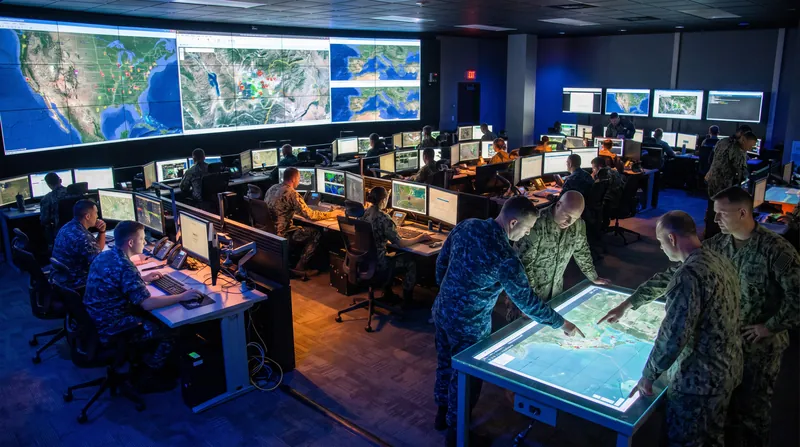
The United States is currently executing a massive overhaul of the nervous system that controls its nuclear arsenal. While public attention often focuses on the physical weapons—submarines, bombers, and silos—the operational prerequisite for launching them is the Nuclear Command, Control, and Communications (NC3) network. As the strategic environment shifts to include contested space and cyberspace domains, the Department of Defense is transitioning the NC3 architecture from a Cold War-era reliance on hardened ground lines to a more resilient, space-based framework.[2]
The NC3 system is officially defined by the Department of Defense's Nuclear Matters Handbook as the "facilities, equipment, communications, procedures, and personnel that enable the President to exercise nuclear authority." It is the mechanism through which the Commander in Chief monitors threats, consults with advisors, and transmits launch orders to the military. Without this connective tissue, the physical weapons cannot be legally or technically employed.[2]
Defense analysts frequently refer to NC3 as the "fourth leg" of the nuclear triad, joining intercontinental ballistic missiles (ICBMs), ballistic missile submarines (SSBNs), and strategic bombers. However, researchers at the Center for Strategic and International Studies (CSIS) argue that this analogy understates its importance. Rather than a fourth leg, NC3 is "more like the top of the three-legged stool holding all the other legs together." If the command and control network fails, the deterrent fails entirely.
The 2022 U.S. Nuclear Posture Review outlines five core functions that the NC3 system must perform under any conditions. These are "detection, warning, and attack characterization; adaptive nuclear planning; decision-making conferencing; receiving and executing Presidential orders; and enabling the management and direction of forces." The system integrates approximately 204 ground, space, and airborne components to ensure these functions survive even a direct attack.[1]
The first phase of the NC3 sequence is early warning and detection. The United States relies heavily on space-based assets, such as the Space Based Infrared System (SBIRS) and newer Overhead Persistent Infrared (OPIR) satellites, to detect the thermal signatures of missile launches globally. These sensors provide the initial data required to characterize an incoming attack and calculate its trajectory and intended targets.
Once a threat is detected, the system facilitates decision-making conferencing. If ground-based facilities like the National Military Command Center at the Pentagon are compromised, the NC3 architecture relies on airborne command posts. The E-4B National Airborne Operations Center and the E-6B Take Charge and Move Out (TACAMO) aircraft serve as survivable nodes where the President can consult with the Secretary of Defense and the Chairman of the Joint Chiefs of Staff to review response options.[2]
A critical requirement for these communication links is their ability to function in a highly degraded environment, particularly one contaminated by an electromagnetic pulse (EMP) following a nuclear detonation. The NC3 architecture maintains a "thin line" of secure, survivable communications designed specifically to withstand EMP effects and jamming attempts, ensuring that the President's orders can reach the triad.
The transmission of the execution order—often referred to as an Emergency Action Message—must be authenticated and distributed to the dispersed forces. This involves sending encrypted codes to ICBM launch control centers, submerged SSBNs via very low frequency radio, and airborne bomber crews. The system is designed to prevent unauthorized access while guaranteeing that a legitimate presidential order is executed without delay.[2]
Modernizing this vast network is a central component of the broader U.S. nuclear modernization effort. The Congressional Budget Office estimated in 2025 that the 10-year cost to operate, sustain, and modernize the entire nuclear enterprise will reach $946 billion. A significant portion of this budget is dedicated to replacing legacy NC3 systems that were originally designed in the 1980s with modern, digitally engineered alternatives.[1]
A major focus of this modernization is the transition to advanced space-based communications. The Advanced Extremely High Frequency (AEHF) satellite constellation is being deployed to provide jam-resistant, secure communications for the NC3 network. These satellites are designed to be protected against specific counterspace attacks, reflecting the growing recognition that orbit is now a contested domain.
The shift toward digital and space-based systems introduces new vulnerabilities, particularly in the realm of cybersecurity and anti-satellite weapons. Unlike the Cold War, where the primary threat to NC3 was physical destruction by a nuclear strike, modern defense planners must account for the possibility of adversaries using cyber intrusions or directed energy weapons to blind sensors or sever communication links before a kinetic attack begins.
To manage the increasing complexity and speed of modern threats, the Department of Defense is exploring the integration of artificial intelligence into the NC3 architecture. In late 2024, U.S. Strategic Command General Anthony Cotton outlined a vision for using AI to increase efficiency in intelligence, surveillance, and reconnaissance. However, military leaders emphasize that AI will be used to inform decision-making, not to replace the human-in-the-loop requirement for nuclear launch authority.
Some defense experts advocate for a hybrid approach to AI integration. Analysts at CSIS have noted proposals to increase reliance on AI not only for detecting attacks but also for preprogramming responses in the event that national leadership is incapacitated. These concepts remain highly controversial due to the existential risks associated with automated nuclear responses.
The urgency of NC3 modernization is driven by what defense officials describe as a novel strategic environment. Former acting assistant secretary of defense for space policy Vipin Narang stated in 2024, "Absent a change in the nuclear trajectories of the PRC, Russia, and North Korea, we may reach a point where a change in the size or posture of our current deployed forces is necessary." The United States is now planning to simultaneously deter two nuclear peers—Russia and China—a scenario it has never faced before.
The effectiveness of the NC3 system rests entirely on the perception of adversaries. Deterrence requires opponents to believe that the United States possesses both the capability to respond to an attack and the secure command infrastructure to order that response under any circumstances. As the modernization effort continues through the late 2020s, ensuring the resilience of this unseen network remains the foundation of American strategic stability.[2][3]
Key terms
- Nuclear Triad
- The three-pronged military force structure consisting of land-based intercontinental ballistic missiles (ICBMs), submarine-launched ballistic missiles (SSBNs), and strategic bombers.
- Emergency Action Message (EAM)
- A highly formatted, encrypted message used to transmit the President's authorization to launch nuclear weapons to the military forces.
- Electromagnetic Pulse (EMP)
- A burst of electromagnetic radiation following a nuclear detonation that can disrupt or destroy unshielded electronic equipment and communication networks.
- SBIRS and OPIR
- Space Based Infrared System and Overhead Persistent Infrared; satellite constellations designed to detect the heat signatures of missile launches to provide early warning of an attack.
- AEHF
- Advanced Extremely High Frequency; a constellation of secure, jam-resistant communications satellites used to transmit critical orders to military forces.
Reader questions
What does NC3 stand for?
NC3 stands for Nuclear Command, Control, and Communications. It is the network of sensors, command centers, and communication links that allows the President to authorize and direct the use of nuclear weapons.
Why is the NC3 system being modernized?
The current system relies heavily on technology designed in the 1980s during the Cold War. Modernization is required to protect the network against modern threats, such as cyberattacks and anti-satellite weapons, and to ensure it remains reliable in a contested electromagnetic environment.
Will artificial intelligence control the US nuclear arsenal?
No. While the Department of Defense is exploring AI to process intelligence and surveillance data more efficiently, military leaders have explicitly stated that AI will not replace the requirement for a human—specifically the President—to authorize a nuclear launch.
Where opinion splits
The Defense Establishment's View
Modernization is essential to maintain credible deterrence against multiple nuclear peers.
Military planners argue that the Cold War-era NC3 architecture is insufficient for a strategic environment characterized by contested space and cyber domains. They emphasize that without a modernized, digitally resilient command network, the physical weapons of the triad lose their deterrent value. This perspective prioritizes rapid deployment of advanced systems like AEHF satellites and the integration of AI for intelligence processing to outpace the capabilities of Russia and China.
The Cyber Vulnerability View
Digitizing the NC3 network introduces unprecedented risks of non-kinetic disruption.
Cybersecurity and space analysts caution that moving NC3 away from isolated, analog systems toward networked, space-based architectures creates new attack vectors. They argue that adversaries might not need to launch a physical strike if they can blind early-warning satellites or sever communication links using directed energy weapons or cyber intrusions. From this viewpoint, the complexity of a 'system of systems' makes it inherently harder to secure against modern electromagnetic threats.
The Risk Reduction View
Integrating AI and expanding nuclear capabilities could trigger an uncontrollable arms race.
Arms control advocates and risk reduction experts express deep concern over proposals to integrate artificial intelligence into nuclear decision-making. They argue that even 'human-in-the-loop' AI systems can compress decision times dangerously, increasing the risk of an accidental launch based on false sensor data. This camp advocates for maintaining strict analog firebreaks and prioritizing diplomatic arms control agreements over unilateral technological expansion.
- Strategic Deterrence Advocates
- Focus on modernizing the triad and NC3 to ensure credible deterrence against peer competitors.
- Cyber & Space Resilience Analysts
- Emphasize the vulnerabilities of digital and space-based NC3 components to non-kinetic attacks.
- Arms Control & Risk Reduction Advocates
- Warn against the destabilizing effects of AI integration and advocate for diplomatic constraints on nuclear expansion.
Perspectives this story doesn't cover
- Adversary strategic planners
- Non-nuclear allied nations
Sources
Source coverage
3 outlets
3 viewpoints surfaced



- [1]Congressional Research ServiceStrategic Deterrence Advocates
Defense Primer: Nuclear Command, Control, and Communications (NC3)
Read on Congressional Research Service → - [2]Department of DefenseStrategic Deterrence Advocates
Nuclear Matters Handbook 2020: Nuclear Weapons Employment Policy, Planning, and NC3
Read on Department of Defense → - [3]Factlen Editorial TeamArms Control & Risk Reduction Advocates
Synthesis by Factlen editorial team
Read on Factlen Editorial Team →
More in Defense & Security
See all →Strategic Planning
The Comparison of Capabilities, Concepts, and Context: How Net Assessment Defines Long-Term Military Competition
6 sources

Intelligence Architecture
The Statutory Roles and Responsibilities of the 18 Members of the U.S. Intelligence Community
8 sources

Defense Procurement
The Technology Readiness Level 6-7 Gap: How the 'Valley of Death' Separates Defense R&D from Program of Record
6 sources
CFIUS Jurisdiction
The Three Categories of Covered Transactions: How CFIUS Reviews Foreign Investment in U.S. Technology, Infrastructure, and Data
8 sources

Comments
Every angle. Every day.
Get Defense & Security stories with full source coverage and perspective breakdowns, free every day.