
How the Tony Awards Are Decided: Inside Broadway's Complex Voting Process
The journey to winning a Tony Award involves a strict eligibility calendar, a dedicated 50-person nominating committee, and an uncompromising attendance rule for over 800 industry voters.

Share this story
In short
- The Tony Awards utilize a strict peer-review voting system rather than public polling.
- A 50-person Nominating Committee must see every eligible new Broadway show to determine the nominees.
- Approximately 831 industry professionals make up the final voting body.
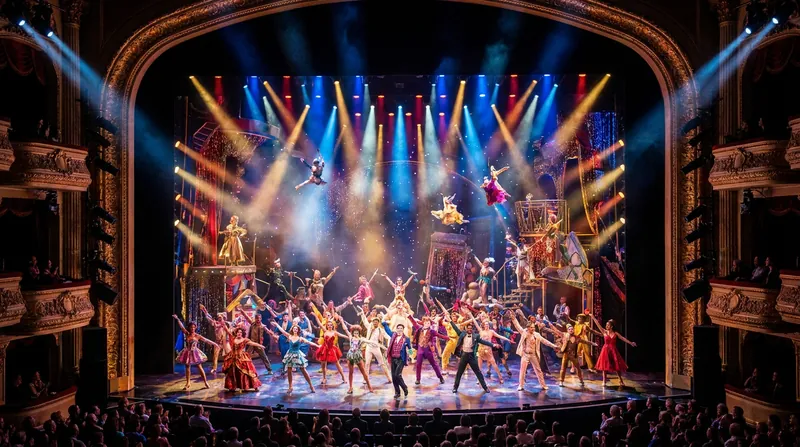
The 79th Annual Tony Awards recently wrapped up at Radio City Music Hall, crowning shows like the new musical Schmigadoon! and the revival of Death of a Salesman as the pinnacle of the 2025–2026 Broadway season. But long before the silver medallions are handed out on national television, a rigorous, multi-tiered evaluation process takes place behind the scenes.
Unlike many popular entertainment awards that rely on mass public voting or small, opaque Hollywood committees, the Antoinette Perry Award for Excellence in Broadway Theatre operates on a strict system of peer review. Winning a Tony can guarantee a production's financial success, launch a lucrative national tour, and cement an artist's legacy. Because the stakes are so high, the mechanism for choosing the winners is surprisingly complex, involving strict eligibility calendars, a dedicated nominating committee, and an uncompromising attendance rule for over 800 industry voters.[2][3]
The journey to a Tony Award begins with eligibility. To even be considered, a production must officially open in one of the 41 designated "legitimate" Broadway theaters in Manhattan by a strict cut-off date—which, for the 2026 ceremony, was April 26. These theaters typically house 500 or more seats and operate under specific union contracts.[2]
Overseeing this initial phase is the Tony Awards Administration Committee, a 24-member body comprising representatives from the American Theatre Wing, The Broadway League, and various theatrical unions. This committee meets regularly throughout the season to make granular rulings, such as determining whether an actor's performance qualifies as a "Leading" or "Featured" role, and whether a show's score is eligible for Best Original Score.[3]
Once eligibility is established, the power shifts to the Tony Awards Nominating Committee. This rotating group consists of approximately 50 working theatre professionals—ranging from actors and directors to designers and casting agents—who serve overlapping three-year terms.[1]
Serving on the Nominating Committee is a monumental commitment. Nominators are required to see every single eligible new Broadway production that opens during the season. In a busy year, this can mean attending upwards of 35 to 40 shows, evaluating each one critically against its peers. Shortly after the April eligibility deadline, this committee meets in secret to cast their ballots, determining the official nominees in each category.[3]
After the nominees are announced in early May, the final phase of the process begins: the general voting. The ultimate winners are chosen by a much larger pool of approximately 831 eligible Tony voters. This number fluctuates slightly from year to year based on active memberships and industry shifts.[1]
The voting body is a comprehensive cross-section of the theatrical industry. It includes voting members of The Broadway League, the board of directors of the American Theatre Wing, and members of the governing boards of major unions like Actors' Equity Association, the Dramatists Guild, and the Stage Directors and Choreographers Society. Select theatre critics and casting directors are also included, ensuring that the winners are selected by a deeply informed electorate.[2]
The most critical—and unique—aspect of the Tony voting process is the strict attendance rule. In order to cast a ballot in any specific category, a Tony voter must have seen every single nominated production in that category.[1]
In the past, this requirement was enforced largely on the honor system. Today, it is meticulously tracked. Voters are required to log their attendance for each production in a secure online Tony Voter Portal. If a voter misses even one of the five nominees for Best Musical, they are completely locked out of voting for the Best Musical category.[1][3]
This attendance mandate creates a frantic sprint during the weeks between the nomination announcement and the voting deadline. Producers of nominated shows work tirelessly to ensure that all 800-plus voters receive their complimentary tickets and actually get into the theater to see the production. A show cannot win if the voters haven't seen it, making voter outreach a critical component of any Tony campaign.[3]
Voting takes place online via a secure platform maintained by an independent firm, under the strict supervision of certified public accountants. The ballot is typically made available at least 14 days prior to the ceremony, and all votes are tabulated at least 50 hours before the curtain rises at Radio City Music Hall.[1]
The secrecy surrounding the final results is absolute. Only a limited number of representatives from the accounting firm know the names of the winners before the envelopes are opened on live television. The final tabulation is never disclosed to the Administration Committee, the Nominating Committee, or anyone outside the accounting firm.[1]
The system is also designed to handle edge cases. Ties, while rare, do occur, resulting in both nominees taking home a medallion. In highly unusual circumstances where a category has only one nominee—such as Aaron Tveit's solo nomination for Best Actor in a Leading Role in a Musical in 2021—voters are asked to vote "yes" or "no." The nominee must receive an affirmative vote on at least 60% of the ballots to win the award.[1]
Ties, while rare, do occur, resulting in both nominees taking home a medallion.
Ultimately, the Tony Awards voting process is designed to protect the integrity of Broadway's highest honor. By requiring voters to physically sit in the theater and experience the nominated work firsthand, the system ensures that the spinning silver medallion remains a true mark of excellence, bestowed by a dedicated community of peers.[2][3]
Key terms
- The Broadway League
- The national trade association for the Broadway industry, which co-presents the Tony Awards.
- American Theatre Wing
- The non-profit organization that founded the Tony Awards in 1947 to celebrate excellence in theatre.
- Legitimate Broadway Theater
- One of 41 specific professional theaters in Manhattan, typically with 500 or more seats, where a production must play to be eligible for a Tony Award.
- Tony Voter Portal
- The secure online system where voters must log their attendance to prove they have seen nominated shows.
Frequently asked
Do Tony voters get free tickets?
Yes, eligible Tony voters receive complimentary tickets to ensure they can see all the nominated productions before the voting window closes.
Can a voter vote for their favorite show without seeing the others?
No. Voters must log their attendance for every nominated show in a specific category; if they miss even one, they are locked out of voting in that category entirely.
What happens if there is a tie?
Ties do occur occasionally. In the event of a tie, both nominees receive a Tony Award.
Who counts the Tony Award votes?
An independent firm of certified public accountants tabulates the online ballots and keeps the results strictly secret until the live ceremony.
Viewpoints in depth
Administration & Committees
Focuses on maintaining the strict rules, eligibility cut-offs, and the integrity of the voting process.
The Administration and Nominating Committees view the strict rules—from theater size requirements to the April eligibility cut-off—as essential for maintaining the award's prestige. By carefully vetting which roles qualify for which categories and requiring nominators to see every single show, they ensure that the initial ballot is a comprehensive reflection of the season's true artistic merit, rather than a popularity contest.
The Voting Body
Represents the industry professionals who must commit significant time to see every nominated show to fulfill their voting duties.
For the 800-plus eligible voters, participating in the Tony Awards is both a high honor and a massive logistical burden. Union members, critics, and industry veterans must carve out time to see dozens of productions. The strict attendance rule, enforced via the online portal, is seen as a necessary safeguard that forces voters to evaluate every nominee fairly, preventing them from simply voting for the shows with the biggest marketing budgets or the most recognizable stars.
Producers & Campaigns
Focuses on the high stakes of winning and the logistical challenge of getting voters into theater seats before the deadline.
From the perspective of Broadway producers, the voting process is a high-stakes race against the clock. Because a Tony win can dictate a show's financial survival, campaigns are heavily focused on voter outreach. Producers must ensure that every single voter receives complimentary tickets and actually attends the show before the voting window closes, knowing that a missed attendance log means a lost potential vote.
- The Voting Body
- Represents the industry professionals who must commit significant time to see every nominated show to fulfill their voting duties.
- Administration & Committees
- Focuses on maintaining the strict rules, eligibility cut-offs, and the integrity of the voting process.
- Producers & Campaigns
- Focuses on the high stakes of winning and the logistical challenge of getting voters into theater seats before the deadline.
Perspectives this story doesn't cover
- Touring theater professionals who operate outside the 41 Broadway houses
- General theatergoers and fans who purchase the majority of tickets but have no voting power
Sources
Source coverage
3 outlets
3 viewpoints surfaced



- [1]BroadwayWorldThe Voting Body
How Does Tony Awards Voting Work?
Read on BroadwayWorld → - [2]WikipediaAdministration & Committees
Tony Award
Read on Wikipedia → - [3]Factlen Editorial TeamThe Voting Body
Synthesis by Factlen editorial team
Read on Factlen Editorial Team →

More in Entertainment
See all →Awards Mechanics
The Math Behind the Magic: How the Oscars' Preferential Ballot Actually Works
3 sources

Broadway Economics
The Tony Effect: How Broadway's Biggest Night Dictates the Economics of American Theater
5 sources

Awards Mechanics
Behind the Ballot: How the Tony Awards Actually Decide Broadway's Best
3 sources

Broadway Economics
The 'Tony Effect': How Winning Best Musical Transforms a Broadway Show's Financial Trajectory
3 sources
Comments
Every angle. Every day.
Get Entertainment stories with full source coverage and perspective breakdowns, free every day.