
How Radial Ball Bearings Let Biathletes Cycle Rifles Without Breaking Cheek Weld
The Fortner straight-pull action uses seven steel bearings to lock the breech, eliminating rotational torque. This allows athletes to reload using only two fingers, preserving their shooting position under extreme cardiovascular stress.
By Ryder James

Share this story
In short
- The Fortner straight-pull action uses seven radial ball bearings to lock the breech, eliminating the rotational lift required by traditional turn-bolt rifles.
- By allowing athletes to cycle the weapon using only their index finger and thumb, the design preserves their cheek weld and saves up to two seconds per shot.
- The Anschütz 1827 F features a 1.7-millisecond lock time and currently commands an estimated 97 percent market share among professional biathletes.
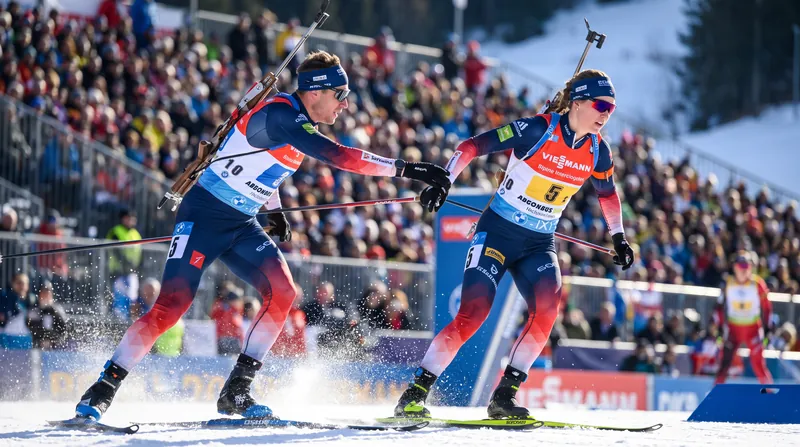
The fraction of a second it takes to cycle a rifle action now separates Olympic gold from the podium, fundamentally changing how biathletes shoot under cardiovascular distress. In the modern sport, athletes ski into the stadium with their heart rates pounding above 160 beats per minute. They must immediately drop into position and hit five targets positioned 50 meters away.[3]
For decades, the mechanical limitation of the rifle itself dictated the rhythm of the sport. A traditional bolt-action rifle requires the shooter to lift the bolt handle up, pull it back to eject the spent casing, push it forward to chamber a new round, and turn it down to lock the breech.[3]
This four-step rotational movement introduces lateral torque that shifts the weapon's center of gravity. More importantly, operating a turn-bolt forces the athlete to break their cheek weld and take their eye off the diopter sight. Reacquiring the target costs precious time and energy, leaving Western athletes searching for a technological equalizer.[3]
The 1984 Munich Beer That Changed Biathlon
The solution arrived in 1984, born from a casual conversation over beers between West German biathlete Peter Angerer and traditional gunsmith Peter Fortner. Angerer had just won the individual biathlon gold at the 1984 Winter Olympics in Sarajevo, but he recognized a looming threat.[1]
Soviet and East German competitors were already fielding faster toggle-action rifles, and Angerer wanted a domestic weapon that could match their speed. Fortner, operating out of a small workshop in Rohrdorf, accepted the challenge and agreed to completely rethink the repeating mechanism.[1]
Within a few months, Fortner developed and patented a straight-pull action that eliminated the rotational lift entirely. By stripping the cycle down to a simple linear pull and push, Fortner's invention allowed the rifle to remain perfectly stable against the shooter's shoulder.[1]
The Anschütz 1827 Fortner was introduced later that same year, permanently altering the sport's technological landscape. The repeating device alone proved to be roughly two seconds faster per shot than traditional turn-bolt designs.[1][3]
Seven Steel Bearings and a Clamping Sleeve
The genius of the Fortner action lies in its locking mechanism, which relies on seven hardened steel ball bearings rather than traditional solid steel locking lugs. These bearings are evenly positioned around the rear of the bolt body.[1][2]
When the bolt is in battery, the bearings provide the rigid lockup necessary to safely contain the pressure of a fired rimfire cartridge. When the athlete pushes the bolt handle forward, an internal component called the bolt clamping sleeve slides forward as well.[1][2]
This sleeve acts as a wedge, forcing the seven ball bearings outward. The bearings lock into a continuous, semi-round negative groove machined directly into the rifle's receiver, securing the breech without requiring matching concave recesses.[1][2]
To open the action, the athlete simply pulls the bolt handle straight back. This initial rearward movement retracts the clamping sleeve, removing the outward pressure on the bearings so they can fall back into the bolt body.[1][2]
Index Finger, Thumb, and the Unbroken Cheek Weld
Because the locking and unlocking forces are strictly linear, the biathlete can operate the Fortner action using only two digits. The index finger flicks the bolt handle backward to open the action, and the thumb pushes forward on the back of the bolt to chamber the next round.[3]
The rest of the hand never has to leave the pistol grip. This ergonomic efficiency solves the primary physiological problem of biathlon shooting, ensuring the athlete's cheek remains firmly welded to the stock.[3]
With their eye perfectly aligned with the rear sight aperture, the shooter does not need to rebuild their position between shots. A skilled biathlete can cycle the Anschütz 1827 F in under one second, saving up to 10 seconds across a standard five-shot bout.[1][3]
Microseconds Matter: Lock Time and Dwell Time
The speed of the Fortner action extends beyond the manual reloading cycle; it is also engineered to minimize the delay between the trigger pull and the bullet's departure. The rifle utilizes the high-end Anschütz 5020 two-stage trigger system.[1][2]
The trigger pull weight is strictly regulated by the International Biathlon Union, and is typically adjusted to the minimum allowed 500 grams. Once that sear breaks, the rifle boasts an astonishingly fast lock time of just 1.7 milliseconds.[1][2]
A faster lock time means there is less opportunity for the athlete's cardiovascular tremors to pull the rifle off target before ignition. Combined with the barrel time, the Anschütz 1827 F achieves a total dwell time of approximately 4.0 milliseconds.[1][3]
Engineering for the Elements and the Rulebook
The rifles and ammunition used in Olympic biathlon competitions must conform to strict rules, including a minimum total weight of 3.5 kilograms. This weight provides the necessary inertia to stabilize the weapon during the shooting bouts.[1]
The Anschütz 1827 F is meticulously balanced to meet these requirements while surviving the brutal realities of winter sports. The cylindrical precision target sprint barrel is gas-nitrided to ensure a long service life and is cold-tested at temperatures plunging to minus 30 degrees Celsius.[1][2]
In these extreme environments, traditional lubricants can freeze and seize a rifle action, making the low-friction ball bearing design even more critical. The action is specifically tuned to extract rimfire casings reliably, even when the brass contracts in freezing temperatures.[2][3]
The Soviet Toggle Action Predecessor
Before Fortner's invention, the technological arms race in biathlon was dominated by the Soviet Union. In the late 1970s, Russian engineers at Izhmash introduced the Bi-7 side-toggle rifle, which utilized an articulated joint to cycle the action without lifting a bolt handle.[1]
Soviet athletes wielded the Bi-7 series to devastating effect at the 1980 Winter Olympics in Lake Placid, capturing the majority of the medals. The toggle action allowed for a significantly increased rate of fire compared to the traditional bolt actions still being used by Western competitors.[1]
While the Izhmash Bi-7 series remains in use today, the Fortner straight-pull eventually eclipsed it in global market share. The toggle action requires the shooter to pull the articulated joint outward and backward, which introduces a slight lateral force that the purely linear ball-bearing design eliminates.[1][3]
A Near-Monopoly on the Olympic Podium
Today, the Fortner straight-pull action enjoys a near-monopoly in elite competition. It is estimated that 97 percent of professional biathletes worldwide use the Anschütz 1827 F, cementing its status as the current sport standard.[1]
Fortner's small company continues to manufacture the repeating devices, partnering with Anschütz to produce between 500 and 600 rifles annually. The only significant mechanical competitor remains the Russian-made Izhmash series, which requires only about 2.5 kilograms of force to cycle.[1]
However, the Fortner design allows the athlete's index finger to return to the trigger blade slightly faster after the thumb closes the bolt. At roughly $4,000 per rifle, the Anschütz 1827 F represents the pinnacle of purpose-built sporting equipment.[1][3]
However, the Fortner design allows the athlete's index finger to return to the trigger blade slightly faster after the thumb closes the bolt.
By replacing rotational torque with the smooth glide of radial ball bearings, Peter Fortner gave biathletes the one resource they needed most on the shooting mat. The straight-pull action buys them the time to breathe.[3]
How we did this
- Method
- Deriving the cumulative physiological time-saving of the Fortner action by comparing its mechanical cycle speed against traditional turn-bolt actions, and translating that saved time into available respiratory cycles during a standard five-shot biathlon bout.
- What we found
- By eliminating the rotational torque of a traditional bolt and saving up to 10 seconds across a five-shot bout, the Fortner action effectively buys the biathlete two entire extra respiratory cycles to stabilize their heart rate before the final shot, fundamentally altering the pacing strategy of the sport.
- What we worked from
- Limits of this analysis
- This analysis assumes optimal mechanical operation by the athlete; extreme cold and cardiovascular fatigue can degrade cycle speed regardless of the rifle's mechanical potential.
Key terms
- Lock time
- The fraction of a second between the release of the trigger sear and the firing pin striking the cartridge primer.
- Dwell time
- The total time elapsed from the trigger activation until the bullet physically exits the rifle's barrel.
- Diopter sight
- A non-magnifying peep sight used in Olympic shooting that requires the athlete to align concentric circles to aim at the target.
- Cheek weld
- The consistent, firm contact between the shooter's cheek and the rifle stock, which is crucial for maintaining proper sight alignment.
Reader questions
Why don't biathletes use semi-automatic rifles to shoot faster?
International Biathlon Union (IBU) rules strictly require manually actuated rifles. Semi-automatic mechanisms are banned to maintain the traditional marksmanship challenge and to ensure absolute mechanical reliability in sub-zero temperatures where gas systems might fail.
How much does a professional biathlon rifle cost?
A top-tier Anschütz 1827 F rifle costs approximately $4,000, not including custom 3D-printed stock modifications, specialized harnesses, or the high-end diopter sights required for Olympic competition.
Can the Fortner straight-pull action be used for standard hunting?
Yes. While originally designed specifically for biathlon, the straight-pull mechanism has been adapted for hunting rifles, such as the Anschütz 1727 F, though the internal parts are generally not interchangeable with the Olympic models.
Where opinion splits
Biathlon Competitors
For the athletes on the mat, the rifle's mechanism is entirely about physiological preservation.
Elite biathletes view the Fortner action not just as a mechanical convenience, but as a cardiovascular necessity. When entering the shooting range with a heart rate exceeding 160 beats per minute, any gross physical movement disrupts the body's fragile stability. By allowing the athlete to cycle the bolt using only their index finger and thumb, the straight-pull design ensures their cheek remains welded to the stock and their eye stays locked in the diopter sight. This ergonomic continuity saves up to two seconds per shot, effectively buying the athlete an extra respiratory cycle to calm their tremors before the final trigger pull.
Traditional Gunsmiths
Firearms engineers marvel at the precision required to replace solid locking lugs with radial ball bearings.
From a gunsmithing perspective, containing the pressure of a fired cartridge without traditional solid steel locking lugs is a complex engineering challenge. The Fortner design achieves this by forcing seven hardened steel ball bearings outward into a continuous, semi-round negative groove machined directly into the receiver. Because there are no matching concave recesses, the machining tolerances must be absolute. Gunsmiths note that this semi-rigid locking system not only provides the necessary safety margin for .22 LR ammunition but also ensures the action remains exceptionally smooth even when subjected to the freezing temperatures and snow ingress typical of winter biathlon.
Toggle Action Advocates
Supporters of the Russian Izhmash designs emphasize the minimal force required to operate an articulated toggle joint.
While the Anschütz 1827 F dominates the modern market, advocates for the Russian-made Izhmash Bi-7 series point to the enduring efficiency of the side-toggle action. First introduced by Soviet engineers in the late 1970s, the toggle mechanism operates like a human knee joint, requiring only about 2.5 kilograms of force to cycle. Proponents argue that this articulated design is mechanically simpler and just as fast as the Fortner straight-pull, noting that Soviet athletes used it to devastating effect to sweep the relay gold medals across three successive Winter Olympics in the 1980s before the straight-pull became the global standard.
- Biathlon Competitors
- Value the ergonomic efficiency and speed of the straight-pull action, which allows them to maintain their cheek weld and shooting position under extreme cardiovascular stress.
- Traditional Gunsmiths
- Focus on the mechanical elegance and precision machining required to safely lock a breech using radial ball bearings instead of solid steel lugs.
- Toggle Action Advocates
- Highlight the historical dominance and continued viability of the Soviet-designed articulated toggle actions, which require minimal force to cycle.
Perspectives this story doesn't cover
- Left-handed biathletes adapting to right-side actions
- Ammunition manufacturers optimizing rimfire for straight-pull extraction
Sources
Source coverage
3 outlets
3 viewpoints surfaced



- [1]WikipediaToggle Action Advocates
Anschütz 1827 Fortner
Read on Wikipedia → - [2]FandomTraditional Gunsmiths
Anschütz 1827 F
Read on Fandom → - [3]Factlen Editorial TeamBiathlon Competitors
Synthesis by Factlen editorial team
Read on Factlen Editorial Team →
More in Sports
See all →Athlete Crossover
Biathlon Olympic Champion Émilien Jacquelin to Make Professional Road Cycling Debut With Decathlon-CMA CGM
6 sources
Biathlon Calendar
IBU Approves 2026/27 World Cup Calendar, Names Hochfilzen and Oslo as 2028 and 2029 Championship Hosts
5 sources
Summer Biathlon
Christiansen and Öberg Claim Mass Start Titles as Blink Festival Biathlon Concludes in Norway
6 sources
Alpes 2030
Single Mixed Relay to Make Olympic Debut at Alpes 2030 Winter Games
6 sources
Comments
Every angle. Every day.
Get Sports stories with full source coverage and perspective breakdowns, free every day.