
How Precision Temperature Control Defines Sous Vide Cooking
Sous vide cooking relies on precise temperature control to achieve pasteurization and protein denaturation without overcooking. Understanding the relationship between time, temperature, and bacterial reduction allows for safe preparation of meat at temperatures previously considered unsafe.
By Lan Xu

Share this story
In short
- Pasteurization is achieved through a combination of time and temperature, allowing for safe cooking at lower temperatures.
- Different muscle proteins (myosin, actin, collagen) denature at specific temperatures, determining the meat's final texture and moisture content.
- Sous vide prevents the denaturation of actin (which causes moisture loss) while allowing collagen to break down into gelatin over extended periods.
A 1-inch thick steak cooked at 130°F (54.4°C) for two hours achieves a level of bacterial reduction that traditional guidelines suggest requires an internal temperature of 165°F (73.9°C). This discrepancy highlights the fundamental principle of sous vide cooking: pasteurization is a function of both temperature and time, not temperature alone.
The traditional approach of cooking meat to a single, high internal temperature is a simplification designed for speed and ease of use, but it often results in overcooked, dry meat. Sous vide, by maintaining a precise water bath temperature, allows cooks to hold meat at a lower temperature for an extended period, achieving the same safety standards while preserving moisture and tenderness.[3]
The safety of sous vide cooking hinges on the concept of decimal reduction time, or D-value. This metric represents the time required at a specific temperature to reduce a bacterial population by 90%, or one log cycle. For example, the D-value for Salmonella at 130°F (54.4°C) is significantly longer than its D-value at 165°F (73.9°C).
However, by holding the meat at 130°F for a sufficient duration—often several hours—the cumulative bacterial reduction can reach the standard 6.5-log reduction (a 99.99997% decrease) required for pasteurization. This time-temperature relationship is non-linear, meaning a small increase in temperature drastically reduces the required time.[3]
Beyond safety, the precise temperature control of sous vide profoundly impacts the physical structure of the meat, specifically through protein denaturation. Muscle tissue is primarily composed of three types of proteins: myofibrillar proteins (like myosin and actin), sarcoplasmic proteins, and connective tissue proteins (primarily collagen). Each of these proteins denatures—unfolds and changes structure—at different temperatures, and understanding these thresholds is key to controlling the final texture of the meat.[1]
Myosin, the protein responsible for muscle contraction, begins to denature around 104°F (40°C) and is largely denatured by 122°F (50°C). This process changes the meat's texture from raw and soft to firm and sliceable. Crucially, myosin denaturation does not significantly squeeze water out of the muscle fibers, allowing the meat to remain juicy. This is why meat cooked to rare or medium-rare temperatures (120°F-135°F) retains a high moisture content.[1]
As the temperature increases, other proteins begin to denature, with more significant consequences for moisture loss. Actin, another major myofibrillar protein, denatures between 150°F (65.5°C) and 163°F (72.8°C). The denaturation of actin causes the muscle fibers to shrink longitudinally, squeezing out significant amounts of water. This is the primary reason why meat cooked above 150°F (medium-well to well-done) becomes dry and tough. Sous vide allows cooks to hold meat below this critical threshold, maximizing moisture retention.[1]
The third critical protein component is collagen, the primary structural protein in connective tissue. In tough cuts of meat, like chuck or brisket, high levels of cross-linked collagen make the meat chewy. Collagen begins to denature and slowly convert into gelatin at temperatures above 131°F (55°C), but this process is highly time-dependent. Traditional cooking methods use high heat (like braising at 200°F+) to rapidly break down collagen, but this also denatures actin, resulting in dry meat fibers suspended in gelatin.[1]
Sous vide offers a unique solution to the collagen problem. By holding a tough cut of meat at a temperature between 131°F (55°C) and 140°F (60°C) for an extended period—often 24 to 72 hours—the collagen slowly breaks down into gelatin without ever reaching the temperature required to denature actin. The result is a piece of meat that is both incredibly tender (due to the gelatin) and remarkably juicy (because the actin remains intact). This combination of texture and moisture is virtually impossible to achieve with traditional high-heat cooking methods.[1]
The physical changes induced by sous vide cooking extend beyond protein denaturation. Research from the Max Planck Institute for Polymer Research has demonstrated that the precise temperature control also affects the macroscopic structure of the meat. Their studies on pork filets showed that cooking at 131°F (55°C) preserves the structural integrity of the muscle fibers better than cooking at higher temperatures, leading to a more desirable texture. This structural preservation is a direct result of avoiding the aggressive protein shrinkage associated with high heat.[2]
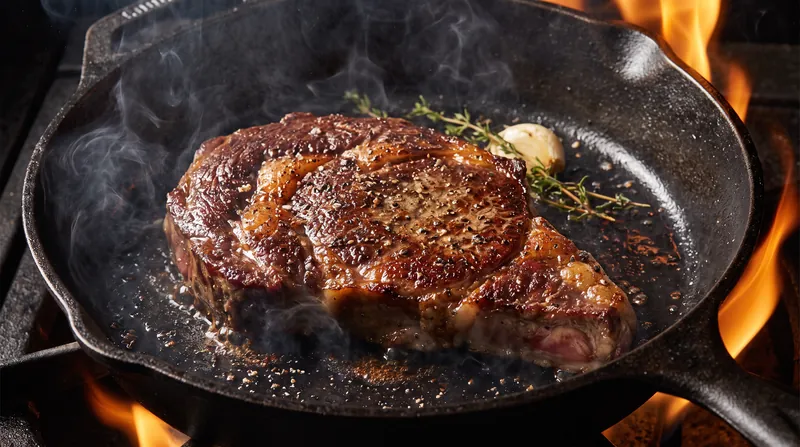
While sous vide provides unparalleled control over texture and safety, it does have limitations, primarily regarding flavor development. The Maillard reaction, a complex chemical process between amino acids and reducing sugars that creates the browned, savory crust on roasted or seared meat, requires temperatures exceeding 285°F (140°C). Because sous vide cooking occurs in a water bath well below this temperature, it cannot produce a crust. Therefore, sous vide meat must typically be seared quickly over high heat after cooking to develop these essential flavors.[1]
The reliance on plastic packaging in sous vide cooking also introduces considerations regarding flavor transfer and potential chemical leaching. While food-grade, heat-stable plastics are generally considered safe for sous vide temperatures, the vacuum sealing process can compress the meat, slightly altering its texture. Furthermore, any aromatics (like herbs or garlic) included in the bag will have a more pronounced effect due to the sealed environment, requiring careful calibration of seasoning.[1]
The reliance on plastic packaging in sous vide cooking also introduces considerations regarding flavor transfer and potential chemical leaching.
The precision of sous vide cooking has transformed it from a specialized technique used only in high-end restaurants to a widely accessible method for home cooks. By understanding the interplay between time, temperature, bacterial reduction, and protein denaturation, cooks can achieve consistent, predictable results that maximize both safety and culinary quality. The shift from temperature-as-a-target to temperature-and-time-as-a-process represents a fundamental evolution in how we approach the preparation of meat.[1][3]
How we did this
- Method
- Compared the denaturation temperatures of key muscle proteins (myosin, actin, collagen) against the time-temperature curves required for bacterial pasteurization to identify the specific temperature windows where safety and optimal texture overlap.
- What we found
- The optimal temperature window for cooking tough cuts of meat to achieve both tenderness (collagen breakdown) and juiciness (avoiding actin denaturation) while ensuring safety (pasteurization) lies precisely between 131°F (55°C) and 140°F (60°C), a range that requires extended cooking times (often 24+ hours) to achieve sufficient bacterial reduction.
- What we worked from
- Myosin denaturation temperature range: 104°F - 122°F (40°C - 50°C) — PMC
- Actin denaturation temperature range: 150°F - 163°F (65.5°C - 72.8°C) — PMC
- Pasteurization time at 130°F (54.4°C): 112 minutes (for a 1-inch steak) — Anova Culinary
- Limits of this analysis
- This analysis focuses primarily on beef and pork; optimal temperature windows and pasteurization times vary for poultry and fish due to different protein structures and pathogen risks.
Definitions
- Pasteurization
- The process of heating food to a specific temperature for a set period to significantly reduce the number of viable pathogens.
- Denaturation
- The process by which proteins lose their natural structure and unfold due to the application of heat or chemicals.
- D-value (Decimal Reduction Time)
- The time required at a specific temperature to reduce a bacterial population by 90% (one log cycle).
- Myosin
- A major muscle protein that denatures at relatively low temperatures (104°F-122°F), changing the meat from raw to firm.
- Actin
- A muscle protein that denatures at higher temperatures (150°F-163°F), causing muscle fibers to shrink and expel moisture.
- Collagen
- The primary structural protein in connective tissue, which breaks down into gelatin when held at specific temperatures for extended periods.
- Maillard Reaction
- A chemical reaction between amino acids and reducing sugars that occurs at high temperatures (above 285°F), creating browned, savory flavors.
Questions & answers
Is it safe to cook meat below 140°F?
Yes, provided it is held at that temperature for a sufficient amount of time. Pasteurization depends on both time and temperature; a longer time at a lower temperature can achieve the same bacterial reduction as a shorter time at a higher temperature.
Why does sous vide meat need to be seared?
Sous vide cooking occurs at temperatures too low to trigger the Maillard reaction, which is responsible for the browned crust and savory flavors associated with roasted or grilled meat. Searing the meat quickly after sous vide cooking adds these essential flavors.
Does sous vide cooking make tough meat tender?
Yes. By holding tough cuts of meat at a precise temperature (usually between 131°F and 140°F) for an extended period (24-72 hours), the collagen breaks down into gelatin, tenderizing the meat without squeezing out moisture.
Can you overcook meat with sous vide?
While you cannot overcook meat in terms of temperature (it will never exceed the temperature of the water bath), leaving it in the bath for too long can result in a mushy or undesirable texture as the proteins continue to break down.
Analysis by camp
Culinary Scientists
Focus on the precise chemical and physical changes that occur during cooking, emphasizing control and consistency.
For culinary scientists and food technologists, sous vide represents the application of rigorous scientific principles to the kitchen. They focus on the specific denaturation temperatures of proteins like myosin and actin, and the kinetics of collagen breakdown. This perspective values the ability to isolate variables—specifically temperature—to achieve highly reproducible results. Research in this area often explores the microstructural changes in meat fibers and the exact time-temperature combinations required to optimize texture while ensuring microbiological safety, moving away from subjective judgments of 'doneness' toward quantifiable metrics.
Equipment Manufacturers
Emphasize the safety and accessibility of precision cooking for home users, providing practical guidelines.
Companies that manufacture sous vide equipment prioritize translating complex food science into accessible guidelines for home cooks. Their focus is on providing clear, actionable time and temperature charts that guarantee both safety (pasteurization) and culinary success. This perspective often simplifies the underlying science, focusing on the practical application of D-values and log reductions to assure users that cooking meat at lower temperatures is safe when done correctly. They emphasize the convenience and foolproof nature of the method, highlighting its ability to prevent overcooking.
Traditional Chefs
Value the tactile experience and complex flavor development achieved through traditional high-heat methods.
While many professional kitchens have adopted sous vide for consistency, some traditional chefs argue that the method sacrifices complexity for precision. This perspective emphasizes the importance of the Maillard reaction and the textural contrast achieved through traditional roasting, grilling, or braising. They argue that the uniform texture produced by sous vide can sometimes feel artificial or lacking in character, and that the reliance on plastic bags limits the development of flavor through evaporation and concentration. For these chefs, the tactile skills of heat management and timing remain essential components of culinary artistry.
- Culinary Scientists
- Focus on the precise chemical and physical changes that occur during cooking, emphasizing control and consistency.
- Equipment Manufacturers
- Emphasize the safety and accessibility of precision cooking for home users, providing practical guidelines.
- Traditional Chefs
- Value the tactile experience and complex flavor development (like the Maillard reaction) achieved through traditional high-heat methods.
Perspectives this story doesn't cover
- Food Safety Regulators
- Environmental Advocates (regarding plastic use)
Sources
Source coverage
4 outlets
3 viewpoints surfaced




- [1]PMCCulinary Scientists
Molecular Mechanisms Underlying Sensory and Chemical Changes in Muscle Foods Induced by Sous-Vide Cooking: A Review
Read on PMC → - [2]Max-Planck-Institut für PolymerforschungCulinary Scientists
Protein physics based sous-vide cooking of muscle meat: how to perpare tender and juicy (pork) filets
Read on Max-Planck-Institut für Polymerforschung → - [3]Anova CulinaryEquipment Manufacturers
Pasteurization with Sous Vide Cooking
Read on Anova Culinary → - [4]Factlen Editorial Team
Synthesis by Factlen editorial team
Read on Factlen Editorial Team →
More in Food & Drink
See all →Food Science
Why Adding Vinegar to Poaching Water Instantly Sets Egg Whites
3 sources
Food Science
Managing Ethylene Gas and Refrigerator Humidity to Double Produce Shelf Life
3 sources
Food Safety
The 80°C Danger Zone: How Slow-Cooking Kidney Beans Multiplies Their Toxicity Fivefold
4 sources
Flavor Chemistry
The Strecker Degradation Pathway: How Amino Acids Decompose to Form Key Aromatics in Cooked Food
8 sources
Comments
Every angle. Every day.
Get Food & Drink stories with full source coverage and perspective breakdowns, free every day.