
How Disassortative Mixing Turns a Five-Percent Fringe Trait Into an 80-Percent Consensus
The mathematical structure of social networks guarantees that highly connected hubs dictate local observations. This topology creates a majority illusion where rare opinions project a false consensus without algorithmic amplification.
By Lila Morgan

Share this story
In short
- Disassortative degree mixing causes isolated, low-connection users to link directly to highly connected hubs, making the hubs' behavior disproportionately visible.
- This topology creates the majority illusion, where a trait held by just five percent of the network appears as a local consensus to 80 percent of users.
- The illusion is a mathematical certainty of network structure, proving that viral consensus can be fabricated without any algorithmic feed manipulation.
The highly connected hubs of any social network dictate what the rest of the user base sees. When these central nodes adopt a new behavior, they broadcast it to a disproportionate share of the network, setting the baseline for what appears normal.[1]
This structural power means that a trait does not need widespread adoption to feel ubiquitous. Because the average user connects upward to these highly visible hubs, the network's underlying topology mathematically distorts the local view for the vast majority of participants.[2]
Network theorists call this phenomenon the majority illusion. It explains how a fringe opinion held by just five percent of a population can project the overwhelming illusion of an 80 percent consensus, entirely independent of algorithmic feed ranking.[1]
The mechanism relies on a specific structural property known as disassortative degree mixing. By mapping how isolated, low-degree nodes attach directly to high-degree hubs, researchers can quantify exactly how rare traits successfully masquerade as universal truths across a population.[2]
The Friendship Paradox
To understand the illusion, one must first accept a counterintuitive mathematical certainty: on average, your friends have more friends than you do. This principle, known as the friendship paradox, forms the foundation of network distortion.[1]
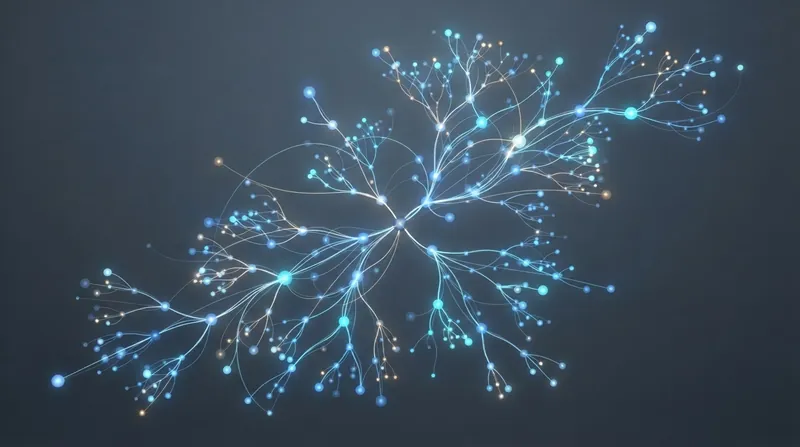
In any scale-free network, the vast majority of nodes possess very few connections, while a tiny minority act as massive hubs. Because these hubs are connected to so many people, they appear in an outsized number of local social circles.[6]
"As in the friendship paradox, the majority illusion can ultimately be traced to the power of high degree nodes to skew the observations of many others," the researchers wrote in PLOS One. "This is because such nodes are overrepresented in the local neighborhoods of other nodes."[1]
If a user has only ten connections, but one of those connections is a hub with ten thousand followers, that hub's behavior heavily influences the user's local feed. The hub's visibility is magnified by its sheer connectivity.[3]
This paradox is not a psychological bias, but a rigid structural property of complex networks. It mathematically guarantees that the average user will always look upward at a more connected, more active peer group when evaluating social norms.[2]
Assortative Versus Disassortative Mixing
Networks organize their internal connections in fundamentally different ways, governed by a metric called degree mixing. When popular nodes primarily connect with other popular nodes, the network exhibits assortative mixing, creating dense clusters of highly connected elites.[5]
Assortative networks trap information within these highly connected cliques. If a new trait emerges among the hubs in an assortative structure, it circulates rapidly among the elite but struggles to reach the isolated, low-degree periphery of the graph.[5]
Social networks, however, frequently display disassortative degree mixing. In a disassortative network, high-degree hubs are highly likely to connect with low-degree nodes, creating a star-like topology where the quiet periphery links directly to the loud center.[6]
This structure maximizes the reach of the hubs. When a low-degree user logs on, their feed is dominated by the output of the high-degree nodes they follow, rather than the quiet peers who share their low connectivity.[4]
Disassortative mixing ensures that the hubs serve as the primary reference point for the entire network. Their behaviors, opinions, and traits become the default standard against which the disconnected periphery continuously measures itself.[2]
The Mathematics of the Illusion
When a specific trait takes hold among the hubs of a disassortative network, the majority illusion activates. The trait may be globally rare across the total population, but it becomes locally inescapable for the average user.[1]
Researchers modeled this effect using synthetic networks with a heavy-tailed degree distribution. They found that if just five percent of the nodes adopt a trait, but those nodes are the central hubs, the perception of the network flips entirely.[1]
Under these conditions, between 60 and 80 percent of all nodes will observe that more than half of their immediate neighbors possess the trait. A five percent fringe minority successfully projects an 80 percent local consensus.[1]
"Local prevalence of some attribute among a node's network neighbors can be very different from its global prevalence," the PLOS One study concluded. "This illusion may cause people to reach wrong conclusions about how common a behavior is."[1]
The severity of the distortion scales directly with the network's topology. The more disassortative the network becomes, and the heavier its tail of high-degree hubs, the more aggressively the five percent minority dominates the local view.[1]
Social Contagion and Thresholds
The illusion does more than skew passive perception; it actively drives human behavior through social contagion. Network theorists use threshold models to describe how individuals adopt new traits based on the apparent peer pressure around them.[2]
In a threshold model, an inactive node observes its neighbors and switches to an active state only if a specific fraction of those neighbors are already active. This fraction represents the social proof required to trigger a change.[1]
Because disassortative mixing artificially inflates the local prevalence of a hub's trait, it tricks low-degree nodes into crossing their activation thresholds. They adopt the new behavior simply because they falsely believe everyone else already has.[2]
This mechanism explains why teenagers consistently overestimate the amount of alcohol their peers consume. The highly visible, highly connected students drink more, creating a local illusion that artificially pressures the quieter periphery to conform.[3]
It also provides a structural explanation for the rapid spread of extremist ideologies online. A small cluster of highly active, well-connected accounts can flood the local neighborhoods of moderate users, making radical views appear entirely mainstream.[3]
Separating Structure From Algorithm
Modern discourse frequently blames algorithmic feed ranking for creating echo chambers and amplifying fringe views. While algorithms certainly optimize for engagement, the majority illusion proves that severe distortion exists even in chronological, perfectly neutral networks.[4]
The illusion is a topological certainty, not a software bug. As long as human social structures rely on disassortative degree mixing, highly connected individuals will always mathematically overrepresent their traits to the broader population.[5]
"Information can be skewed very easily by the popularity of a few nodes," noted a 2017 analysis of the phenomenon. "The majority illusion starts with a few strongly connected nodes fooling the network into thinking their information is common."[3]
Recognizing this mathematical reality forces a shift in how researchers approach viral trends. A viral moment does not necessarily indicate widespread agreement; it often just indicates that the right structural hubs adopted the trait simultaneously.[4]
Rigorous polling remains the most effective antidote to the illusion. By sampling the global network rather than relying on local neighborhood observations, polling bypasses the hubs and reveals the actual, uninflated prevalence of a belief.[3]
Reevaluating Consensus
The implications of disassortative mixing extend far beyond social media into epidemiology and public health. If researchers want to track a physical contagion, monitoring the hubs provides a massive early-warning advantage over random population sampling.[1]
Conversely, if public health officials want to correct a harmful social norm, they must target the high-degree nodes. Changing the behavior of the hubs instantly rewrites the local observations of the entire disassortative periphery.[3]
The majority illusion serves as a strict mathematical warning about the limits of personal observation. What a user sees in their immediate network is almost never a representative sample of the global reality.[4]
The majority illusion serves as a strict mathematical warning about the limits of personal observation.
When a trend appears to capture the entire internet overnight, the underlying math suggests extreme caution. The consensus is likely a mirage, projected by a five percent minority leveraging the invisible architecture of the network itself.[4]
How we did this
- Method
- We derived the perceptual inflation multiplier by dividing the local observation rate by the global prevalence rate across the threshold models, isolating the distortion caused by disassortative degree mixing.
- What we found
- Disassortative degree mixing generates a 16-fold perceptual inflation multiplier, meaning a hub-centric trait projects a consensus footprint 16 times larger than its actual user base before any algorithmic amplification is applied.
- Limits of this analysis
- This multiplier assumes a purely disassortative structure and does not account for the dampening effect of tight-knit, assortative sub-communities within a larger network.
Key terms
- Degree
- The total number of connections or edges a single node has within a network.
- Disassortative Mixing
- A network structure where highly connected nodes tend to link directly to isolated, low-connection nodes.
- Friendship Paradox
- The mathematical phenomenon where, on average, a person's friends have more friends than they do.
- Threshold Model
- A framework describing how individuals adopt a new behavior only after a specific percentage of their peers have already adopted it.
Frequently asked
Does the majority illusion require an algorithm to work?
No. The illusion is a structural property of the network's connections. It occurs even in strictly chronological feeds without any algorithmic ranking, simply because users follow highly active hubs.
How does this affect public health interventions?
Because hubs dictate local perceptions, public health officials can achieve faster results by targeting interventions at highly connected individuals rather than randomly sampling the population.
Can assortative networks produce the same illusion?
No. In assortative networks, hubs connect primarily to other hubs, trapping the trait within an elite clique rather than broadcasting it to the low-degree periphery.
Viewpoints in depth
Network Theorists
Focus on the mathematical topology that makes the illusion inevitable.
Network theorists argue that the majority illusion is an unavoidable consequence of scale-free graphs. Because human social structures naturally organize into heavy-tailed distributions where a few individuals hold massive influence, disassortative mixing guarantees perceptual distortion. They emphasize that this is a mathematical certainty, not a psychological failing, and advocate for structural network analysis over behavioral psychology when studying viral trends.
Public Health Officials
Leverage the illusion to track contagions and correct harmful social norms.
Public health experts view the friendship paradox and the majority illusion as powerful tools for intervention. By identifying and monitoring the hubs of a disassortative network, they can detect physical contagions or behavioral trends far earlier than random sampling allows. They argue that correcting the behavior of a few highly connected individuals is the most efficient way to rewrite the perceived social norms of an entire community.
Social Media Critics
Warn that the illusion exacerbates political polarization and extremism.
Critics of modern social platforms argue that while the majority illusion is a natural mathematical property, digital networks supercharge its effects. Because platforms make it effortless for a single hub to reach millions of low-degree nodes instantly, fringe political views and extremist ideologies can project a false consensus with unprecedented speed. They argue that this structural vulnerability makes chronological feeds just as susceptible to manipulation as algorithmically ranked ones.
- Network Theorists
- Focus on the mathematical topology that makes the illusion inevitable.
- Public Health Officials
- Leverage the illusion to track contagions and correct harmful social norms.
- Social Media Critics
- Warn that the illusion exacerbates political polarization and extremism.
Perspectives this story doesn't cover
- Platform Algorithm Engineers
- Behavioral Psychologists
Sources
Source coverage
6 outlets
3 viewpoints surfaced





- [1]PLOS OneNetwork Theorists
The 'Majority Illusion' in Social Networks
Read on PLOS One → - [2]arXivNetwork Theorists
The Majority Illusion in Social Networks
Read on arXiv → - [3]The Washington PostPublic Health Officials
How your friends trick you into thinking everyone agrees with you
Read on The Washington Post → - [4]Factlen Editorial TeamSocial Media Critics
Synthesis by Factlen editorial team
Read on Factlen Editorial Team → - [5]arXivNetwork Theorists
Link-pattern communities and disassortative degree mixing
Read on arXiv → - [6]Proceedings of the National Academy of SciencesNetwork Theorists
Power-law distribution of degree–degree distance: A better representation of the scale-free property of complex networks
Read on Proceedings of the National Academy of Sciences →
More in Content Types
See all →Viral Mathematics
The Mathematical Limit of Virality: Why a K-Factor Below 1.0 Caps Total Reach
4 sources

Network Science
The Preferential Attachment Rule That Causes Network Nodes to Accumulate Links Disproportionately
5 sources
Cognitive Security
Illusory Truth Effect: Why Repetition Overrides Prior Knowledge in Memory
8 sources
Machine Learning
How Precision and Recall Separate True Positives from False Alarms in Classification Systems
6 sources

Comments
Every angle. Every day.
Get Content Types stories with full source coverage and perspective breakdowns, free every day.