
Global Weightlifting Injury Report: Djuraev Navigates Hip Rehab as Charron Manages Chronic Knee Ahead of Glasgow
Olympic medalists Akbar Djuraev and Maude Charron are utilizing specialized load management to navigate chronic injuries ahead of the 2026 fall majors, while several 89kg contenders continue their long-term recoveries.
By Jackson Reed
Share this story
As the global weightlifting calendar accelerates toward the 2026 fall majors, the sport's top athletes are navigating a complex landscape of rehabilitation and load management. While acute surgical repairs often dominate the headlines, the reality for many elite lifters is a daily battle with chronic wear-and-tear. For reigning champions and Olympic medalists, the focus has shifted from simply resting injured joints to actively rebuilding tissue capacity under the bar.
Uzbekistan's Akbar Djuraev, one of the most dominant heavyweights of his generation, is currently managing a chronic hip issue that flared up during his spectacular performance at the IWF World Championships in Forde, Norway. Despite setting world records with a 196-kilogram snatch and a 232-kilogram clean and jerk, Djuraev admitted that the final attempts took a severe physical toll. He immediately began a dedicated recovery protocol, prioritizing hip stabilization as he prepares for the Los Angeles 2028 qualification cycle.[1]
Djuraev's hip aggravation follows a grueling multi-year period of physiological stress. To compete at the Paris Olympics, he forced his body down from a natural 120 kilograms to the 102-kilogram class—a drastic cut that left him battling fatigue and joint pain. Now back in the 110-kilogram division where his frame is fully supported, Djuraev's medical team is utilizing his improved nutritional status to accelerate his hip rehabilitation, allowing him to train without the compounding stress of a severe caloric deficit.
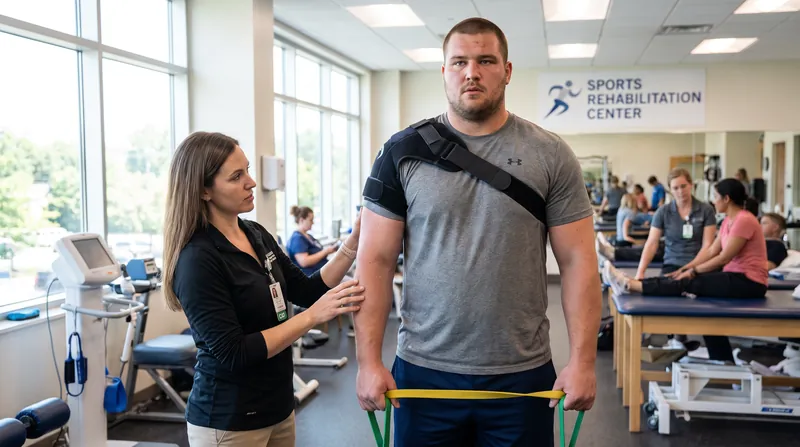
In the women's 59-kilogram and 63-kilogram categories, Canadian Olympic champion Maude Charron is demonstrating how to successfully compete at the highest level while managing chronic reactive tendinopathy. Charron has dealt with persistent knee inflammation since 2022, a condition she affectionately refers to as her "high-maintenance princess." Rather than stepping away from the platform, she has integrated intense daily physical therapy into her programming.
Charron's knee requires a strict daily regimen of targeted massage, topical treatments, and specific morning stretching protocols, supplemented by weekly acupuncture and physiotherapy sessions. This proactive approach allowed her to secure a silver medal in Paris and has kept her active on the international circuit. Sports medicine professionals increasingly point to Charron's regimen as a textbook example of progressive loading, proving that chronic tendinopathy responds better to modified, consistent training than to complete rest.
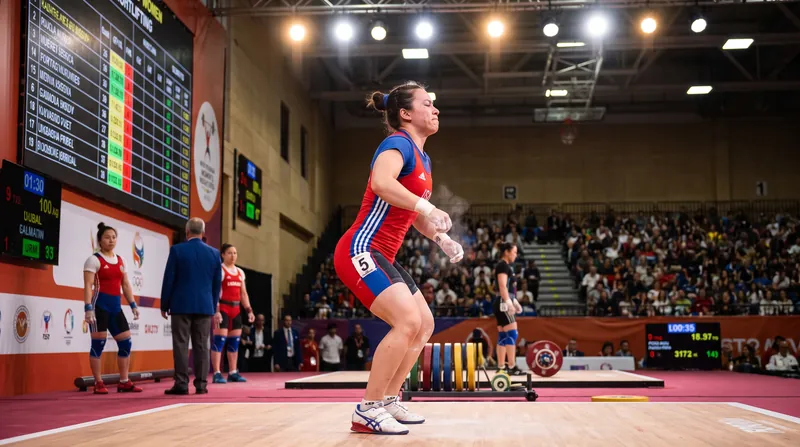
The effectiveness of Charron's management strategy was on full display at the recent Commonwealth Championships in Ahmedabad, India. Competing in the 63-kilogram class, she successfully executed five of her six attempts, securing a dominant victory and qualifying directly for the 2026 Commonwealth Games in Glasgow. After taking a brief, much-needed mental and physical break following the Olympics, Charron is now methodically building her squat volume back up ahead of the Scottish games.[2]
While Djuraev and Charron manage chronic conditions, several athletes are still working their way back from the devastating acute injuries sustained during the Men's 89-kilogram session in Paris. Canada's Boady Santavy, who suffered a severe knee injury during his first clean and jerk attempt, remains in long-term rehabilitation. Similarly, Egypt's Karim Abokahla is steadily rebuilding his upper-body strength after sustaining a significant right bicep and elbow injury during the snatch portion of that same event.
However, the grueling rehabilitation process does yield triumphant returns. Spain's Marcos Ruiz provided a powerful reminder of this at the recent World Championships. After a severe injury completely derailed his hopes of competing in Paris, the 30-year-old heavyweight spent over a year meticulously rebuilding his strength. He returned to the platform in Norway to hit a lifetime personal best total of 406 kilograms, visibly emotional after proving that a catastrophic injury does not have to be a career ender.[1]
As weightlifting's understanding of biomechanics and tissue adaptation evolves, the binary concept of being "injured" versus "healthy" is fading. Elite lifters are increasingly supported by integrated teams of physical therapists and coaches who adjust training variables—volume, intensity, and range of motion—to keep athletes moving. For champions like Djuraev and Charron, the barbell itself remains the most potent tool for recovery, provided the dose is calibrated with precision.
Key points
- Akbar Djuraev is managing a chronic hip issue after setting world records in the 110kg class.
- Maude Charron continues to compete at an elite level while treating chronic knee tendinopathy daily.
- Charron recently won the Commonwealth Championships and qualified for the 2026 Glasgow Games.
- Boady Santavy and Karim Abokahla remain in long-term rehab after severe acute injuries in Paris.
- Spain's Marcos Ruiz successfully returned from a devastating injury to hit a lifetime personal best at age 30.
How we got here
August 2024
Boady Santavy and Karim Abokahla suffer acute injuries during the Men's 89kg Olympic session.
September 2025
Maude Charron wins the Commonwealth Championships, successfully managing her chronic knee issue.
October 2025
Akbar Djuraev sets world records at 110kg but reports chronic hip pain requiring rehabilitation.
Mid-2026
Charron prepares for the Glasgow Commonwealth Games while Djuraev focuses on hip stabilization for the LA 2028 cycle.
- Rehabilitation Specialists
- Advocate for progressive loading and active recovery, noting that chronic tendinopathy responds better to modified training than complete rest.
- National Federations
- Focused on preserving their top medal contenders for the LA 2028 qualification cycle, prioritizing long-term joint health over minor off-season meets.
- The Athletes
- Balancing the psychological toll of chronic pain and grueling daily therapy with the drive to compete at the highest international level.
Perspectives this story doesn't cover
- Sports Psychologists
Sources
Source coverage
2 outlets
3 viewpoints surfaced

- [1]IWFNational Federations
Akbar Djuraev returns to his best weight and posts two world records
Read on IWF → - [2]IWFNational Federations
Five female Olympians among winners at Commonwealth Championships
Read on IWF →
More in Sports
See all →Standings
Women's 81kg Global Standings: Koanda, Ahmed, and Dajomes Set for Historic Clash at the 2026 Ningbo World Championships
6 sources
IWF Youth Worlds
13-Year-Old Rory van Ulft Shatters World Records as Georgia Tops Medal Table at Youth Worlds
6 sources
Injury
Global Weightlifting Injury Report: Rogers Adapts Training as Connelly Vows Comeback Following Glasgow Withdrawal
5 sources
Standings
The Race to Ningbo: Li Wenwen, Park Hye-jeong, and Emily Campbell Headline the Women's +86kg Global Standings
8 sources
Comments
Every angle. Every day.
Get Sports stories with full source coverage and perspective breakdowns, free every day.