
Global Speed Chess Power Rankings: Carlsen's Unbroken Reign and the Rise of Lazavik
Following the conclusion of the 2026 Esports World Cup in Paris, Magnus Carlsen remains the undisputed king of fast time controls, while 19-year-old Denis Lazavik cements his status as the circuit's breakout star.
By Meera Iyer
Share this story
The 2026 speed chess calendar has delivered its highest-stakes moments, culminating in the Esports World Cup (EWC) in Paris and the Speed Chess Championship (SCC) live finals in London. As classical chess continues its traditional circuit, the fast-time-control arenas have exploded in popularity, drawing massive global audiences and lucrative prize pools. The landscape of elite speed chess is undergoing a generational shift, with teenagers dismantling veterans, yet the man at the absolute pinnacle remains entirely immovable.[1][3]
Magnus Carlsen continues to defy the aging curve, retaining his undisputed status as the greatest speed chess player on the planet. At the Esports World Cup in Paris this August, the Norwegian grandmaster successfully defended his title by sweeping 19-year-old Denis Lazavik in straight sets during the Grand Final. Carlsen's run through the Paris bracket was historically dominant; he navigated the entire tournament without dropping a single game, finishing with 11 wins and nine draws against the world's elite.[1][2]
The EWC victory secured Carlsen a $250,000 first-place prize and earned Team Liquid 1,000 crucial Club Championship points, cementing his value not just as an individual competitor but as an esports franchise anchor. This August triumph followed his performance earlier in the year at the Speed Chess Championship in London, where he claimed his third consecutive SCC crown. Across every major fast-chess format in 2026, Carlsen has proven that he is still the ultimate final boss.[1][3]
If Carlsen is the reigning king, Denis Lazavik has firmly established himself as the heir apparent. The 19-year-old Belarusian grandmaster has been the definitive breakout star of the 2026 season. Lazavik surged to the EWC Grand Final in Paris, showcasing a remarkably solid, error-free style that makes him a nightmare to break down in knockout formats. Though he ultimately fell to Carlsen after a critical king-and-pawn endgame error under severe time pressure, his runner-up finish secured vital points for his team, AG.AL, and proved his elite pedigree.[2][5]
Lazavik's phenomenal August run was foreshadowed by his performance at the SCC live finals in London. There, the teenager reached the semifinals before being halted by Carlsen, but he immediately bounced back to edge out American veteran Hikaru Nakamura in the third-place consolation match. By consistently reaching the final weekends of the sport's most prestigious speed events, Lazavik has separated himself from the rest of the chasing pack.[3][6]
Right alongside Lazavik in the next generation's vanguard is Alireza Firouzja, who remains the circuit's ultimate wildcard. The French-Iranian grandmaster pushed Carlsen to the absolute brink in the SCC finals in London, ultimately falling by a narrow 15-12 margin. Firouzja's path to that final was spectacular, highlighted by a thrilling 15-13 overtime victory over Nakamura in the semifinals. When the clock drops below thirty seconds in the 1+1 bullet segments, Firouzja's raw tactical vision makes him arguably the most dangerous player on earth.[3]
The youth movement is equally dominant in the women's speed circuit, highlighted by the meteoric rise of 16-year-old American prodigy Alice Lee. During the Women's Speed Chess Championship in July, Lee delivered a giant-killing performance that shocked the chess establishment. Entering the tournament as the No. 11 seed, she systematically dismantled two-time defending champion Ju Wenjun with a crushing 9.5-3.5 victory in the quarterfinals.[4]
In a ruthless format where a single bad segment can end a tournament, Lee demonstrated the composure of a seasoned veteran. Her ability to completely overpower established world champions in the knockout arena signals a massive generational shift. The $75,000 WSCC event proved that the gap between the traditional classical hierarchy and the new wave of online-native speed specialists is rapidly closing.[4]
Meanwhile, the established titans of the fast-chess world are fighting to hold their ground against this rising tide. Hikaru Nakamura, the American streaming giant and former speed king, remains an elite threat but has found himself edged out in 2026's most crucial moments. Falling to Firouzja in the SCC semifinals and then to Lazavik in the third-place match illustrates how incredibly tight the margins have become at the very top of the sport.[3]
The explosion of the speed chess circuit proves that fast time controls are the future of chess entertainment. The 2025 EWC drew a peak viewership of nearly 260,000 concurrent fans, outpacing prestigious classical tournaments, and the 2026 edition has only built on that momentum. As the season rolls on, the narrative is clear: the next generation has arrived, but they still have to find a way to dethrone Magnus Carlsen.[1][2]
Key points
- Magnus Carlsen defended his Esports World Cup title in Paris without dropping a single game.
- 19-year-old Denis Lazavik reached the EWC Grand Final, cementing his status as the circuit's breakout star.
- Alireza Firouzja and Hikaru Nakamura continue to battle for dominance in the Speed Chess Championship standings.
- 16-year-old Alice Lee signaled a generational shift by dominating the Women's Speed Chess Championship quarterfinals.
- The massive viewership and prize pools of the speed circuit are shifting the commercial center of gravity in chess.
How we got here
February 2026
Magnus Carlsen wins his third consecutive Speed Chess Championship title in London.
July 2026
16-year-old Alice Lee shocks the Women's Speed Chess Championship by eliminating the defending champion.
August 2026
Carlsen sweeps Denis Lazavik in the Grand Final to win the 2026 Esports World Cup in Paris.
- Speed Chess Specialists
- Argue that fast time controls are the truest test of pure intuition and tactical sharpness, favoring younger, online-native players.
- Esports Organizers
- Focus on the commercial viability of speed chess, emphasizing that fast-paced, knockout formats with live broadcasts are essential for growing the game's global audience.
- Classical Traditionalists
- View speed chess as an entertaining but flawed format where blunders dictate outcomes, maintaining that classical time controls remain the gold standard.
Perspectives this story doesn't cover
- Classical World Championship Contenders
- Amateur Club Players
Sources
Source coverage
6 outlets
3 viewpoints surfaced






- [1]Esports World CupEsports Organizers
Magnus Carlsen defends title in Chess at EWC 26
Read on Esports World Cup → - [2]CNNEsports Organizers
Magnus Carlsen successfully defends his crown at Esports World Cup
Read on CNN → - [3]ChessBaseEsports Organizers
Speed Chess Championship concluded in London
Read on ChessBase → - [4]Kingdom of ChessEsports Organizers
Women's Speed Chess Championship 2026 Quarterfinals
Read on Kingdom of Chess → - [5]WikipediaClassical Traditionalists
Denis Lazavik
Read on Wikipedia → - [6]Chess.comSpeed Chess Specialists
Denis Lazavik Player Profile
Read on Chess.com →

More in Sports
See all →Power ranking
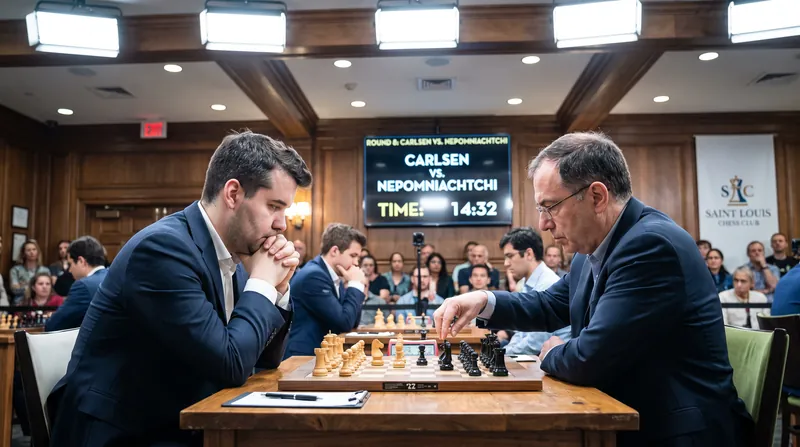
Global Chess Power Rankings: Praggnanandhaa and So Surge Heading Into the Samarkand Olympiad
4 sources
Trade
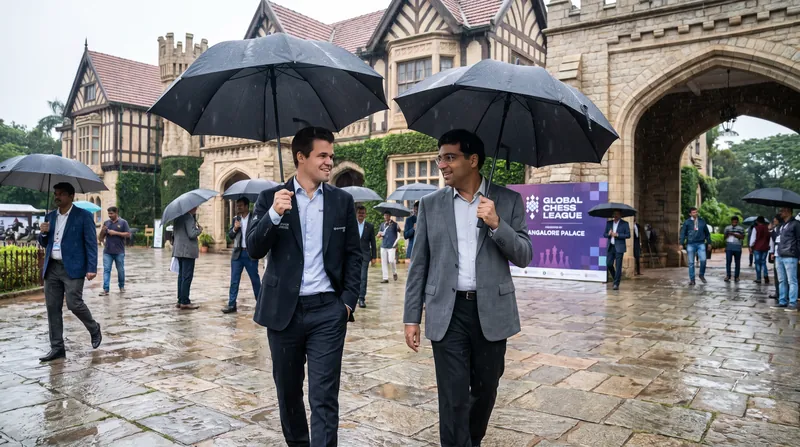
Global Chess League Season 4 Rosters Locked: Carlsen Returns to Pipers, Anand Moves to Alaskan Knights
7 sources
Injury
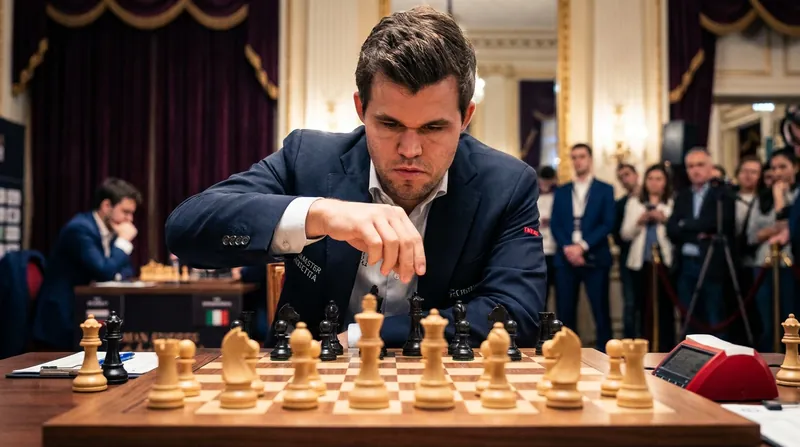
Chess Health Report: Carlsen's Undefeated 'Flu Game' and Aronian's Triumphant Return
6 sources
Injury
Ghanaian Court Overturns Chess Player's Suspension Over Medical Withdrawal
3 sources

Comments
Every angle. Every day.
Get Sports stories with full source coverage and perspective breakdowns, free every day.