
Global Handball Injury Desk: Simić Completes 10-Month Rehab as Moreschi and Thurin Navigate Summer Recoveries
MT Melsungen goalkeeper Nebojsa Simić has made a triumphant return following a devastating knee injury, highlighting a busy summer of rehabilitation across global handball. Meanwhile, CSM Bucuresti's Gabriela Moreschi and Montpellier's Jack Thurin face their own recovery timelines ahead of the 2026–27 season.
By Meera Iyer

Share this story
The physical toll of elite handball is coming into sharp focus this summer as clubs balance celebrating major injury returns with managing fresh casualties from the end of the 2025–26 season.
The highlight of the summer is the triumphant return of MT Melsungen goalkeeper Nebojsa Simić. After suffering a catastrophic knee injury in April 2025—tearing all ligaments and both menisci—the Montenegrin international endured a grueling 10-month rehabilitation.[1]
Simić's return proved decisive, as he anchored Melsungen's qualification for the Winamax EHF Finals 2026 in Hamburg. His presence in the net restored a critical defensive pillar for the German Bundesliga side at the most crucial point of the year.[1]
"The surgery took more than two hours, for six weeks I needed crutches to walk, more than 10 months I was ruled out," Simić recounted, expressing his profound relief at finally returning to high-stakes European competition.[1]
While Simić celebrates his comeback, other elite players are just beginning their long rehabilitation journeys following severe late-season setbacks.
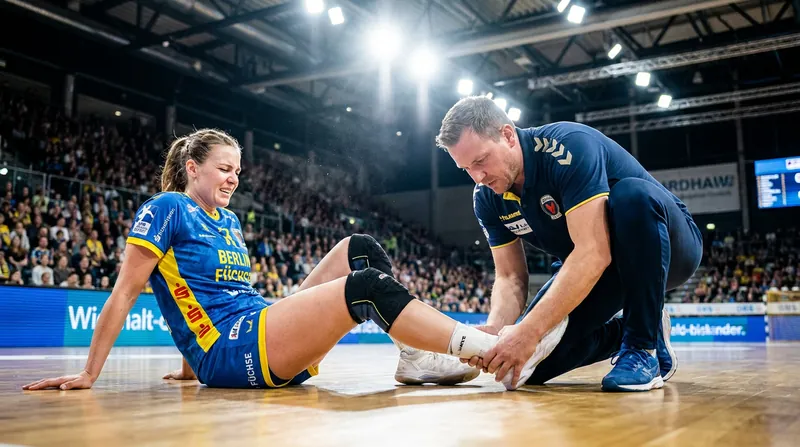
In the Women's EHF Champions League, CSM Bucuresti goalkeeper Gabriela Moreschi suffered a knee injury during the 3/4 placement match of the EHF FINAL4 in Budapest on June 7.
Moreschi had been delivering a stellar performance against Brest Bretagne Handball, recording 10 saves before being forced off the court in the 42nd minute. Her teammate Evelina Eriksson stepped up to secure the 32:26 victory, but Moreschi's summer will now be entirely dedicated to recovery.
In the Men's EHF European League, Montpellier Handball has been forced to navigate the postseason without their leading scorer, Jack Thurin.
The Swedish right back suffered a dislocated knee in April, abruptly ending his campaign and ruling him out of Montpellier's critical quarter-final clashes against HC Vardar 1961.
Similarly, Veszprém HC felt the immediate impact of losing centre back Luka Cindrić during their Machineseeker EHF Champions League quarter-final thriller against Füchse Berlin in early May.
Cindrić's mid-game injury shifted the tactical balance, forcing head coach Xavi Pascual to scramble his backcourt rotation as Veszprém ultimately fell short in a tense penalty shootout.
Beyond the European theater, the Asian handball circuit is welcoming back a familiar face. Bahraini youth international Ahmed Al Ghazal has been medically cleared to return to the court after nearly two seasons sidelined by severe health issues.[2]
Al Ghazal, who last played for Tubli Club in the 2023–24 season and previously won the Asian youth title with Bahrain, is now a free agent seeking a new club ahead of the fall campaigns.[2]
The contrasting timelines of these athletes underscore the evolving sports science behind handball recoveries. Recent studies published in the Journal of Human Sport & Exercise emphasize that elite handball players face a 35.3% reinjury risk if they return to the court before achieving full neuromuscular symmetry.
Sports physiotherapists now strongly advocate for delaying return-to-play until at least the nine-month mark following major knee reconstructions. Data shows that returning before nine months increases the risk of a second ACL tear by up to seven times—a protocol that Simić's successful 10-month timeline validates.
To combat these trends proactively, federations are launching new surveillance initiatives. In July 2026, Olympic Handball Ireland rolled out a comprehensive injury reporting framework funded by Sport Ireland to track injury types and frequencies across its senior leagues.
Additionally, a July 2026 study in the journal Diagnostics highlighted that up to 34.3% of competitive male handball players exhibit asymptomatic patellar tendinopathy on ultrasounds. Researchers are urging clubs to use routine imaging to catch overuse injuries before they result in lost court time.[3]
Researchers are urging clubs to use routine imaging to catch overuse injuries before they result in lost court time.
As the 2026–27 preseason approaches, medical staffs across the globe will be carefully monitoring these athletes, balancing the urgency of competition with the long-term health required to survive handball's punishing physical demands.
Key points
- MT Melsungen goalkeeper Nebojsa Simić successfully returned from a 10-month knee rehabilitation to play in the EHF Finals.
- CSM Bucuresti's Gabriela Moreschi and Montpellier's Jack Thurin both suffered late-season knee injuries requiring summer rehab.
- Bahraini youth international Ahmed Al Ghazal has been cleared to play after missing two seasons due to health issues.
- Sports scientists warn that returning to handball before nine months post-ACL surgery drastically increases reinjury risk.
How we got here
April 2025
Nebojsa Simić suffers a catastrophic knee injury, tearing his ACL and both menisci.
April 2026
Montpellier's Jack Thurin dislocates his knee, ruling him out of the EHF European League quarter-finals.
May 2026
Simić returns to the court to help MT Melsungen qualify for the Winamax EHF Finals.
June 2026
Gabriela Moreschi sustains a knee injury during the Women's EHF FINAL4 placement match.
July 2026
Ahmed Al Ghazal is medically cleared to resume his handball career in Bahrain.
- Sports Medical Professionals
- Advocating for conservative, data-driven rehabilitation timelines to ensure full neuromuscular recovery and prevent reinjury.
- Club Management & Coaches
- Focused on tactical adjustments and roster depth when key players go down, balancing immediate competitive needs with player health.
- Players & Athlete Advocates
- Emphasizing the psychological toll of long-term injuries and the intense personal drive required to complete grueling rehabs.
Perspectives this story doesn't cover
- Surgeons specializing in elite sports orthopedics
- Handball equipment manufacturers developing protective gear
Sources
Source coverage
3 outlets
3 viewpoints surfaced



- [1]European Handball FederationPlayers & Athlete Advocates
Nebojsa Simić: Back on court, out for his first title
Read on European Handball Federation → - [2]News of BahrainPlayers & Athlete Advocates
Ahmed Al Ghazal ready for handball return
Read on News of Bahrain → - [3]DiagnosticsSports Medical Professionals
Musculoskeletal Ultrasonography of the Knee in Young Elite Handball and Basketball Athletes
Read on Diagnostics →
More in Sports
See all →Injury
Global Handball Injury Desk: Zehnder and Palicka Complete Remarkable Returns as Scaglione Faces Wrist Surgery
5 sources
Injury
Handball Medical Update: Palicka’s Unorthodox Rehab and Zehnder’s Triumphant Return Set the Stage for 2026
2 sources
Injury
Summer Handball Injury Desk: Kukic, Munk, and Wiede Navigate Critical Recoveries Ahead of 2026–27 Season
2 sources
Injury
International Handball Injury Update: High-Profile Casualties and the 35% ACL Reinjury Crisis
3 sources
Comments
Every angle. Every day.
Get Sports stories with full source coverage and perspective breakdowns, free every day.