
Global Fencing Injury Report: Bianchi's Resurgence, Mohamed's Setback, and the Toll of the 2026 Season
As the 2026 fencing season approaches the World Championships, the physical toll of the international circuit is reshaping the standings, highlighted by Guillaume Bianchi's triumphant return and Moutaz Mohamed's recent withdrawal.
Share this story
The 2026 international fencing season has been a grueling war of attrition. With the Senior World Championships in Hong Kong fast approaching, the global circuit has tested the physical limits of the world's top fencers. The asymmetrical nature of the sport—requiring hours of explosive lunging, rapid changes of direction, and heavy deceleration on the lead leg—creates a unique injury profile that demands rigorous load management and specialized rehabilitation.[3][4]
In the men's foil division, Italy's Guillaume Bianchi has provided a dramatic and inspiring example of the injury-recovery cycle. During the Paris World Cup in January 2026, the Paris 2024 Olympic silver medalist was forced to withdraw due to an injury during his semi-final bout against American Alexander Massialas. The sudden exit left Bianchi with a bronze medal and raised immediate concerns about his trajectory for the remainder of the season.[1][7]
However, Bianchi underwent a meticulous rehabilitation protocol, focusing on restoring dynamic stability and eccentric strength to protect his lower extremities from the violent forces of the lunge. His recovery proved spectacular. Bianchi returned to the piste with vengeance, capturing gold at the Turin Grand Prix in February and following it up with another gold at the Lima Grand Prix in March, where he defeated Kirill Borodachev 15-12 in a thrilling final. His resilience has firmly cemented his status as the world No. 2 in foil.[1][4]
While Bianchi's story is one of successful recovery, the epee circuit recently witnessed a major disruption. At the UIPM World Cup in Pazardzhik, Bulgaria, in May 2026, Egyptian world No. 1 Moutaz Mohamed suffered a severe fencing injury during the men's semi-final. Mohamed, who had been virtually unbeatable for over 12 months, sustained the injury directly on the piste, causing a significant delay to the proceedings and forcing his immediate withdrawal.[2]
Mohamed's unexpected exit blew the competition wide open, allowing rivals like Korea's Changwan Seo to capitalize and claim gold. The Egyptian medical team is now racing against the clock to rehabilitate Mohamed's injury ahead of the summer championships. His absence has drastically altered the landscape of the men's epee standings, serving as a stark reminder of how quickly an acute injury can upend a dominant reign.[2]
Conversely, the women's circuit celebrated a triumphant comeback at the Budapest World Cup in late May. Mariya Gnedtchik, competing as an Individual Neutral Athlete, made an impressive return to the piste after a prolonged absence due to injury. Gnedtchik, who previously won gold at the 2024 Budapest World Cup, demonstrated that careful, patient rehabilitation can successfully restore an athlete to elite form, providing a blueprint for others navigating the arduous recovery process.[2]
The prevalence of these injuries aligns closely with recent advancements in sports medicine research. A 2026 prospective cohort study published in 'The Physician and Sportsmedicine' tracked elite fencing athletes over 12 months, revealing an overall incidence of 3.22 injuries per 1,000 training hours. The data confirmed that overuse injuries vastly outnumber acute traumas, driven by the repetitive strain of daily training.[3]
The study highlighted that the lower extremity is the most frequently injured region, accounting for over 57.5% of all recorded injuries. Ligament injuries, particularly in the knee and ankle, required the longest return-to-sport durations. Sports physiotherapists note that patellar tendinopathy and meniscal irritation are typically linked to repetitive loading rather than single traumatic events, making proactive strength screening essential.[3][4]
Despite these challenges, fencing remains one of the safest combat sports. A comprehensive six-season analysis by USA Fencing, encompassing over 637,000 direct elimination bouts, found a medical withdrawal rate of just 0.338%. The data indicates that while elite athletes push their bodies to the brink, the overall risk of catastrophic injury remains remarkably low, especially when proper conditioning and recovery protocols are followed.[5]
To further combat attrition, the International Fencing Federation (FIE) has placed a renewed emphasis on athlete health and longevity. The upcoming FIE Hong Kong Sports Medicine Conference, scheduled for July 23, 2026, alongside the Senior World Championships, will focus specifically on injury trends, biomechanical demands, and the implementation of the Fencing Injury Surveillance System (FISS).[1][6]
As fencers finalize their preparations for the ultimate test in Hong Kong, the focus in training camps worldwide has shifted from pure technical refinement to holistic injury prevention. For athletes like Bianchi, Mohamed, and Gnedtchik, the greatest opponent on the piste is often their own physical limits—and mastering those limits is the true mark of a champion.[1][2][4]
Key points
- Italy's Guillaume Bianchi recovered from a January injury withdrawal to win back-to-back Grand Prix golds in Turin and Lima.
- Egyptian world No. 1 Moutaz Mohamed suffered a fencing injury in May, forcing his withdrawal from the Pazardzhik World Cup.
- Mariya Gnedtchik made a successful return from injury at the Budapest World Cup, highlighting the power of patient rehabilitation.
- A 2026 study revealed that elite fencers suffer 3.22 injuries per 1,000 training hours, predominantly overuse injuries.
- Lower extremity issues account for 57.5% of all fencing injuries, driven by the heavy deceleration of the lunge.
- The FIE is launching a dedicated Sports Medicine Conference in Hong Kong to address athlete safety and injury prevention.
How we got here
January 2026
Guillaume Bianchi withdraws from the Paris World Cup semi-final due to injury, settling for bronze.
February 2026
Bianchi makes a triumphant return, capturing gold at the Turin Grand Prix.
March 2026
Bianchi secures his second consecutive gold at the Lima Grand Prix, defeating Kirill Borodachev.
April 2026
The Physician and Sportsmedicine publishes a landmark study on fencing injury patterns, highlighting lower extremity risks.
May 2026
World No. 1 Moutaz Mohamed suffers a fencing injury at the Pazardzhik World Cup, forcing his withdrawal.
May 2026
Mariya Gnedtchik successfully returns from injury to compete at the Budapest World Cup.
- Medical Consensus
- Focuses on biomechanics and load management to prevent overuse injuries.
- Athletic Resilience
- Highlights the athletes' drive to rehabilitate and return to elite competition.
- Governing Bodies
- Prioritizes systemic safety tracking and tournament protocols to protect fencers.
Perspectives this story doesn't cover
- Club-level fencing coaches who manage the daily training loads of developing athletes.
- Sports psychologists who assist fencers in overcoming the mental hurdles of returning from a severe injury.
Sources
Source coverage
7 outlets
3 viewpoints surfaced







- [1]FIEAthletic Resilience
Bianchi Captures Gold at Lima Foil Grand Prix
Read on FIE → - [2]UIPM WorldAthletic Resilience
UIPM 2026 Pentathlon World Cup Pazardzhik: Seo (KOR) Capitalises on Mohamed (EGY) Injury
Read on UIPM World → - [3]The Physician and SportsmedicineMedical Consensus
Training-related injury patterns and return-to-sports in elite fencing athletes: a prospective cohort study
Read on The Physician and Sportsmedicine → - [4]Strength4FencingMedical Consensus
Knee Injuries in Fencing: Causes, Rehabilitation Principles and Return to Piste
Read on Strength4Fencing → - [5]Academy of Fencing MastersGoverning Bodies
The Numbers Are In: Fencing Remains One of the Safest Combat Sports
Read on Academy of Fencing Masters → - [6]Inside the GamesGoverning Bodies
Fencing points to future with new league and medical focus
Read on Inside the Games → - [7]Getty ImagesAthletic Resilience
Guillaume Bianchi of Italy reacts with an injury during the Fencing Men's Foil
Read on Getty Images →
More in Sports
See all →Injury
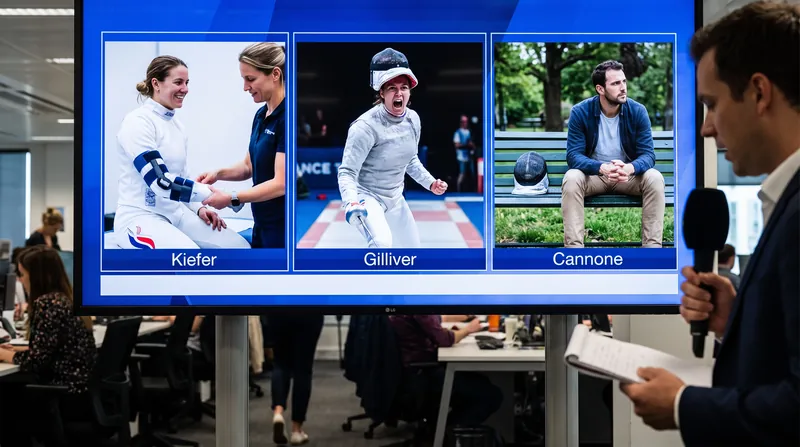
Global Fencing Injury Report: Kiefer's Recovery, Gilliver's Return, and Cannone's Mental Health Break
4 sources
Standings
Historic Gridlock in FIE Epee Standings Sets Up Winner-Takes-All World Championship Showdown
4 sources
Injury
French Fencing Star Ysaora Thibus Returns to the Piste After Knee Surgery and Legal Exoneration
4 sources
Injury
Fencing Injury Report: World Cup Absences Mount as FIE Launches New Safety Protocols
6 sources

Comments
Every angle. Every day.
Get Sports stories with full source coverage and perspective breakdowns, free every day.