
Dylan McCullough Caps 18-Month Injury Nightmare With World Cup Gold in Asunción
After a career-threatening spine and Achilles injury sidelined him for 574 days, New Zealand's Dylan McCullough has surged back to the top of the sport with back-to-back World Cup medals in South America.

Share this story
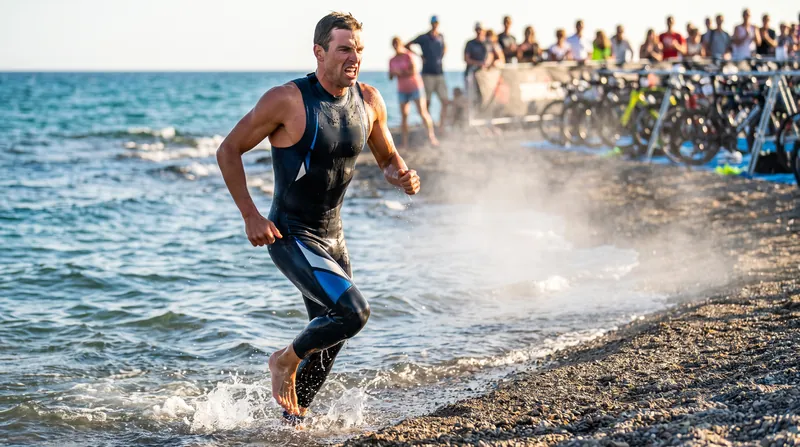
The blue carpet in Asunción was supposed to be a coronation for the new generation of short-course speedsters, but Dylan McCullough had other plans. In a brutal, shoulder-to-shoulder sprint over the final 300 meters of the World Triathlon Cup, the 25-year-old New Zealander found an extra gear that didn't exist a year ago.
He dropped Germany’s Justus Töpper by nine seconds to break the tape, letting out a roar that carried the weight of 18 agonizing months on the sidelines. The comeback wasn't just on schedule; it was terrifyingly ahead of it.[2][3]
McCullough’s victory in Paraguay on August 9 didn't happen in a vacuum. It came exactly seven days after he tore through the Copacabana surf to claim a spectacular silver at the World Triathlon Cup in Rio de Janeiro.
Back-to-back medals on the grueling Americas swing have officially put the triathlon world on notice: the Kiwi who famously sacrificed his own Olympic dreams in Paris is back, and he is racing with house money. For a man who spent the better part of two years wondering if he would ever walk without pain, standing on top of a World Cup podium is nothing short of a medical marvel.[1][2]
To understand the gravity of this two-week tear, you have to rewind to the summer of 2024. At the Paris Olympics, McCullough wrote himself into New Zealand triathlon lore by deliberately dropping back on the bike leg to drag teammate Hayden Wilde into silver-medal contention.
It was the ultimate selfless act on the sport's biggest stage, but the physical toll of that relentless season was devastating. Shortly after the Games, his body gave out entirely—diagnosed with a near-complete stress fracture in his spine, compounded by a severe Achilles tear that brought his career to a grinding halt.[1][5]
For 574 excruciating days, McCullough disappeared from the elite start lists. The dual injuries were so severe, and the rehabilitation so complex, that early retirement wasn't just a passing thought; it was a daily conversation in his camp.
'Last year was a really tough year, and you know, I wasn’t even sure I’d come back to the sport,' McCullough confessed after his Rio podium. The road back required a complete physical and mental rebuild, prompting legendary coach John Hellemans to come out of retirement just to guide the young Aucklander through the darkest phases of his recovery.[1]
The return began quietly in May 2026 with low-stakes Continental Cup starts in Asia, far away from the glare of the European circuit. McCullough showed up in Lianyungang, China, and Osaka, Japan, treating the sprint-distance events as glorified fitness tests to see how the spine and Achilles would hold up under race pressure.
He won both comfortably. But the real litmus test arrived in August, when the World Cup circuit touched down in South America. The fields were significantly deeper, the pace was punishing, and the crucial Olympic Qualification points for LA 2028 were finally on the line.[3][4]
In Rio de Janeiro, on the exact same pancake-flat beachfront circuit that hosted the 2016 Olympic Games, McCullough proved his engine was fully rebuilt. He led the 62-man field out of the water and immediately went to work fracturing the peloton on the bike.
American Braxton Legg, who ultimately won the race, was blunt about the Kiwi's sheer power: 'Huge thanks to Dylan McCullough. He was hammering the bike the whole time and killing us all, but it was perfect.' McCullough held on for silver, missing the gold medal by a single second in a thrilling finish.[1]
If Rio was the proof of concept, Asunción was the tactical masterpiece. Once again, McCullough dictated the terms from the starting gun, exiting the 1,500-meter swim with an 11-second cushion over the rest of the field. On the bike, he orchestrated a five-man breakaway that included Töpper and Australia’s Toby Powers, driving the pace so relentlessly that the massive 18-man chase pack bled nearly three minutes by the second transition. It was a textbook execution of neutralizing the pure runners by burying them in a massive deficit before T2.[2][3]
But the 10-kilometer run in the stifling Paraguayan heat nearly broke him. 'My legs were pretty cooked on the run, they were cramping badly,' McCullough admitted in his post-race interview. With 5 kilometers remaining, the severe cramps finally subsided, allowing him to lock into a brutal shoulder-to-shoulder duel with Töpper. When the German surged in the final kilometer, McCullough responded, unleashing a devastating finishing kick that secured his first World Cup gold since Tongyeong in late 2024, crossing the line in 1:42:41.[3]
The stakes of this South American sweep cannot be overstated for New Zealand's high-performance program. Before he pinned on a number in May, McCullough’s official world ranking had plummeted to a dismal 269th due to inactivity. Today, he sits at 108th globally and, crucially, has rocketed up to 27th in the World Triathlon Olympic Qualification Rankings. That makes him the top-ranked Kiwi male in the LA 2028 hunt, leapfrogging Saxon Morgan, Tayler Reid, and even Wilde, whose early qualifying window has been marred by a frustrating bout of lung inflammation.[3]
For Team NZL, McCullough’s spectacular resurgence changes the entire calculus for the next Olympic cycle. If the federation can keep three men inside the top 30 of the qualification rankings, they unlock a maximum three-athlete roster for the individual races in Los Angeles. McCullough isn't just fighting for a spot on the pontoon anymore; he is actively driving the national standard. The spine is healed, the Achilles is intact, and the most selfless man in triathlon is finally racing for his own glory.[3]
Key points
- Dylan McCullough won gold at the World Triathlon Cup Asunción, edging Germany's Justus Töpper by nine seconds.
- The victory comes just one week after McCullough took silver at the World Triathlon Cup in Rio de Janeiro.
- McCullough recently returned from an 18-month layoff due to a near-complete spine stress fracture and an Achilles tear.
- The back-to-back medals have rocketed McCullough to 27th in the Olympic Qualification Rankings, making him the top-ranked New Zealand male.
How we got here
August 2024
McCullough sacrifices his own race to help Hayden Wilde win silver at the Paris Olympics.
Late 2024
Diagnosed with a near-complete spine stress fracture and Achilles tear, halting his career.
May 2026
Returns to racing after 574 days, winning Asia Triathlon Cups in Lianyungang and Osaka.
August 2, 2026
Claims silver at the World Triathlon Cup Rio de Janeiro on the Copacabana course.
August 9, 2026
Wins gold at the World Triathlon Cup Asunción, surging to 27th in the Olympic rankings.
- The Comeback Athlete
- McCullough's camp emphasizes the grueling mental and physical toll of the 18-month rehab and the sheer relief of returning to form.
- The Coaching Staff
- The trainers and coaches who managed his return, including John Hellemans coming out of retirement to oversee the rebuild.
- The Rivals & Peloton
- Fellow competitors who respect McCullough's immense power on the bike and his selfless history in the sport.
Perspectives this story doesn't cover
- National selectors balancing the LA 2028 squad dynamics
- Medical staff who managed the 18-month dual-injury rehabilitation
Sources
Source coverage
5 outlets
3 viewpoints surfaced




- [1]SBR MagThe Coaching Staff
Silver in Rio continues McCullough's remarkable road back from career-threatening injury
Read on SBR Mag → - [2]World TriathlonThe Comeback Athlete
From Rio silver to Asuncion gold: McCullough's late charge delivers the win
Read on World Triathlon → - [3]SBR MagThe Coaching Staff
The comeback is done. Dylan McCullough is officially back and basking in the golden afterglow
Read on SBR Mag → - [4]Tri247
World Triathlon announces 2026 race calendar with new World Cup venues
Read on Tri247 → - [5]New Zealand Olympic Committee
Dylan McCullough - New Zealand Olympic Team
Read on New Zealand Olympic Committee →
More in Sports
See all →Trade
Supertri Finalizes Jersey Roster: Yee and Wilde Renew Rivalry as Brownlee Bows Out
2 sources
Storyline
Lucy Charles-Barclay Withdraws From 70.3 World Championship to Go All-In on Kona Redemption
6 sources
Recap
Laura Philipp and Lasse Nygaard Priester Sweep Ironman 70.3 Zell am See-Kaprun
6 sources
Trade
Triathlon Enters Its 'Free Agency' Era: T100 Drops Season Contracts as French Riviera Roster Takes Shape
2 sources
Comments
Every angle. Every day.
Get Sports stories with full source coverage and perspective breakdowns, free every day.