
Democrat Abdul El-Sayed Defeats Mike Rogers in Michigan to Become First Muslim US Senator
Democrat Abdul El-Sayed has defeated Republican Mike Rogers to win Michigan's open US Senate seat. The victory secures a critical hold for the Democratic Party and makes the former Detroit health director the first Muslim elected to the upper chamber.

Share this story
Following an unprecedented $220 million campaign cycle and months of bitter partisan attacks, Michigan voters have elected a progressive insurgent to represent them in Washington. The closely watched contest concluded early Wednesday morning when the Associated Press called the race for the 42-year-old former public health official. The result ends a grueling proxy battle over the ideological direction of the Midwestern electorate.[1][2]
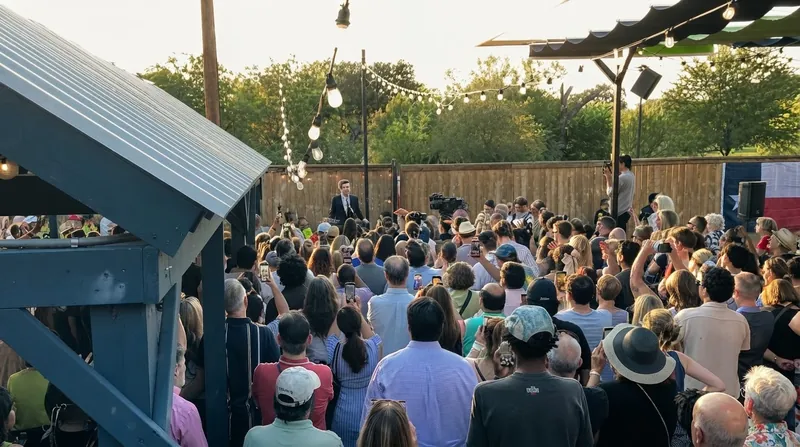
El-Sayed declared victory at the state Democratic headquarters in Detroit, addressing a jubilant crowd of supporters. He framed the win as a triumph over bigotry and corporate influence, following a campaign marked by intense national scrutiny and personal attacks. "You took a chance on the unlikeliest of candidates," El-Sayed told the audience.[1]
The newly elected senator directly addressed the Islamophobic rhetoric that characterized the Republican opposition throughout the cycle. "To all the parents who struggled to explain why the president openly mocks someone for their name or how they pray, let them know tomorrow that the bad guys lost," he said. He credited his grassroots movement for overcoming the well-funded opposition.[4]
The Michigan seat was left open by retiring two-term Democratic Senator Gary Peters. Rogers, an Army veteran and former FBI agent, had hoped to capitalize on economic anxieties to claim the seat. He previously lost a narrow 2024 Senate bid to Elissa Slotkin by fewer than 20,000 votes.[2][4]
Despite Rogers' deep resume and the backing of President Donald Trump, the Republican strategy ultimately fell short against El-Sayed's populist economic message. The race drew well over $220 million in total advertising spending by mid-October, reflecting its critical importance to the national balance of power. Both parties viewed Michigan as a must-win state for control of the Senate.[1]
A Campaign Defined by Sharp Contrasts
The general election presented Michigan voters with a stark ideological choice between a populist progressive and a traditional conservative. El-Sayed campaigned on a platform of passing Medicare for All, breaking up corporate monopolies, and overhauling campaign finance laws. He consistently argued that working-class voters were being left behind by an establishment beholden to wealthy donors.[2][4]
Rogers countered with a platform focused on tax cuts for working families and pledges to restore the state's manufacturing base. He attempted to walk a careful line, embracing Trump's economic policies while occasionally distancing himself from the White House's more controversial statements. Rogers argued that El-Sayed's progressive policies would endanger communities and drive up the cost of living.[2]
As the race tightened, the rhetoric from national Republicans grew increasingly hostile. Trump and top allies repeatedly targeted El-Sayed's faith, with the president falsely labeling him a "jihadist" and a member of the Muslim Brotherhood. Trump even invoked the September 11 terror attacks while urging Michiganders to vote against the Democrat.[1][2]
El-Sayed forcefully rejected the accusations, telling Fox News during the campaign that he had never been affiliated with the Muslim Brotherhood. He argued that his detractors were relying on divisive fear-mongering because they lacked substantive answers to the rising costs of groceries and housing. The attacks ultimately failed to dissuade the diverse coalition of voters that propelled him to victory.[2]
During his victory speech, El-Sayed delivered a pointed message to the White House regarding the months of racially charged rhetoric. "Donald, I know you struggled with my name," the senator-elect said from the stage in Detroit. "So after JD swears me in in January, you can just go on to call me Senator."[4]
Surviving a Fractured Democratic Primary
El-Sayed's path to the Senate was complicated by deep divisions within his own party. He narrowly defeated Representative Haley Stevens by approximately one percentage point in August, surviving a proxy war between the progressive and establishment wings. Stevens had the backing of prominent figures, including Governor Gretchen Whitmer.[2][4]
Foreign policy became a major flashpoint in the race, particularly regarding the ongoing conflict in Gaza and United States policy toward Israel. El-Sayed advocated for ending American taxpayer support for Israel's military, a position that drew sharp rebukes from Jewish Democrats but galvanized young progressive voters. The stance made him a primary target for pro-Israel lobbying groups.[2]
The American Israel Public Affairs Committee, operating through its Super PAC United Democracy Project, spent roughly $30 million during the primary in an effort to defeat El-Sayed. The unprecedented spending set a record for a single race, highlighting the national establishment's anxiety over his candidacy. Despite the financial disadvantage, El-Sayed's grassroots organizing secured the nomination.[1]
The primary rivalry continued to haunt the general election, culminating in a dramatic defection just days before voters went to the polls. On the Sunday before Election Day, Stevens officially retracted her endorsement of El-Sayed and announced she would support Rogers instead. She cited El-Sayed's criticism of Israel and a personal conflict over campaign advertisements as her primary motivations.[2][4]
Stevens' unprecedented cross-party endorsement outraged many Democrats, who viewed it as a betrayal that threatened the party's Senate majority. However, political analysts suggest the defection may have inadvertently helped El-Sayed in the final hours. The controversy generated millions of dollars in last-minute grassroots donations and energized progressive voters who viewed the establishment's resistance as proof of his anti-corruption credentials.[1][4]
Mobilizing a New Electorate
To overcome the institutional resistance and Republican attacks, El-Sayed built a coalition heavily reliant on young people, minority communities, and infrequent voters. He spent a year and a half campaigning across Michigan, focusing equally on the state's largest urban centers and its smallest rural towns. His background as a public health official provided a foundation for his detailed healthcare proposals.[2]
El-Sayed first gained statewide prominence during an unsuccessful bid for the Democratic gubernatorial nomination in 2018. Since then, he has cultivated a loyal following by consistently advocating for systemic reforms rather than incremental changes. "We showed that in a battle between the money and the many, that the many can win," he told his supporters on election night.[1][4]
His campaign successfully harnessed widespread frustration over the cost of living, directing voter anger toward corporate monopolies rather than the opposing party. El-Sayed argued that ordinary citizens were struggling to pay taxes while the government prioritized funding foreign wars over domestic needs. This economic populism resonated even in some conservative-leaning areas of the state.[2][4]
The victory demonstrates the viability of an unapologetically progressive platform in a critical Midwestern swing state. National Democrats had previously questioned whether a candidate with El-Sayed's leftist credentials could win a general election in a state that twice supported Donald Trump. His success provides a new blueprint for progressive organizers operating outside deep-blue coastal strongholds.[1][2]
Reshaping the Senate Landscape
The outcome in Michigan fundamentally alters the balance of power in Washington as the new Congress prepares to convene in January 2027. El-Sayed's victory ensures that Democrats retain a critical seat, complicating the Republican agenda for the final two years of the Trump administration. It also establishes El-Sayed as a prominent national voice within the Democratic Party.[1][3]
As Democrats wrestle with their party's identity, El-Sayed is positioned to influence the debate over future strategy. His ability to withstand tens of millions of dollars in negative advertising suggests traditional attack lines may be losing effectiveness. The progressive wing is already pointing to Michigan as a model for future contests.[2]
For Republicans, the loss represents a significant missed opportunity to capitalize on a fractured Democratic base and an open seat. Rogers' defeat, his second consecutive Senate loss after the 2024 cycle, raises questions about the GOP's approach in Midwestern battlegrounds. The party's reliance on culturally divisive rhetoric failed to overcome the economic concerns driving voter turnout.[2][3]
The historic nature of El-Sayed's election is expected to resonate far beyond Michigan's borders, particularly for Muslim Americans seeking representation in federal government. Community leaders have hailed the victory as a milestone that shatters a long-standing political ceiling. It signals a growing acceptance of diverse religious backgrounds in the highest levels of American politics.[1][4]
Community leaders have hailed the victory as a milestone that shatters a long-standing political ceiling.
When the new Congress is sworn in, El-Sayed will transition from an insurgent candidate to a sitting senator with a mandate for systemic change. He faces the immediate challenge of translating his ambitious campaign promises into legislative action within a deeply divided chamber. However, his decisive victory in Michigan ensures he will arrive in Washington with significant political capital.[2][3]
Key points
- Abdul El-Sayed defeated Republican Mike Rogers to win Michigan's open Senate seat, becoming the first Muslim elected to the US Senate.
- The victory secures a crucial seat for the Democratic Party in its effort to maintain control of the upper chamber.
- El-Sayed overcame a fractured Democratic primary and an unprecedented late-stage endorsement retraction from Representative Haley Stevens.
- The race drew over $220 million in advertising spending and featured intense national scrutiny, including personal attacks from President Trump.
What we don’t know
- How El-Sayed's staunchly progressive platform, particularly his stance on Medicare for All, will align with the broader Democratic agenda in the closely divided Senate.
- Whether the unprecedented cross-party endorsement by Representative Haley Stevens will lead to formal disciplinary action or lasting fractures within the Michigan Democratic Party.
- How the influx of new, infrequent voters mobilized by El-Sayed's campaign will impact future statewide elections in the Midwest.
How we got here
August 2026
Abdul El-Sayed narrowly defeats Representative Haley Stevens in the Democratic primary by roughly one percentage point.
Mid-October 2026
Total advertising spending in the Michigan Senate race surpasses $220 million, breaking regional records.
November 1, 2026
November 3, 2026
Abdul El-Sayed defeats Mike Rogers in the general election, securing the open Senate seat.
- Progressive Wing
- Argues that unapologetic economic populism and grassroots organizing are the key to winning swing states.
- Establishment Democrats
- Values party unity and remains cautious about how progressive foreign policy stances play in general elections.
- Conservative Base
- Believes progressive policies threaten economic stability and national security.
Perspectives this story doesn't cover
- Michigan working-class voters
- Arab American community leaders in Dearborn
Sources
Source coverage
4 outlets
3 viewpoints surfaced




- [1]The GuardianProgressive Wing
Progressive Abdul El-Sayed wins Michigan Senate race to become first Muslim US senator
Read on The Guardian → - [2]CBS NewsConservative Base
Abdul El-Sayed wins Michigan 2026 Senate election, CBS News projects - CBS News
Read on CBS News → - [3]AxiosEstablishment Democrats
Abdul El-Sayed defeats Mike Rogers in 2026 Michigan Senate election
Read on Axios → - [4]Al JazeeraProgressive Wing
El-Sayed defeats Rogers to win Senate seat in Michigan
Read on Al Jazeera →
More in News & Politics
See all →Midterm Elections
Trump Job Approval Plummets to 32 Percent Ahead of US Midterm Elections
4 sources
Judicial Process
Supreme Court Rule of Four: How the Justices Select Their Docket
14 sources
Labor Rights
Dolores Huerta, Pioneer of Farmworker Movement and Civil Rights Icon, Dies at 96
4 sources
Political Corruption
Flávio Bolsonaro Lands in Miami With US Visa After Fleeing Brazilian Corruption Probe
5 sources

Comments
Every angle. Every day.
Get News & Politics stories with full source coverage and perspective breakdowns, free every day.