
Avalanche Kills 11 Climbers and Leaves Six Missing on Russia's Mount Mizhirgi
A massive avalanche in the Bezengi Gorge struck a camp of 33 climbers on a training exercise, triggering a major search and rescue operation and a criminal negligence investigation.
By Jackson Reed

Share this story
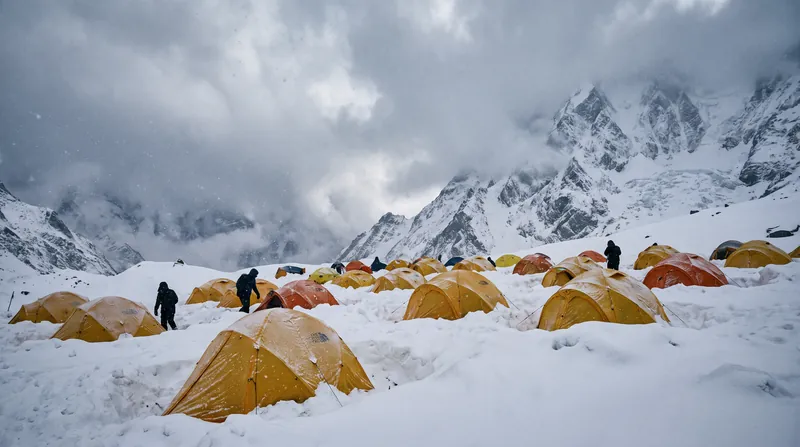
At 5:00 p.m. local time on Sunday, September 6, 2026, a massive wall of snow, ice, and rock broke loose from the upper slopes of Mount Mizhirgi. The 5,025-meter peak in Russia's Bezengi Gorge became the site of one of the deadliest mountaineering disasters in the North Caucasus in recent years, as the avalanche swept directly into a camp of 33 climbers. The sheer volume of the slide left those in its path with virtually no time to react or seek shelter.[2][4][5]
The immediate toll was catastrophic. Eleven climbers were killed instantly by the crushing force of the debris. Ten members of the group managed to dig themselves out of the snowpack and descend the mountain under their own power, while six others sustained severe injuries and required immediate medical evacuation. In the chaotic aftermath, survivors administered first aid to their teammates before formal rescue units could reach the remote altitude.[1][2][4][5][6]
As of Monday morning, six climbers remain entirely unaccounted for beneath the frozen wreckage. "Tragically, 11 people were killed. The fate of six climbers remains unknown," the local branch of Russia's emergency ministry confirmed in a public statement. The window for finding those individuals alive is closing rapidly, shifting the grim reality of the operation from rescue toward recovery.[6]
This was not a commercial tourist expedition caught off guard by sudden weather. The 33 alpinists on the mountain were primarily Russian security and law-enforcement personnel conducting a heavily planned high-altitude training exercise. They were actively practicing technical climbing and safety systems when the slide struck their tent camp and training ground directly, underscoring the indiscriminate nature of the mountain's hazards.[5]
Investigators and mountain guides point to a rapid, violently compounding sequence of events on the upper slopes. Hurricane-force winds reportedly tore across the mountain, triggering a localized rockfall. That falling rock subsequently destabilized a hanging glacier or snowfield, bringing thousands of tons of combined material down the 16,400-foot mountain and funneling it straight into the climbers' position.[5][6]
A massive recovery effort launched immediately following the strike, with 56 specialists deployed to the site, including elite members of the Elbrus high-altitude search-and-rescue unit. However, the terrain and environmental conditions are actively working against the recovery teams. "Search and rescue operations are being complicated by difficult terrain and the risk of avalanches," the emergency ministry noted, as the unstable snowpack threatens to trigger secondary slides.[2][5][6]
Aviation support has been critical but inconsistent. Mi-8 helicopters have been brought in to assist with the search and to transport the wounded, but their deployment remains heavily restricted by the unpredictable weather patterns typical of the Greater Caucasus range. Pilots are forced to wait for narrow windows of clear visibility and lower wind speeds before making approaches to the steep Bezengi Gorge.[5]
The disaster has already triggered a severe legal response. Russia's Investigative Committee has opened a formal criminal case under Article 293 of the criminal code, which covers negligence. Because the climbers were active security personnel, the investigation is being handled by a military investigative department, which will scrutinize whether expedition leaders ignored weather warnings or violated safety protocols by placing the camp in a known avalanche path.[5]
As the search stretches into its second day, the focus remains on the treacherous work of probing the debris field. With rescue teams forced to pause operations during periods of high wind, the tragedy on Mount Mizhirgi stands as a stark reminder of the absolute authority of the alpine environment, prompting a broader reckoning over how military training exercises are conducted in Russia's most dangerous peaks.[4][5]
The essentials
- An avalanche on Mount Mizhirgi in Russia's Kabardino-Balkaria region killed 11 climbers and left six others missing.
- The slide struck a camp of 33 alpinists, primarily security personnel on a training exercise, at 5:00 p.m. on Sunday.
- Ten climbers managed to descend on their own, while six injured individuals were evacuated by rescue teams.
- More than 50 specialists from the Elbrus search-and-rescue unit are navigating severe terrain and weather to locate the missing.
- Russia's Investigative Committee has opened a criminal negligence case to determine if safety protocols were violated.
- Emergency Responders
- Prioritize immediate recovery efforts and managing the ongoing risk of secondary avalanches.
- Investigative Authorities
- Focus on establishing accountability and determining if safety protocols were violated during the training exercise.
- Mountaineering Analysts
- Emphasize the extreme environmental hazards of the Bezengi Gorge and the unpredictable nature of high-altitude rockfalls.
Perspectives this story doesn't cover
- Families of the victims
- Local Bezengi Gorge mountain guides
Sources
Source coverage
6 outlets
3 viewpoints surfaced






- [1]OC MediaMountaineering Analysts
Avalanche kills 11 climbers in Kabarda–Balkaria
Read on OC Media → - [2]The Moscow TimesEmergency Responders
Avalanche in Kabardino-Balkaria Kills 11 Climbers
Read on The Moscow Times → - [3]İlkhaEmergency Responders
At least 11 climbers killed, 6 missing after avalanche in Russia's N. Caucasus
Read on İlkha → - [4]MeduzaInvestigative Authorities
Avalanche kills 11 in Russia. Six climbers still missing.
Read on Meduza → - [5]Sherpa LegendInvestigative Authorities
A wall of snow, ice and rock broke loose on Mount Mizhirgi
Read on Sherpa Legend → - [6]Al ArabiyaEmergency Responders
Avalanche kills 11 climbers in southern Russia: Rescuers
Read on Al Arabiya →
More in Sports
See all →Standings
Melissa Ruiz and Angelino Zeller Chase Perfect Seasons as the 2026 World Climbing Para Series Heads to Laval Finale
4 sources

Standings
Gianluca Vighetti and Anika Deubler Surge in the 2026 World Climbing Europe Series Standings Following Historic Žilina Victories
5 sources
Standings
Japan and France Locked in Historic Battle Atop the 2026 World Climbing Series Team Standings
5 sources
Standings
Erin McNeice and Annie Sanders Command the 2026 Women's Boulder Standings as the Title Race Heats Up
4 sources

Comments
Every angle. Every day.
Get Sports stories with full source coverage and perspective breakdowns, free every day.