
2026 FIS Roller Ski World Cup Opens as Athletes Chase Olympic Points on Asphalt
The 2026 FIS Roller Ski World Cup season kicks off in Latvia, featuring equal race distances for men and women and a spectacular urban sprint in Rome as athletes prepare for the Milano Cortina Winter Olympics.
By Ryder James

Share this story
The 2026 FIS Roller Ski World Cup season is officially set to launch this week in the historic Nordic hub of Madona, Latvia, marking the beginning of a critical summer campaign for international athletes. As the final warm-weather circuit before the highly anticipated Milano Cortina 2026 Winter Olympics, this year's tour carries unprecedented weight.
Competitors from across the globe are descending on the Latvian municipality not just to chase the summer Crystal Globe, but to secure vital International Ski and Snowboard Federation (FIS) points that will directly impact their winter qualification standings.
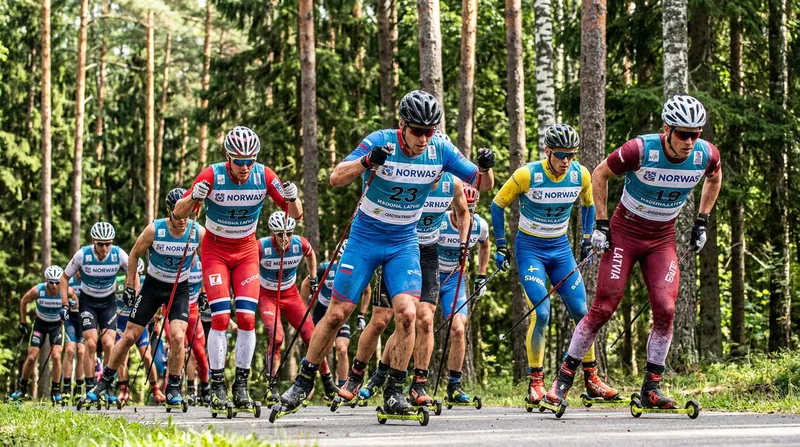
The opening stage in Madona promises a grueling test of early-season fitness, featuring a comprehensive program that includes individual interval starts, technical team sprints, and a chaotic mass start finale. For fans and analysts alike, the asphalt races offer the first genuine glimpse into which athletes have successfully built their aerobic engines during the offseason and who is primed to dominate when the snow finally falls.
Originally conceived in the 1930s in Italy as a practical dry-land training method for cross-country skiers desperate to maintain their form during the summer months, roller skiing has steadily evolved into a fiercely competitive, high-speed discipline in its own right. While it retains its fundamental utility as an offseason conditioning tool, the modern iteration of the sport features highly specialized equipment, including precision-engineered carbon-fiber poles, ultra-lightweight racing chassis, and standardized wheels designed to ensure a level playing field.
The transition from snow to asphalt fundamentally alters the race dynamics; the lack of friction allows athletes to reach blistering speeds, while the hard surface demands flawless technique and introduces a significantly higher risk of injury during crashes. Today, the sport boasts its own dedicated World Championships and a vibrant World Cup circuit that attracts both winter Olympic veterans and a unique breed of summer specialists who excel specifically on the unforgiving pavement.
Defending men's overall champion Raimo Vigants enters the 2026 season shouldering the immense pressure of being the hometown favorite in Madona. The 26-year-old Latvian superstar, who captured his first overall Crystal Globe last season, is aiming to defend his title in front of a passionate local crowd. Vigants has openly stated that his primary objective is to use the intense, tactical mass starts of the roller ski circuit to hone his race craft and positioning ahead of the Winter Games.
Known for his explosive finishing speed and tactical brilliance in pack-racing scenarios, Vigants represents the perfect hybrid athlete—capable of dominating the summer circuit while remaining entirely focused on translating that success to the Olympic snow in Italy. His performance in Madona will set the tone for a grueling title defense against a deeply talented men's field hungry to unseat the reigning champion.[1]
On the women's side of the draw, Swedish powerhouse Linn Sömskar returns to the asphalt to defend her overall World Cup title. Sömskar has been a dominant force in roller skiing for several years, leveraging her immense double-poling power and peerless technical efficiency to break her rivals on long, sustained climbs. However, her path to a repeat championship is fraught with challenges.
She faces stiff competition from a rising contingent of aggressive Italian athletes, who have historically performed exceptionally well on the summer circuit, as well as a deeply talented international field eager to challenge her supremacy. The Swedish team has invested heavily in their summer program, recognizing that the high-intensity efforts required to win on the roller ski tour perfectly mimic the physiological demands of winter World Cup racing. Sömskar's ability to fend off the younger generation of challengers will be one of the defining narratives of the 2026 season.
The 2026 World Cup calendar features four major stages that brilliantly blend traditional Nordic strongholds with spectacular, unconventional urban settings. Following the opening barrage of races in Latvia, the tour heads north to Trollhättan, Sweden, in late August. The Swedish stage, held in partnership with the popular Trollhättan Action Week, is renowned for its massive crowds and deeply technical courses that wind through the city's undulating terrain.
From there, the circuit makes a dramatic geographical and cultural shift, transitioning to a highly anticipated city sprint in the heart of Rome, Italy, in mid-September. This diverse scheduling forces athletes to constantly adapt to wildly different environments, from the quiet, pine-lined tracks of the Baltics to the chaotic, sun-baked streets of a major European metropolis, testing both their physical endurance and their mental resilience.
The inclusion of the Rome stage represents a deliberate and strategic push by the International Ski and Snowboard Federation (FIS) to bring the sport directly to the masses. Rather than requiring fans to travel to remote mountain resorts, the Rome event places the explosive speed of elite Nordic racing right in the center of one of the world's most visited cities.
Athletes will race past historic landmarks, including the Colosseum, on a specially designed sprint course that maximizes spectator visibility and television broadcast appeal. This urban initiative is designed to showcase the sheer athleticism of the competitors to a mainstream audience, breaking down the traditional barriers of winter sports and proving that skiing can be a spectacular, accessible event regardless of the season or the climate.
The 2026 season will reach its dramatic conclusion in late September in Val di Fiemme, Italy, a venue steeped in Nordic skiing history. The grand finale will see competitors tackle the grueling Alpe Cermis climb, a notoriously steep, paved ascent that perfectly mirrors the iconic final stage of the winter Tour de Ski. The Alpe Cermis climb is widely considered one of the most brutal physical tests in endurance sports, forcing athletes to battle gravity and mounting lactic acid on pitches that exceed a 28 percent gradient.
Crowning the overall World Cup champions at the summit of this legendary mountain ensures that only the most complete, resilient athletes walk away with the Crystal Globe. For the Italian national team, hosting the finale on home soil provides a massive motivational boost as they look to secure podium finishes in front of their dedicated fans.
Beyond the spectacular venues, this year's circuit introduces a suite of significant rule changes designed to modernize the sport and align it more closely with traditional cross-country events. Most notably, the FIS has mandated that men and women will now race equal distances across all formats, from the shortest sprints to the longest mass starts.
This historic shift represents a major step forward for gender parity in the sport, acknowledging that female athletes are more than capable of tackling the same grueling endurance challenges as their male counterparts. The move to equal distances has been widely praised by athletes and coaches alike, standardizing training protocols and ensuring that the women's races receive the same strategic depth and broadcast time as the men's events.[2]
Additionally, the governing body has implemented a deeper, more rewarding points system that closely mirrors the structure used in the winter Cross-Country World Cup. Points will now be awarded to the top 50 finishers in each race, rather than just the top 30, providing a crucial lifeline to developing athletes and smaller nations striving to maintain their funding and international standing.
Furthermore, the 2026 season marks the debut of a dedicated Sprint World Cup title, complete with its own distinct trophy. This new classification is designed to highlight and reward the discipline's fast-twitch specialists—athletes who may struggle on the long mountain climbs but possess the explosive, raw power necessary to dominate the chaotic, elbow-to-elbow 200-meter city sprints.[2]
For a significant portion of the peloton, the summer asphalt serves as a vital, high-stakes stepping stone to the winter snow. Competitors like Kazakhstan's Anna Melnik are utilizing the roller ski circuit to secure crucial FIS points and gain invaluable international race experience as the Olympic qualification window rapidly narrows.
Because the FIS points earned during the summer can be used to improve an athlete's starting position in winter World Cup races, success on the pavement directly translates to a tangible advantage on the snow. This interconnected ranking system ensures that the Roller Ski World Cup is never treated as a mere exhibition; it is a fiercely contested battleground where Olympic dreams are quietly forged months before the first snowflake falls.
The inherent accessibility of roller skiing—requiring only a stretch of paved road rather than a snow-covered mountain—is also fundamentally shifting the sport's global demographics. Nations without reliable year-round snow are seizing the opportunity to develop elite Nordic programs. Kazakhstan, for example, recently made history by claiming the Nation Cup overall ranking, proving that a dedicated summer program can yield world-class results.
Nations without reliable year-round snow are seizing the opportunity to develop elite Nordic programs.
Similarly, countries like Thailand are emerging as rapidly growing regions for the discipline, utilizing roller skiing to build a foundation of endurance athletes capable of eventually transitioning to winter competition. This democratization of the sport is breaking the traditional hegemony of the Scandinavian and Alpine nations, injecting fresh talent and diverse storylines into the World Cup circuit.
As the starting gun approaches in Madona, the unique intersection of dedicated summer roller-ski specialists and elite winter Olympic hopefuls promises to deliver one of the most fiercely contested World Cup seasons in the sport's history. The athletes are not just racing for podiums and prize money; they are racing to establish a psychological edge, to perfect their race tactics, and to secure the points necessary to punch their tickets to Milano Cortina.
With equal distances, a revamped points system, and a spectacular calendar that stretches from the quiet Baltic forests to the shadow of the Roman Colosseum, the 2026 FIS Roller Ski World Cup is poised to captivate fans and redefine the boundaries of endurance sports.
Key points
- The 2026 FIS Roller Ski World Cup season opens in Madona, Latvia, serving as a key preparation circuit for the Milano Cortina Olympics.
- Defending overall champions Raimo Vigants (Latvia) and Linn Sömskar (Sweden) return to defend their titles against a deep international field.
- The four-stage calendar features traditional Nordic venues alongside a spectacular urban city sprint past the Colosseum in Rome, Italy.
- New 2026 rules mandate equal race distances for men and women, advancing gender parity across all World Cup formats.
- A revamped points system now rewards the top 50 finishers, and a dedicated Sprint World Cup title has been introduced.
- Emerging nations without year-round snow, such as Kazakhstan and Thailand, are using the accessible sport to build elite Nordic programs.
How we got here
1930s
Roller skiing emerges in Italy as a dry-land summer training method for cross-country skiers.
1992
FIS officially recognizes roller skiing as a distinct sport discipline.
2000
The first official FIS Roller Skiing World Championships are held in Rotterdam.
July 2025
FIS mandates equal race distances for men and women across all roller ski events.
July 17, 2026
The 2026 World Cup season officially opens in Madona, Latvia.
- Winter Olympic Hopefuls
- Athletes utilizing the summer circuit primarily to build fitness and secure qualification points for the upcoming Winter Games.
- Roller Ski Specialists
- Athletes who view roller skiing as an independent, premier sport and focus their entire year on winning the summer Crystal Globe.
- Emerging Ski Nations
- Federations using the accessibility of roller skiing to bypass the geographical limitations of winter sports.
Perspectives this story doesn't cover
- Local city organizers managing road closures for urban races
- Equipment manufacturers adapting to the new standardized race rules
Sources
Source coverage
2 outlets
3 viewpoints surfaced


- [1]The Baltic TimesWinter Olympic Hopefuls
Latvia's Raimo Vigants Defends Roller Ski Title on Home Soil
Read on The Baltic Times → - [2]EurosportEmerging Ski Nations
FIS introduces equal distances and new sprint title for 2026 Roller Ski World Cup
Read on Eurosport →
More in Sports
See all →Injury
Alpine Skiing Injury Report: Cyprien Sarrazin and Alexander Steen Olsen Hit Major Milestones in Summer Rehab
5 sources
Standings
Race for the World Cup: Mid-Season Standings from the Alpine South American and Australia New Zealand Cups
5 sources

Injury
Australian Snow Sports Injury Report: Bolton, Peel, and Thomas Target Comebacks After Olympic Heartbreak
5 sources
Standings
FIS Roller Skiing World Cup Standings: Tanel and Sömskar Take Early Lead as 2026 Circuit Opens in Latvia
4 sources
Comments
Every angle. Every day.
Get Sports stories with full source coverage and perspective breakdowns, free every day.