full timeline
Amazon AI infrastructure expansion
Follow Amazon AI infrastructure expansion in the Factlen app and get an alert when there is news. Get the app
Share this story
Latest
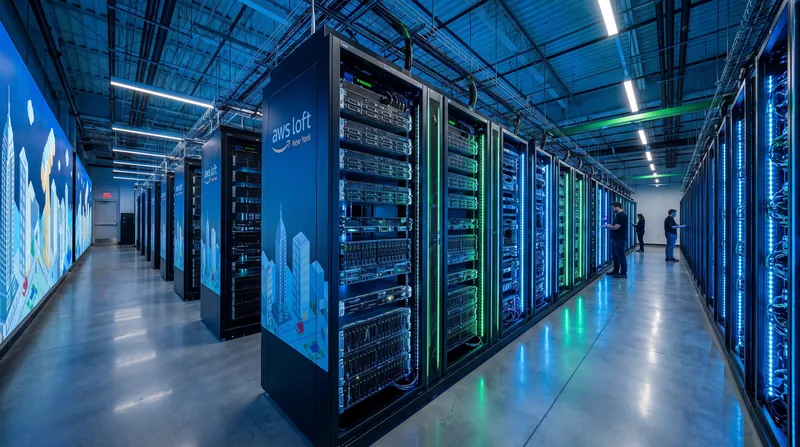
By 10:25 UTC on October 25, 2026, Amazon Web Services CEO Andy Jassy confirmed that the company's global cloud computing capacity is largely reserved through the end of 2027. Enterprise customers are locking in long-term compute contracts to guarantee access to high-performance artificial intelligence accelerators, creating an unprecedented reservation pipeline.
The capacity crunch comes as generative AI deployments outstrip the industry's $220 billion infrastructure buildout. Earlier in the month, by 00:03 UTC on October 4, Amazon began negotiating an $8 billion special purpose vehicle to fund its procurement of Nvidia processors through external investors.
How the story developed
The infrastructure expansion accelerated on August 14, 2026, when Amazon raised its 2026 capital expenditure forecast by $20 billion to a total of $220 billion. The increase was driven by the costs of aggressively expanding its artificial intelligence and Amazon Web Services data center capacity amid surging enterprise demand.
At the time, Amazon Web Services reported a 36.7 percent year-over-year revenue increase, marking its fastest growth rate in 18 quarters. The company's contracted customer backlog for cloud services had doubled over the previous year to reach $496 billion. Additionally, Amazon's proprietary AI chips, Trainium and Graviton, surpassed a $25 billion annual revenue run rate.
Amazon's net income for the quarter tripled to $62.6 billion. This figure was heavily boosted by a $53.4 billion paper gain from the company's investment in Anthropic.
By October 4, Amazon Web Services was exploring a new financial structure to manage its hardware costs, weighing an $8 billion off-balance-sheet vehicle. Under the proposed arrangement, external investors would purchase Nvidia artificial intelligence processors outright, and Amazon would lease the computing capacity back over a set term.
The maneuver is designed to shift the financial burden from an upfront capital expenditure to a recurring operating expense, protecting Amazon's free cash flow. The deal requires investors to price the rapid depreciation risk of silicon, which becomes obsolete much faster than traditional leased assets like aircraft.
What to watch
- Whether external investors will agree to price the rapid depreciation risk of silicon for the proposed $8 billion special purpose vehicle.
- Whether the lack of available Amazon Web Services capacity through 2027 will drive uncontracted workloads toward Microsoft Azure and Google Cloud.
Charts, maps and images
Show 2 moreShow fewer
Timeline
October 2026
AWS Books Out Global Cloud Capacity Through 2027 Amid Surging AI Demand
Amazon Weighs $8 Billion Off-Balance-Sheet Vehicle to Lease Nvidia Chips

August 2026
Amazon Commits Additional $20 Billion to AI Infrastructure Following Record Q2 Cloud Growth
AI-generatedAI-generatedAI-generatedAI-generated