
Zhao and Watson's Sub-4.6 Second Arms Race Redefines Men's Speed Climbing Standings
The 2026 Men's Speed Climbing standings have transformed into a historic two-man dogfight, with 16-year-old Chinese prodigy Zhao Yicheng and American star Sam Watson pushing the sport past the 4.6-second barrier. As the World Climbing Series heads to Chamonix, their rivalry is forcing the entire global field to adapt to unprecedented speeds.

Share this story
The 2026 World Climbing Series has reached its mid-season, but the men's speed climbing standings have already been blown wide open by a historic, barrier-breaking arms race. As the global circuit prepares for its next major stop in Chamonix, France, the traditional incremental progress of the sport has been replaced by massive, sudden leaps in human performance.
The points race for the overall season title is no longer just about consistency; it is about surviving an era where the physical limits of vertical movement are being rewritten on a weekly basis. Fans and analysts alike are watching a leaderboard that has been completely upended by a new generation of athletes who refuse to respect the established boundaries of the 15-meter wall.[2]
At the center of this high-stakes title fight are 16-year-old Chinese prodigy Zhao Yicheng and American powerhouse Sam Watson. Their head-to-head rivalry has pushed the sport into uncharted territory, completely redefining what is physically possible in speed climbing. Watson entered the 2026 season as the defending world record holder and the man to beat, having set a blistering benchmark the previous year.
However, Zhao's sudden emergence onto the senior circuit has turned the standings into a tense, two-man duel. Every time these two athletes step onto the starting pads, the global climbing community holds its breath, knowing that the world record is under immediate threat and the season's points balance could shift in less than five seconds.[1]
The shockwave that disrupted the 2026 standings began in late April at the Asian Beach Games in Sanya, China. In his very first senior international start, Zhao executed a flawless, lightning-fast qualification run that left the crowd stunned. He clocked a staggering 4.58 seconds, officially shattering Watson's 2025 world record of 4.64 seconds.
Zhao maintained his composure through the elimination rounds, ultimately securing the gold medal after his opponent false-started in the final. "It came as a huge surprise to finish this fast, and I'm absolutely thrilled," Zhao told reporters, noting that he had simply aimed to climb at his usual steady level.
Speed climbing is a discipline defined by microscopic margins, where records typically fall by mere hundredths of a second after years of collective global refinement. Zhao shaving six full hundredths of a second off the world mark on his senior debut signaled a seismic shift in the competitive landscape.
The standardized 15-meter route demands perfect choreography; every foothold and handhold has been mapped, dry-tooled, and drilled by elite athletes thousands of times. A momentary fumble at the buzzer or a missed match at the top can cost a tenth of a second, which at this elite level is the difference between standing on the podium and missing the quarter-finals entirely.
The rivalry materialized in a highly anticipated head-to-head matchup at the Wujiang World Cup in May, a critical juncture for the season's standings. In a blockbuster semi-final race, Zhao lined up directly against Watson. Under immense pressure, the Chinese teenager lowered the world record even further, hitting the buzzer at an astonishing 4.54 seconds while Watson finished in 4.67 seconds.
The run proved that Zhao's performance in Sanya was not an anomaly, but rather the new standard required to dominate the World Climbing Series. The sheer explosive power required to drop the record twice in a matter of weeks left the rest of the field scrambling for answers.[1][2]
Zhao went on to take gold in Wujiang with a 4.61-second run against his compatriot, reigning world champion Long Jianguo, who secured silver with a 5.63-second finish after a slip. Watson rebounded to take the bronze, clocking a 4.71-second run to defeat fellow American Michael Hom.
The podium result perfectly encapsulated the current state of the men's speed standings: a fierce battle for supremacy between the deep rosters of Team China and Team USA. Every medal earned in these early-season World Cup stops carries massive weight for the overall series title, making every slip and false start incredibly costly.[1]
The Wujiang results have heavily skewed the early 2026 standings in favor of the Chinese national team. With Zhao's explosive entry and Long's consistent podium finishes, China is currently dominating the team points race.
The Chinese squad's internal competition appears to be driving their times lower, as athletes push each other during national training camps before unleashing their refined beta on the international stage. For the rest of the world, overcoming this unified front requires not just a perfect individual run, but the ability to string together four consecutive flawless races through the elimination bracket.
However, Watson remains a formidable contender for the overall season title and the primary threat to China's dominance. Known for his deeply analytical approach to the sport, the American star viewed the Wujiang defeat not as a permanent setback, but as a crucial data point.
"I came into this competition knowing Yicheng probably had an edge but not a gap over me," Watson noted after the race. He praised Zhao's ability but emphasized that the loss provided him with an "immediate return on investment" regarding what he needs to adjust in his own training to reclaim the top spot on the leaderboard.[1]
The broader international field is now being forced to adapt to a brutal new reality. Athletes like Germany's Leander Carmanns and the deep roster of Indonesian speed specialists are finding that sub-5.0-second runs—once a near-guarantee for a medal—are now merely the baseline required to survive the opening rounds.
The points required to stay in the top ten of the overall standings have inflated dramatically. Climbers who spent the off-season aiming for a 4.8-second peak are realizing they must completely overhaul their explosive strength training just to remain relevant in the title conversation.[2]
What makes this sudden drop in times so remarkable is that the speed climbing route itself has not changed in 15 years. The holds remain in the exact same standardized sequence, meaning there are no new shortcuts or route-setting tricks to exploit. The sub-4.6-second barrier is being broken purely through athletic evolution, optimized biomechanics, and flawless, rehearsed choreography. Coaches are utilizing advanced motion-capture technology and high-speed cameras to shave milliseconds off transition movements, turning the sport into a high-speed physics equation where human muscle is the only variable.
As the World Climbing Series prepares for its next major speed event in Chamonix, France, the standings race is tighter and more volatile than ever. Watson is back in the gym refining his beta to reclaim his record, while Zhao is out to prove that his sub-4.6-second runs can be replicated consistently across different continents and climates. The Chamonix wall is notoriously fast, and the mid-July weather conditions often provide optimal friction, setting the stage for another potential world record attempt and a massive swing in the overall points race.[2]
As the World Climbing Series prepares for its next major speed event in Chamonix, France, the standings race is tighter and more volatile than ever.
For fans of the sport, the 2026 season has transformed from a standard competitive circuit into a weekly spectacle of human limit-testing. The race for the overall men's speed title will ultimately crown whoever can survive this high-stakes dogfight without succumbing to the immense physical and psychological pressure. With the margins of error shrinking to zero and the physical demands reaching unprecedented heights, the second half of the World Climbing Series promises to be the most dramatic and fastest chapter in the history of the sport.[2]
The essentials
- 16-year-old Zhao Yicheng shattered the men's speed climbing world record twice in early 2026, lowering it to 4.54 seconds.
- American Sam Watson, the previous record holder, took bronze in Wujiang but remains a top contender for the season title.
- The sudden drop in times has forced the entire global field to overhaul their training to survive the opening rounds.
- The World Climbing Series standings race heads next to Chamonix, France, where the notoriously fast wall could yield new records.
Timeline
May 2025
Sam Watson sets the world record at 4.64 seconds in Bali.
April 2026
Zhao Yicheng breaks the record with a 4.58-second run at the Asian Beach Games.
May 2026
Zhao lowers the record to 4.54 seconds during a semi-final race against Watson in Wujiang.
July 2026
The World Climbing Series heads to Chamonix for the next major standings battle.
- Team China's Momentum
- Focuses on Zhao's unprecedented rise and the depth provided by World Champion Long Jianguo, arguing that their internal competition is driving the world records lower.
- Team USA's Analytical Approach
- Views Zhao's times as a new data point to analyze and beat, emphasizing that the gap is bridgeable through refined technique and training.
- The Global Field's Adaptation
- Highlights how the rest of the competitors are suddenly forced to overhaul their training just to keep up, as sub-5.0 second times are no longer enough for the podium.
Perspectives this story doesn't cover
- Recreational climbers observing the elite gap
- Route setters who maintain the standardized wall
Sources
Source coverage
2 outlets
3 viewpoints surfaced


- [1]Gripped MagazineTeam USA's Analytical Approach
New World Record for 16-Year-Old Speed Climber
Read on Gripped Magazine → - [2]OlympicsThe Global Field's Adaptation
World Climbing Series 2026: Stars to follow, full schedule and how to watch live
Read on Olympics →
More in Sports
See all →Standings
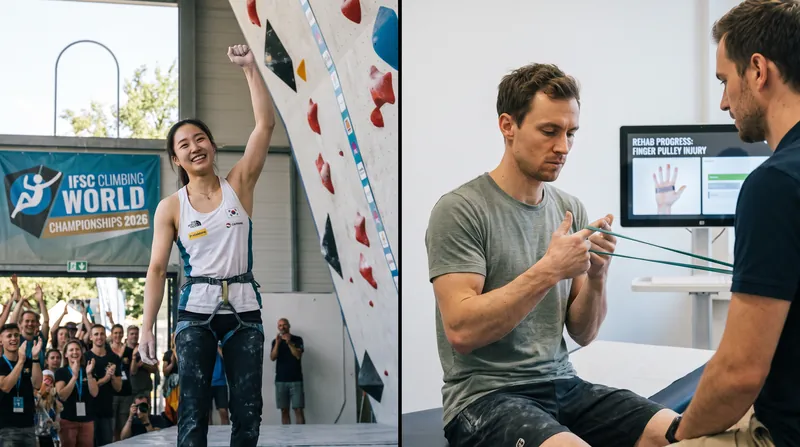
The New Vanguard: Mao Nakamura and Naïlé Meignan Shake Up the 2026 Women's Boulder Standings
6 sources
Injury
2026 Sport Climbing Injury Report: Milne, Richardson, and Dörffel Navigate the Grueling Return to the Wall
7 sources
Standings
The Race for the Podium: Oceania Mackenzie and Oriane Bertone Disrupt the Women's Combined Standings
6 sources
Standings
Colin Duffy and Dohyun Lee Seize Control of Men's Combined Standings as Toby Roberts Extends Injury Hiatus
2 sources

Comments
Every angle. Every day.
Get Sports stories with full source coverage and perspective breakdowns, free every day.