
Wildcard Arthur Fery's Historic Wimbledon Semifinal Run Propels British Star Into ATP Top 40
The 23-year-old British wildcard entered Wimbledon ranked No. 114 and leaves as the nation's new No. 1 male player. Despite a semifinal loss to Alexander Zverev, Fery's breakthrough guarantees him a career-high ranking of No. 36.
By Ryder James
Share this story
The "Fery-tale" at the All England Club has come to an end, but the 23-year-old British wildcard leaves Wimbledon with a fundamentally transformed career. Entering the tournament ranked No. 114 in the world, Arthur Fery captivated the home crowd by becoming the first British male wildcard in the Open Era to reach a Grand Slam singles semifinal.[1][3]
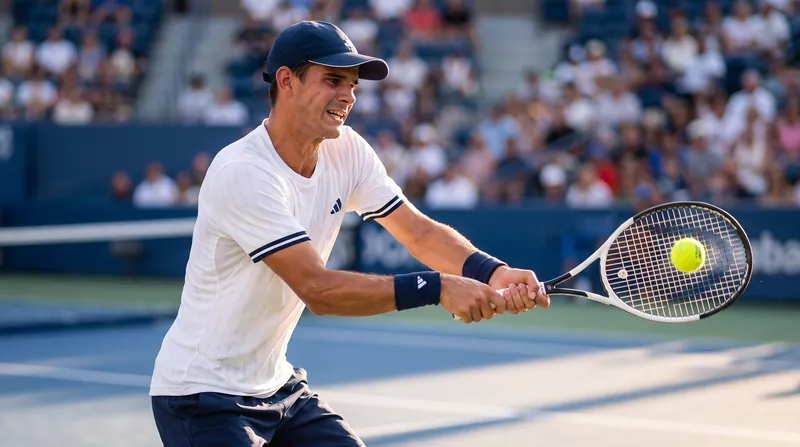
Though his historic run concluded on Friday with a 7-6, 6-2, 6-4 defeat to world No. 3 Alexander Zverev, Fery's performance on Centre Court proved he belongs in the sport's upper echelon. He went toe-to-toe with the recently crowned Roland Garros champion for nearly an hour, trading heavy baseline blows and demonstrating elite court sense before Zverev's experience took over in the first-set tiebreak.[1][2]
The consequences of Fery's fortnight are staggering. When the ATP rankings update on Monday, the London native will vault 78 spots to a career-high No. 36. This mathematical leap officially crowns him as the new British No. 1 male player, surpassing his compatriots and establishing him as the nation's premier tennis hope.[2]
Beyond the prestige, breaking into the top 40 alters the logistical reality of a professional tennis player. For years, Fery has battled through the grueling Challenger circuit and navigated high-stress qualifying rounds just to enter main draws. Now, his ranking guarantees direct entry into all four Grand Slams and the elite Masters 1000 events.
"In just one tournament, he has gone from being a player having to fight to enter the final draws to becoming one of the reference seeds in many circuit events," noted analysts following his quarterfinal victory. He is now on the verge of being a seeded player at the upcoming U.S. Open, a status that protects top players from facing each other in the early rounds.[2]
The financial windfall is equally transformative. Prior to this year's Wimbledon, Fery had amassed roughly $868,000 in career prize money since turning professional. His semifinal appearance alone earned him an additional $1.2 million, instantly doubling his career earnings and providing the resources to invest in elite coaching, physios, and travel logistics.[1][2]
Fery's path to the final four was anything but simple. He mounted a spectacular comeback in the third round against world No. 37 Zizou Bergs, rallying from a deficit in both the fourth and fifth sets. He then dispatched veteran Grigor Dimitrov in a tense fourth-round tiebreak before sweeping ninth-seeded Flavio Cobolli in straight sets in the quarterfinals.[3]
"I'm most proud of never letting go," Fery reflected after the tournament. "I'm most proud of how I kept going in every match, my progression in the tournament." His resilience under pressure became the defining characteristic of his run, earning him legions of new fans and the respect of the locker room.[3]
Zverev himself offered high praise after their semifinal clash, predicting a long and fruitful career for the young Brit. "He's going to be a senior citizen on our tour because I think he's going to play on this tour for 15-plus years and I think he's going to have great results," the German star remarked. "I think this was just the beginning of his career."[2]
The success story is particularly sweet given Fery's local roots. He grew up just steps away from the All England Club in Wimbledon, making his breakthrough on the very courts that defined his childhood. Rather than taking the traditional European academy route, Fery spent three years playing collegiate tennis in the United States at Stanford University.[3]
During his time in California, Fery compiled a 58-16 singles record, became a two-time All-American, and won the Pac-12 Singles Player of the Year award. He is the first Stanford alumnus to reach the Wimbledon semifinals since John McEnroe achieved the feat in 1992, highlighting the growing viability of the NCAA pathway for modern professionals.
As the dust settles on his monumental fortnight, Fery plans to take a brief holiday to process the life-changing events before shifting his focus to the North American hardcourt swing. With a new ranking, a fortified bank account, and the belief that he can compete with the world's best, Britain's newest tennis star is officially ready for the main stage.[3]
Key points
- Arthur Fery became the first British male wildcard in the Open Era to reach a Grand Slam singles semifinal.
- The 23-year-old's run ended with a straight-sets loss to world No. 3 Alexander Zverev.
- Fery will jump 78 spots in the ATP rankings to a career-high No. 36, becoming the British No. 1.
- The top-40 ranking guarantees Fery direct entry into future Grand Slams and Masters 1000 events.
- He earned $1.2 million for the tournament, more than doubling his career prize money.
- Fery played three years of collegiate tennis at Stanford University before turning professional.
How we got here
Jan 2026
Fery makes his Australian Open debut, reaching a career-high ranking of No. 152.
Jun 2026
Granted a wildcard into the Queen's Club Championships, where he secures a first-round victory.
Jul 2026
Enters the Wimbledon main draw as a wildcard ranked No. 114 in the world.
Jul 10, 2026
Reaches the Wimbledon semifinals, guaranteeing a leap into the ATP top 40.
- British Tennis Community
- Celebrating a homegrown hero and the new British No. 1.
- International ATP Analysts
- Focusing on the logistical and financial transformation of Fery's career.
- Collegiate Tennis Advocates
- Highlighting the success of the US college pathway to the pro tour.
Perspectives this story doesn't cover
- Lower-ranked players navigating the Challenger circuit who view Fery's breakthrough as a blueprint for their own careers.
Sources
Source coverage
3 outlets
3 viewpoints surfaced



- [1]The GuardianBritish Tennis Community
Serena Williams back at Wimbledon after being granted doubles wildcard with Venus
Read on The Guardian → - [2]ForbesInternational ATP Analysts
British Wildcard Arthur Fery Scores Huge Payday With Wimbledon Run
Read on Forbes → - [3]OlympicsBritish Tennis Community
Wimbledon 2026: Arthur Fery's semi-final run is one for the ages
Read on Olympics →
More in Sports
See all →Standings
The Cut-Line Battle: Coco Gauff and Marta Kostyuk Vie for the Final WTA Finals Spot
2 sources
Standings
The Hard-Court Swing Shakes Up Tennis Standings: Sabalenka Edges Ahead as Alex Eala Surges
5 sources
Standings
The ATP's Split Reality: Carlos Alcaraz Reclaims World No. 2, But Alexander Zverev Dominates the Race to Turin
5 sources

Standings
The Teenage Contender: Rafael Jodar's Washington Run Shakes Up the ATP Race to Turin
6 sources
Comments
Every angle. Every day.
Get Sports stories with full source coverage and perspective breakdowns, free every day.