
Why Vocational Graduates Face a Mid-Life Earnings Reversal Around Age 50
While vocational training delivers a massive early-career employment advantage, longitudinal data shows that general education graduates catch up and surpass them in earnings by age 50. The reversal is driven by the rapid technological obsolescence of highly specific occupational skills.

Share this story
In short
- Vocational education delivers a massive early-career employment advantage that systematically reverses into a deficit around age 50.
- The reversal is driven by technological obsolescence, as highly specific occupational skills depreciate faster than general cognitive abilities.
- Countries with the most intensive apprenticeship systems, such as Germany and Switzerland, experience the sharpest mid-life earnings penalties.
The promise of vocational education—a fast, secure track into the middle class—comes with a hidden expiration date. For decades, students who chose specific occupational training over broad academic degrees enjoyed a massive head start in the labor market, but that advantage systematically collapses and reverses as they approach age 50.[1][3]
This mid-life earnings cliff fundamentally rewrites the economics of choosing a college alternative. While a 25-year-old with a vocational certificate easily out-earns a peer with a general arts degree, the rapid pace of technological change eventually renders those specific skills obsolete, leaving older workers stranded in a shifting economy.[1][2]
The reversal is not a localized anomaly, but a structural feature of modern labor markets. Across developed economies, the very specificity that makes vocational graduates instantly employable at age 20 becomes their greatest liability by age 50, when adaptability suddenly outweighs specialized experience.[1]
Vocationally trained students have a higher probability of employment than those with a general educational qualification when they enter the labor market, but this pattern reverses around the age of 50, notes the landmark 2017 study by economists Eric Hanushek, Guido Schwerdt, Ludger Woessmann, and Lei Zhang.[1]
The Early-Career Premium
The initial appeal of vocational training rests on its seamless school-to-work transition. Programs designed around specific industry needs produce graduates who are immediately productive, allowing them to bypass the entry-level friction that often plagues general education graduates.[1][2]
In their 20s and 30s, these workers reap a substantial wage premium. Data from various international cohorts shows that earning a vocational degree and entering an apprenticeship can yield tens of thousands of dollars in additional early-career earnings compared to non-specific pathways.
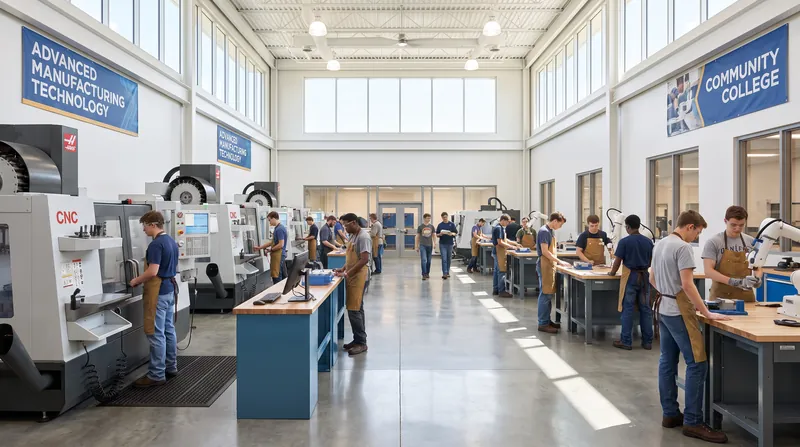
Employers eagerly absorb these graduates because they require minimal on-the-job training. A certified machinist or specialized technician arrives on the factory floor ready to operate machinery, whereas a general studies graduate requires months of costly onboarding to reach the same baseline productivity.[1][3]
This dynamic keeps youth unemployment remarkably low in countries that heavily emphasize vocational tracks. Nations with robust dual-training systems, where classroom instruction is paired with industry apprenticeships, consistently report smoother labor market entries for their young adult populations.[1][2]
However, this early success masks a structural vulnerability that only becomes apparent decades later. The specific skills that command a premium in 2026 are highly vulnerable to the technological paradigms of 2046, setting a trap for workers who lack a broader educational foundation.[1]
The Age 50 Reversal
As workers enter their late 40s, the labor market dynamics undergo a dramatic inversion. The employment probability and wage curves of general education graduates steadily climb, eventually intersecting and surpassing those of their vocationally trained peers.[1]
In countries with extensive apprenticeship systems, this cross-over point occurs surprisingly early. Across major European economies, the age at which individuals with a general education begin to boast higher employment probabilities averages just 44 years old.[1]
The financial penalty compounds over the remainder of the worker's career. In Sweden, for example, longitudinal register data tracking siblings shows that the initial vocational earnings advantage transforms into a permanent 2 to 3 percent relative disadvantage after about ten years in the workforce for men.
Vocational education is associated with an initial relative earnings advantage, but this is transformed into a relative earnings disadvantage, conclude researchers Bart Golsteyn and Anders Stenberg, who tracked uninterrupted population earnings data over three decades.
This late-career penalty is particularly severe following macroeconomic shocks or plant closures. When an industry contracts, older blue-collar workers with highly specific vocational backgrounds find it significantly harder to secure re-employment than peers with general degrees.[1]
The Mechanism of Technological Obsolescence
The primary driver of this life-cycle reversal is the rapid depreciation of occupation-specific human capital. When a worker's entire training is anchored to a specific machine, software language, or industrial process, their value to the market evaporates the moment that technology is automated or replaced.[1][3]
General education, by contrast, focuses on foundational cognitive skills, including advanced literacy, numeracy, and abstract problem-solving. While these broad competencies do not immediately translate to operating a lathe or coding a specific database, they provide the underlying architecture required to learn new systems quickly.[1][2]
As the economy shifts, the generalist adapts while the specialist struggles. A worker trained broadly in mathematics and communication can pivot to a new industry with relative ease, whereas a worker trained exclusively in a defunct manufacturing technique faces a catastrophic loss of earning power.[1]
With rapid technological change, gains in youth employment from vocational education may be offset by less adaptability and thus diminished employment later in life, the Hanushek study warns, highlighting the danger of optimizing education purely for immediate job placement.[1]
The pace of digitalization and artificial intelligence has only accelerated this obsolescence cycle. Skills that once remained relevant for an entire 40-year career now require total reinvention every decade, heavily penalizing workers who lack the theoretical grounding to absorb continuous retraining.[1][3]
The Apprenticeship Paradox
Paradoxically, the countries with the most celebrated vocational systems experience the sharpest mid-life reversals. Nations like Germany, Switzerland, and Austria are globally lauded for their dual-education models, which tightly integrate secondary schooling with corporate apprenticeships.[1][2]
Because these programs are so deeply embedded in current industry practices, they deliver the highest initial employment boosts. Yet, this intense specialization provides the strongest treatment intensity, making these workers the least flexible when structural economic shifts inevitably occur.[1]
In contrast, systems that offer a more generalized approach to vocational training see a flatter curve. When vocational programs include a heavier mix of theoretical coursework alongside practical skills, the mid-life penalty is less pronounced, though the initial hiring advantage is also smaller.[3]
This creates a profound policy dilemma for governments trying to balance youth employment metrics against long-term economic resilience. Optimizing a curriculum to solve today's labor shortages often means condemning those same workers to structural unemployment when they reach their 50s.[1][3]
The data suggests that education systems must resist the urge to strip theoretical foundations out of technical training. Even the most practical trades require a baseline of general cognitive adaptability to survive a half-century in the modern workforce.[1][2]
Rethinking Lifelong Learning
For individuals navigating these pathways, the age 50 reversal underscores the absolute necessity of continuous upskilling. A vocational certificate can no longer be viewed as a terminal degree that secures a lifetime of middle-class stability; it is merely a high-leverage entry ticket.[3]
To mitigate the mid-life penalty, vocational graduates must actively pursue cross-training and generalist credentials throughout their 30s and 40s. Relying solely on the specific skills acquired at age 19 is a mathematical guarantee of eventual wage stagnation as entire occupational categories vanish.[3]
Employers also bear responsibility for this dynamic. Companies that benefit from the immediate productivity of vocational hires rarely invest in broadening those workers' general skill sets, effectively extracting their peak value and discarding them when the technology turns over.[3]
Ultimately, the most resilient career strategy blends both approaches. Workers who leverage vocational training for early market entry, but systematically acquire generalist cognitive skills as they mature, can capture the initial premium while successfully evading the age 50 obsolescence cliff.[3]
Key terms
- Technological Obsolescence
- The process by which specific occupational skills lose their value in the labor market because the underlying technology or process has been automated or replaced.
- Dual-Education System
- A vocational training model, common in Germany and Switzerland, that tightly integrates classroom instruction with industry-specific corporate apprenticeships.
- Human Capital Depreciation
- The loss of earning power over time as a worker's previously acquired knowledge and skills become less relevant to current employer demands.
- Difference-in-Differences
- A statistical technique used by economists to estimate the effect of a specific treatment—such as education type—by comparing changes in outcomes over time between different groups.
Frequently asked
Does this mean vocational education is a bad financial choice?
No. Vocational education still provides a highly lucrative early-career premium and protects against youth unemployment, but it requires workers to actively pursue retraining later in life to avoid wage stagnation.
Are all vocational programs equally vulnerable to this reversal?
Programs that blend theoretical coursework with practical training show a much flatter penalty curve than those that rely exclusively on highly specific, industry-based apprenticeships.
How does general education protect older workers?
General degrees focus on foundational cognitive skills like advanced literacy and abstract problem-solving, which allow workers to learn new systems and pivot across industries when their original roles disappear.
Viewpoints in depth
Labor Economists' View
Focuses on the long-term depreciation of specific human capital.
Labor economists argue that the labor market heavily penalizes over-specialization as workers age. Because technological change continually destroys existing occupational categories, skills that are tied to a specific machine or process have a short half-life. From this perspective, the primary purpose of education is not to teach a student how to perform a specific job, but to equip them with the cognitive architecture required to learn their next five jobs. The mid-life earnings reversal is viewed as the inevitable mathematical consequence of trading long-term adaptability for short-term employability.
Vocational Advocates' View
Emphasizes the immediate societal benefits of preventing youth unemployment.
Proponents of robust vocational and apprenticeship systems argue that focusing on the age 50 reversal ignores the devastating, permanent scarring caused by youth unemployment. A worker who fails to enter the labor market in their 20s suffers compounding financial and psychological damage that often lasts a lifetime. From this viewpoint, securing a high-paying, stable job immediately out of secondary school is a massive victory. They argue that the mid-life penalty should be addressed through adult retraining programs and corporate investment, rather than by diluting the specific skills that make young workers employable in the first place.
Policy Makers' View
Seeks to balance immediate industry demands with long-term workforce resilience.
Government officials and education ministries face a structural dilemma: industries demand workers with highly specific, immediately productive skills, while the state must manage the long-term welfare of its aging population. Policymakers increasingly view the solution as a hybrid model. By injecting more theoretical coursework—such as advanced mathematics and communication—into traditional vocational tracks, they aim to flatten the obsolescence curve. This perspective treats the age 50 reversal not as an indictment of vocational education itself, but as a failure of the adult education system to provide continuous, accessible upskilling for blue-collar workers.
- Labor Economists
- Argue that the long-term obsolescence of specific skills outweighs the initial employment benefits of vocational training.
- Vocational Education Advocates
- Emphasize the immediate reduction in youth unemployment and the high early-career wage premiums delivered by apprenticeship models.
- Lifelong Learning Proponents
- Argue that the dichotomy is false and that workers must blend initial vocational entry with continuous generalist upskilling.
Perspectives this story doesn't cover
- Corporate human resources directors
- Trade union representatives
Sources
Source coverage
3 outlets
3 viewpoints surfaced



- [1]Journal of Human ResourcesLabor Economists
General Education, Vocational Education, and Labor-Market Outcomes over the Life-Cycle
Read on Journal of Human Resources → - [2]IZA Institute of Labor EconomicsLabor Economists
General Education, Vocational Education, and Labor-Market Outcomes over the Life-Cycle
Read on IZA Institute of Labor Economics → - [3]Factlen Editorial TeamLifelong Learning Proponents
Synthesis by Factlen editorial team
Read on Factlen Editorial Team →

More in Education
See all →Apprenticeship Economics
How Swiss and German Apprenticeship Models Balance Training Costs Against Productive Output
2 sources

Workforce Pell
DOL Awards $65 Million to Community Colleges to Expand Workforce Pell Training
3 sources
Curriculum Design
The DACUM Process: How Expert Workers Define the Duties and Tasks of an Occupation
6 sources

Apprenticeship Standards
The 2,000 and 144 Rule: How Time Minimums Define a Registered Apprenticeship
7 sources

Comments
Every angle. Every day.
Get Education stories with full source coverage and perspective breakdowns, free every day.