
ULA Vulcan Rocket Suffers First Mission Failure, Losing 40 Amazon Broadband Satellites
United Launch Alliance’s new heavy-lift vehicle malfunctioned 10 minutes after liftoff from Florida, marking the company’s first total loss since 2006. The anomaly destroyed a payload of Amazon Leo internet satellites and grounds the rocket pending an investigation.
By Sergei Orlov

Share this story
The United Launch Alliance (ULA) Vulcan rocket suffered a critical in-flight anomaly on November 15, 2026, failing to deliver 40 Amazon Leo broadband satellites to orbit. The malfunction occurred approximately 10 minutes after liftoff from Space Launch Complex 41 at the Cape Canaveral Space Force Station in Florida.[1][2]
The heavy-lift vehicle departed the pad at 12:40 p.m. Eastern Time, thundering upward on 3.8 million pounds of thrust. Initial telemetry indicated that the early stages of the flight proceeded normally, with the rocket clearing the launch tower and pushing through the dense lower atmosphere.[1][2]
Launch controllers had already called a hold at the T-minus 20-second mark on Sunday due to an unexplained technical issue. After a brief assessment, the countdown resumed, and the 214-foot-tall rocket was cleared for its northeasterly trajectory over the Atlantic Ocean.[1]
At the 10-minute mark, however, ULA’s launch director received data indicating a severe problem. The company confirmed shortly afterward that the vehicle had failed to deliver its payload, resulting in the total loss of the 40 Amazon satellites onboard.[1][3]
"Based on data received by our Launch Director, we confirm that the Vulcan vehicle launched from Space Launch Complex 41 suffered an anomaly 10 minutes into the flight and failed to deliver the Amazon mission to orbit," ULA stated 50 minutes after liftoff.[1][2]
The company acknowledged that it lacked immediate technical details regarding the root cause. "Since the anomaly just occurred, we don't have any specific data yet to understand what occurred today," ULA representatives said, pledging to work with Amazon to investigate the failure.[3][4]
The Ten-Minute Mark
The timing of the anomaly points toward the rocket's upper stage. Vulcan’s first stage is powered by two methane-burning BE-4 engines manufactured by Blue Origin, while its initial ascent is assisted by six solid rocket boosters built by Northrop Grumman.[1][3]
The BE-4 engines themselves have a complex history. Blue Origin engineers recently retrofitted the engines used on Sunday's flight with a design improvement to resolve an oxygen valve issue that had caused a failure on a New Glenn engine test.[1]
During Sunday's launch, the six solid rocket boosters appeared to perform as expected. They burned out and peeled away from the core stage roughly one minute and 35 seconds into the flight, allowing the BE-4 engines to continue pushing the vehicle toward space.[2][3]
Following stage separation, Vulcan relies on its hydrogen-fueled Centaur upper stage to complete the push to orbital velocity. The Centaur, powered by two RL10 engines from L3Harris, was scheduled for a 12-minute and 15-second burn when the anomaly occurred.[1][3]
Pre-launch timelines and telemetry-driven animations suggested that the first stage may have fired longer than planned. Furthermore, the Centaur stage appeared to make unusual orientation adjustments early in its burn, though ULA has not yet confirmed which specific system caused the failure.[3]
The loss marks the first outright mission failure for United Launch Alliance since the Boeing and Lockheed Martin joint venture was formed in 2006. The company has built a reputation for reliability over two decades, making Sunday's malfunction a significant operational shock.[1][2][4]
A Troubled Return to Flight
Sunday's mission, designated LV-01 by Amazon, was only the fifth flight for the Vulcan Centaur rocket, which debuted in January 2024. It was intended to be a triumphant return to flight after a nine-month hiatus spent addressing previous hardware defects.[3][4]
Vulcan had been grounded while ULA and Northrop Grumman investigated and resolved issues with the solid rocket boosters. During the rocket's second flight in October 2024 and its fourth flight in February 2026, the boosters experienced nozzle failures.[3][4]
In both previous incidents, a booster nozzle burned through and fell off shortly after launch. While the Vulcan core stage was able to compensate and deliver those payloads to orbit, the U.S. Space Force paused national security launches on the vehicle until the defect was addressed.[3][4]
ULA implemented design and process improvements to the nozzles ahead of Sunday's launch. While that specific fix appeared successful—the boosters operated normally—the new, unrelated anomaly in the upper stage now grounds the rocket once again.[3][4]
The launch itself had already faced multiple delays over the weekend. An initial Friday attempt was scrubbed due to a power interruption at an Air Liquide gaseous nitrogen plant, and a Saturday attempt was halted by a network communication issue between the rocket and ground equipment.[1][2]
Amazon's Constellation Deadlines
The destruction of 40 satellites deals a substantial setback to Amazon’s Leo network, formerly known as Project Kuiper. The tech giant is racing to build a low Earth orbit broadband constellation to compete directly with SpaceX's Starlink service.[1][3][4]
Before Sunday's failure, Amazon had successfully launched 396 satellites across 14 missions since April 2025. The company's most recent successful deployment occurred in July, utilizing the last of ULA's older Atlas V rockets to place a batch of satellites into orbit.[3][4]
Vulcan is slated to be the primary workhorse for the Leo constellation, with Amazon having purchased 38 launches on the new heavy-lift vehicle. The larger rocket can carry 40 satellites per mission, compared to the 29 carried by the Atlas V.[3]
Amazon faces strict regulatory deadlines to deploy its network. The Federal Communications Commission requires the company to have half of its planned 3,232 first-generation satellites in operation by July 2029 to maintain its spectrum priority.[3][4]
Despite the loss, Amazon expressed continued confidence in its launch provider. "There is risk with any launch, and that's especially true for inaugural missions like LV-01," the company stated, adding that it expects ULA to learn from the failure and deliver on long-term plans.[1]
The financial toll of the failure is substantial. While neither company has disclosed the exact value of the lost payload, manufacturing 40 custom broadband satellites and securing a dedicated heavy-lift launch represents an investment of hundreds of millions of dollars.[3][4]
Broader Launch Market Impact
The Vulcan failure reverberates through an aerospace industry that is increasingly desperate for heavy-lift alternatives to SpaceX. With Vulcan grounded pending a formal mishap investigation, commercial competitors face a severe bottleneck in getting large payloads to orbit.[4]
Amazon has attempted to diversify its launch strategy by securing contracts with multiple providers, including Europe's Ariane 6 and Blue Origin's New Glenn. However, those alternative vehicles face their own developmental and operational hurdles that limit immediate availability.[3][4]
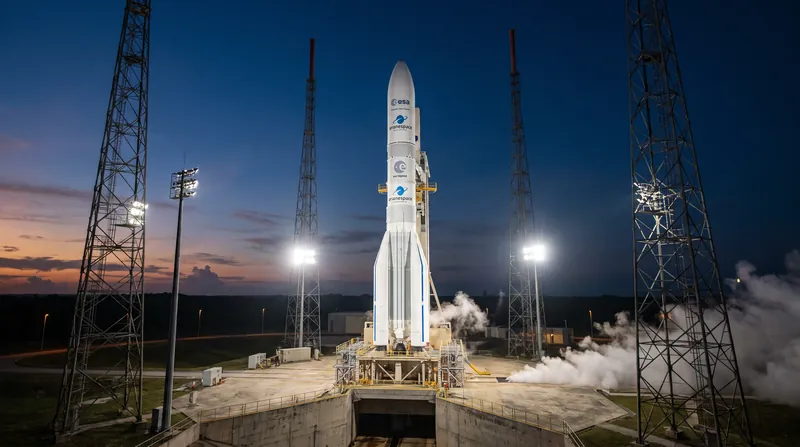
Amazon has attempted to diversify its launch strategy by securing contracts with multiple providers, including Europe's Ariane 6 and Blue Origin's New Glenn.
Blue Origin's New Glenn rocket remains sidelined following a launchpad explosion earlier in the year, and the Ariane 6 is still ramping up its flight cadence. This leaves Amazon heavily reliant on ULA to meet its deployment targets.[3][4]
For ULA, the investigation will dictate how quickly the company can resume operations. Engineers must now sift through telemetry data to isolate the Centaur stage anomaly, design a corrective action, and prove to both commercial and government customers that the vehicle is safe.[1][2]
The grounding of Vulcan also impacts the U.S. Space Force, which relies on the rocket for national security missions. Until ULA can demonstrate that the upper stage issue is resolved, military payloads may need to be shifted to SpaceX's Falcon Heavy.[4]
Key points
- ULA's Vulcan rocket suffered a critical anomaly 10 minutes into its flight, destroying 40 Amazon Leo broadband satellites.
- The malfunction marks the first outright mission failure for United Launch Alliance since the company was formed in 2006.
- Vulcan was returning to flight after a nine-month grounding to fix solid rocket booster defects, which appeared to perform normally on Sunday.
- The loss deals a significant setback to Amazon's race to deploy 3,232 satellites by a July 2029 regulatory deadline.
What we don’t know
- The exact technical cause of the Centaur upper stage anomaly remains unidentified.
- ULA has not provided a timeline for when the Vulcan rocket might return to flight.
- The financial cost of the lost payload and the delayed launch schedule has not been disclosed.
How we got here
Jan 2024
The ULA Vulcan Centaur rocket completes its inaugural flight successfully.
Oct 2024
Vulcan's second flight experiences a solid rocket booster nozzle failure, though the payload reaches orbit.
Feb 2026
A fourth Vulcan flight suffers another booster anomaly, prompting the U.S. Space Force to pause national security missions.
Jul 2026
Amazon completes its last successful Leo satellite deployment using an older Atlas V rocket.
Nov 15, 2026
Vulcan suffers a critical anomaly 10 minutes into flight, destroying 40 Amazon satellites.
- United Launch Alliance
- Focuses on investigating the anomaly, ensuring transparency, and returning the Vulcan rocket to flight safely.
- Amazon Leo Management
- Emphasizes the inherent risks of spaceflight, confidence in ULA as a partner, and commitment to the long-term constellation goals.
- Aerospace Industry Analysts
- Highlights the bottleneck in heavy-lift launch capacity and the strategic advantage this failure hands to competitors like SpaceX.
Perspectives this story doesn't cover
- U.S. Space Force officials regarding national security launch delays
- SpaceX executives on the shifting competitive landscape
Sources
Source coverage
4 outlets
3 viewpoints surfaced




- [1]CBS NewsUnited Launch Alliance
United Launch Alliance loses Vulcan rocket and 40 Amazon Leo internet satellites in launch mishap
Read on CBS News → - [2]Spaceflight NowUnited Launch Alliance
ULA suffers first outright failure with loss of Vulcan rocket carrying 40 Amazon Leo satellites
Read on Spaceflight Now → - [3]GeekWireAmazon Leo Management
Amazon loses 40 Leo satellites as ULA Vulcan launch failure deals setback to tech giant's Starlink rival
Read on GeekWire → - [4]Ars TechnicaAerospace Industry Analysts
Vulcan rocket fails during launch, dealing major blow to SpaceX competitors
Read on Ars Technica →
More in Technology
See all →Propellant Physics
The Engineering Trade-off: Why the Aerospace Industry is Abandoning Hydrogen for Methane
3 sources

Space Industry M&A
Iceye Submits €2.05 Billion Takeover Bid for Italian Rocket Builder Avio
7 sources

Satellite Internet
Russia Files ITU Plan for 374 Rassvet-4 Satellites Following Orbital Fleet Malfunctions
6 sources
Space Commercialization
SpaceX Government Revenue to Drop Below 10 Percent as Commercial Operations Dominate
7 sources
Comments
Every angle. Every day.
Get Technology stories with full source coverage and perspective breakdowns, free every day.