
UCI's Sweeping 2026 Technical Overhaul Mandates Minimum Handlebar Widths, Caps Wheel Depth, and Limits Frame Aerodynamics
Cycling's global governing body has enacted strict new equipment limits to slow the peloton, sparking intense debate over rider biomechanics and aerodynamic innovation.

Share this story
The professional peloton has never been faster, and the bicycles propelling it have never looked more extreme. In a direct bid to squeeze the brakes on a sport that is crashing harder and more frequently than ever, the Union Cycliste Internationale (UCI) has officially enacted its sweeping 2026 technical regulations.
But instead of universal applause for prioritizing rider safety, cycling's global governing body is facing a fierce, multi-front backlash. Female athletes, professional bike fitters, and industry aerodynamicists argue that the new equipment mandates—which dictate everything from cockpit dimensions to rim profiles—actively penalize smaller riders and stifle technological innovation without actually solving the safety crisis.[1][2]
The most contentious and highly debated change targets the bicycle's cockpit. Under the newly enforced mandate, road and cyclocross handlebars used in sanctioned competition must now measure a minimum of 400 millimeters wide from outside to outside, with a maximum allowable flare of 65 millimeters from the tops to the drops.
This ruling effectively bans the ultra-narrow, heavily inward-rotated brake hood setups that had become ubiquitous across the WorldTour over the past three seasons. Riders had increasingly adopted these extreme, inward-pointing levers to shrink their frontal area and chase marginal aerodynamic gains, a practice the UCI deemed detrimental to steering control and overall stability in a tightly packed peloton.[2][4][6]
The implementation of the handlebar rule was not without significant friction. Initially, the UCI proposed a strict 320-millimeter minimum distance between the inner edges of the brake hoods. However, after intense lobbying from WorldTour teams and biomechanical experts—who pointed out that forcing a wide stance would cause severe shoulder impingements and wrist pain for smaller athletes—the governing body compromised, reducing the hood-to-hood minimum to 280 millimeters.
Despite this eleventh-hour concession, critics maintain that a one-size-fits-all 400-millimeter overall width requirement remains fundamentally discriminatory. For many female cyclists and smaller men whose natural biacromial shoulder width is closer to 340 or 360 millimeters, being forced onto 400-millimeter bars compromises both comfort and handling leverage.[1][5][6]
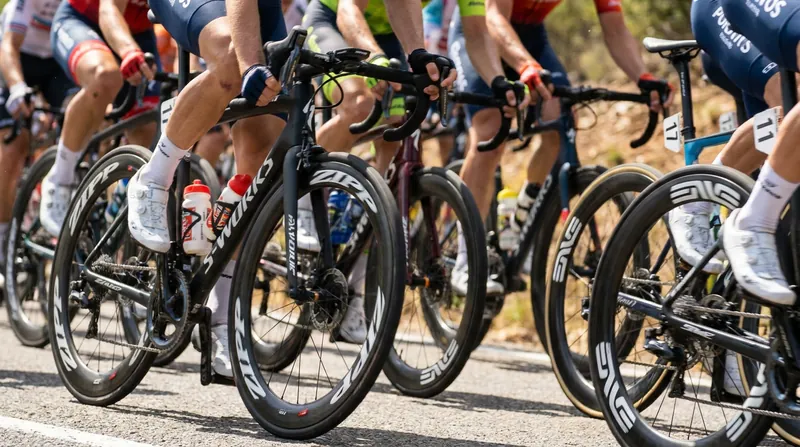
Beyond the biomechanics of the handlebars, the 2026 overhaul places a hard, quantifiable cap on wheel aerodynamics. For all mass-start road events, wheel rim depth is now strictly limited to a maximum of 65 millimeters at any point on the rim profile.
The UCI justifies this restriction entirely on safety grounds, arguing that deeper "deep dish" wheels are dangerously unstable in unpredictable crosswinds and contribute heavily to the peloton's escalating, high-risk speeds. While deeper wheels remain legal for individual and team time trials, the ban forces a massive equipment reset for road stages where 70-millimeter and 80-millimeter rims had become increasingly common on flat, fast days.[1][3][4]
Wheel manufacturers have pushed back aggressively against the depth cap, citing a lack of empirical evidence linking rim depth to mass-start crashes. Swiss Side, a prominent aerodynamic engineering firm that had to scrap a newly developed 68-millimeter wheelset just weeks before its scheduled launch, published an open letter calling the rule "ineffective and even counterproductive" for improving wheel stability.
Wind tunnel data supports the industry's frustration: independent testing shows that reducing wheel depth from a highly aerodynamic 79 millimeters down to a UCI-legal 56 millimeters slows a rider by less than one kilometer per hour at standard WorldTour power levels. This suggests the actual speed reduction achieved by the rule is negligible, while the financial cost to brands forced to retool their manufacturing lines is massive.[1][3][5]
The regulatory clampdown extends beyond bolt-on components to the architecture of the frame itself. The new rules impose strict maximum internal widths of 115 millimeters for fork legs and 145 millimeters for rear seatstays, measured along the entire length of the tubes rather than just at the dropouts.
This abruptly halts the recent industry trend of radically wide, aerodynamically sculpted forks—seen on prototype and production bikes from brands like Factor, Hope, and BMC—which were designed to smooth turbulent airflow around the rider's churning legs. By boxing in the frame dimensions, the UCI is intentionally limiting the aerodynamic efficiency that manufacturers can extract from the chassis.[2][4][5]
Finally, the UCI has officially bifurcated helmet standards, closing a controversial loophole by banning time-trial helmets from mass-start road races. Under the 2026 framework, "traditional" road helmets must feature at least three functional ventilation holes, cannot cover or obstruct the rider's ears, and are strictly prohibited from utilizing integrated or detachable visors. This definitively ends the practice of teams like Visma-Lease a Bike deploying heavily shrouded, TT-style helmets in standard road stages to cheat the wind, forcing a return to more conventional, ventilated headwear in the peloton.[1][2]
The overarching philosophy of the UCI's "SafeR" initiative is clear: limit the equipment to limit the speed. Yet, as the 2026 season gets underway, the debate over the efficacy of these measures rages on. Prominent team bosses argue that capping wheel depth and widening handlebars does little to address the root causes of crashes, suggesting that improving barrier safety or adopting wearable airbag technology would be far more effective.
For the everyday amateur, however, these rules offer a helpful moment of reflection. While the professionals are now forced to widen their bars and shallow their wheels, recreational riders remain entirely free to choose. The practical takeaway is to prioritize a setup that fits your natural biomechanics and local wind conditions, rather than blindly copying the WorldTour.[1][6]
Key points
- The UCI's 2026 technical regulations mandate a minimum 400mm handlebar width and cap wheel rim depth at 65mm for mass-start events.
- The rules aim to slow the peloton and improve handling stability in response to a rise in severe crashes.
- Female cyclists and smaller riders argue the 400mm width mandate is biomechanically discriminatory and forces them into painful riding postures.
- Wind tunnel data suggests the aerodynamic penalty of shallower wheels is minimal, but wheel manufacturers are frustrated by the sudden obsolescence of deep-section models.
Open questions
- Whether the UCI will further adjust the 280mm hood-to-hood minimum after gathering more rider feedback during the 2026 season.
- How strictly local and national racing federations will enforce these WorldTour-level equipment dimensions at amateur events.
- Equipment Brands & Aerodynamicists
- Argue that the depth caps stifle innovation and cost millions in R&D while providing negligible safety benefits.
- Bike Fitters & Rider Advocates
- Highlight that mandatory wide handlebars discriminate against women and smaller men by forcing painful, unnatural biomechanics.
- UCI Regulators & Safety Committee
- Maintain that limiting extreme aerodynamic postures and deep wheels is necessary to restore steering control and reduce peloton speeds.
Perspectives this story doesn't cover
- Amateur racers who must now purchase new compliant equipment
- Race commissaires tasked with measuring bikes on the start line
Sources
Source coverage
6 outlets
3 viewpoints surfaced






- [1]OutsideBike Fitters & Rider Advocates
More UCI Tech Restrictions, More Angry People: The 3 Key Rule Changes for 2026
Read on Outside → - [2]BikeRadarUCI Regulators & Safety Committee
The UCI rule changes for 2026 you need to know about
Read on BikeRadar → - [3]CyclingNewsEquipment Brands & Aerodynamicists
Wheel depth LABS
Read on CyclingNews → - [4]Superteam WheelsEquipment Brands & Aerodynamicists
UCI Regulations 2026 Major Changes Overview
Read on Superteam Wheels → - [5]Avenger BikesEquipment Brands & Aerodynamicists
What's New in 2026? Handlebars, Wheels
Read on Avenger Bikes → - [6]Custom Bike FitBike Fitters & Rider Advocates
UCI Handlebar Regulations 2026
Read on Custom Bike Fit →

More in Fitness
See all →Cycling Tech
UCI Announces Major Equipment Overhaul for 2026: Limits on Gear Ratio, Rim Height, and Handlebar Width
5 sources
Cycling Tech
How V2X Communication Technology Aims to Eliminate Cyclist Blind Spots
3 sources

Cycling Biomechanics
The 60-RPM Metabolic Sweet Spot: How Cycling Cadence Trades Efficiency for Power and Fatigue Resistance
9 sources
Anti-Doping Enforcement
Swiss Federal Tribunal Upholds Miguel Ángel López's Four-Year Doping Ban, Closing Final Appeal
6 sources

Comments
Every angle. Every day.
Get Fitness stories with full source coverage and perspective breakdowns, free every day.