
The Seventh Boundary: How Ocean Acidification's Irreversible Crossing Rewrites the Timeline for Marine Collapse
A new planetary health assessment confirms that ocean acidification has breached safe operating limits, fundamentally altering marine chemistry and threatening the Earth's climate buffering capacity.

Share this story
The Earth's life-support systems are undergoing a profound and measurable shift. According to the Planetary Health Check report released by the Potsdam Institute for Climate Impact Research, humanity has officially crossed the seventh of nine planetary boundaries: ocean acidification. This threshold marks a critical transition in global marine chemistry, confirming that human-driven carbon dioxide emissions have pushed the ocean outside the safe operating space that has maintained planetary stability for the last 11,700 years.[3]
The planetary boundaries framework, first introduced in 2009 by an international team of Earth system scientists, defines the environmental limits within which human societies can safely operate. Prior to this latest assessment, six boundaries had already been breached, including climate change, biosphere integrity, and freshwater use. Ocean acidification had long been approaching the danger zone, but revised baseline data and accelerating chemical changes have now pushed it definitively over the line.[1][3]
To understand how this boundary was crossed, it is necessary to examine the ocean's role as the planet's primary carbon sponge. The global ocean absorbs approximately 25 percent of all anthropogenic carbon dioxide emitted into the atmosphere. While this massive uptake has historically buffered the worst atmospheric impacts of climate change, it comes at a steep chemical cost to the marine environment.[2]
When carbon dioxide dissolves in seawater, it triggers a fundamental chemical reaction. The CO2 reacts with water molecules to form carbonic acid, which rapidly dissociates into bicarbonate and hydrogen ions. The influx of hydrogen ions increases the water's acidity, driving down the overall pH. Since the dawn of the industrial era, the average surface pH of the global ocean has dropped by roughly 0.1 units. Because the pH scale is logarithmic, this seemingly small numerical decrease translates to a 30 to 40 percent increase in actual ocean acidity.
However, the planetary boundary for ocean acidification is not measured strictly by pH. Instead, scientists use a metric known as the aragonite saturation state. Aragonite is a highly soluble form of calcium carbonate that many marine organisms rely on to construct their shells and skeletons. As the ocean becomes more acidic, the concentration of available carbonate ions plummets, making it increasingly difficult for these organisms to extract the building blocks they need from the water.[2][3]
The safe operating limit for the ocean was set at maintaining the aragonite saturation state at 80 percent of its pre-industrial average. For years, models suggested the global ocean was hovering just above this threshold. But a comprehensive reanalysis of pre-industrial baselines, combined with high-resolution monitoring of modern ocean chemistry, revealed that the 80 percent boundary was breached in the early 2020s.[1][3]
The biological consequences of this chemical shift are already materializing in marine ecosystems. Among the first casualties are pteropods, tiny free-swimming sea snails affectionately known as "sea butterflies." These organisms form the bedrock of many marine food webs, sustaining everything from krill to commercial fish species and baleen whales. Recent oceanic surveys have documented pteropods with ragged, dissolving shells, a direct result of the water becoming corrosive to their delicate aragonite structures.[1][2]
Corals face an equally dire prognosis. Both shallow-water tropical reefs and deep-sea cold-water corals require high aragonite saturation to calcify and grow. The European Union’s Copernicus Marine Service recently reported that over 10 percent of marine biodiversity hotspots are acidifying faster than the global average. For corals already battered by marine heatwaves and bleaching events, the added stress of acidification severely compromises their ability to recover and rebuild their structural foundations.
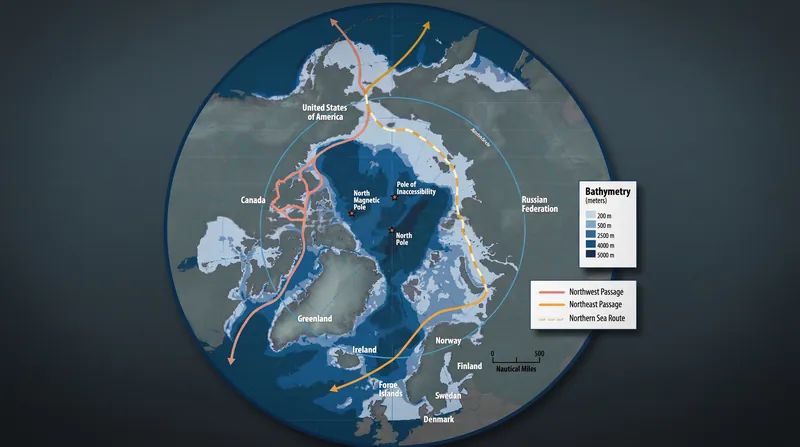
The rate of acidification is not uniform across the globe. Cold water naturally absorbs more carbon dioxide than warm water, making the Arctic and Southern Oceans particularly vulnerable. In these polar regions, the aragonite saturation state drops much faster, and vast swaths of the Arctic surface waters already experience periods of undersaturation, where the water literally dissolves unprotected calcium carbonate. These regions are critical engines for global nutrient cycles, meaning localized acidification has cascading effects on global marine productivity.[3]
Beyond the immediate threat to biodiversity, the crossing of the acidification boundary introduces a dangerous climate feedback loop. As the ocean absorbs more CO2 and its carbonate buffering system depletes, its capacity to take up additional carbon diminishes. This weakened buffering means that a higher proportion of future human emissions will remain in the atmosphere, accelerating global warming and further destabilizing the climate boundary.[3]
Despite the stark findings, scientists emphasize that planetary boundaries are not inevitable tipping points of no return. They are risk indicators—warning lights on the planetary dashboard signaling that the resilience of the Earth system is being compromised. The ocean's chemistry can theoretically stabilize, but the timescale for natural recovery spans thousands of years, far beyond the horizon of current human planning.[3][4]
The uncertainty now lies in the biological adaptability of marine life. While the chemical mechanism of acidification is perfectly understood, the exact threshold at which entire food webs might collapse remains a subject of intense study. Some species may exhibit genetic resilience or shift their ranges, but the unprecedented speed of the current chemical change outpaces the evolutionary adaptation rates of most calcifying organisms.[2][3]
Addressing ocean acidification requires confronting its singular root cause. Unlike other environmental crises that demand localized interventions, such as plastic pollution or overfishing, ocean acidification cannot be mitigated through marine conservation alone. Because the crisis is driven entirely by the atmospheric buildup of carbon dioxide, the only viable mechanism to halt the decline in ocean pH is the rapid and sustained reduction of global fossil fuel emissions.[1]
Key points
- The Planetary Health Check confirms ocean acidification is the seventh of nine planetary boundaries to be officially crossed.
- The global ocean absorbs 25% of human carbon emissions, causing a chemical reaction that lowers pH and depletes essential carbonate ions.
- The aragonite saturation state has fallen below the 80% safe threshold, directly threatening shell-building organisms like pteropods and corals.
- Weakened ocean buffering capacity means the seas will absorb less carbon dioxide in the future, accelerating atmospheric warming.
What we don’t know
- The exact threshold at which the decline of foundational species like pteropods will trigger a broader collapse of commercial fisheries.
- The extent to which certain marine organisms can genetically adapt to rapidly changing pH levels over the coming decades.
- How regional variations in deep-water upwelling will interact with surface acidification to create localized dead zones.
How we got here
2009
Scientists introduce the Planetary Boundaries framework, defining nine critical Earth system processes.
2023
Assessments confirm that six of the nine planetary boundaries have been breached, with ocean acidification approaching the limit.
2024
The EU-funded COMFORT project warns of a climate feedback loop accelerating sudden, permanent changes in marine environments.
Sep 2025
The Planetary Health Check report officially declares the ocean acidification boundary crossed, citing breached aragonite saturation thresholds.
- Earth System Scientists
- Focus on the planetary boundary framework and the loss of Earth's stable operating space.
- Marine Biologists
- Focus on the immediate physiological impacts on calcifying organisms and marine food webs.
- Climate Policy Advocates
- Focus on the necessity of addressing the root cause through rapid decarbonization.
Perspectives this story doesn't cover
- Commercial Fishing Industry
- Coastal Indigenous Communities
Sources
Source coverage
4 outlets
3 viewpoints surfaced




- [1]Sierra ClubClimate Policy Advocates
Earth Breaches Seventh Planetary Boundary as Oceans Become More Acidic
Read on Sierra Club → - [2]ForbesMarine Biologists
The App Store Freedom Act Is Worse Than A Price Control
Read on Forbes → - [3]Planetary Health CheckEarth System Scientists
Planetary Boundary for Ocean Acidification Transgressed
Read on Planetary Health Check → - [4]Smithsonian Magazine
Earth Is on the Brink of Crossing a Seventh Planetary Boundary
Read on Smithsonian Magazine →

More in Content Types
See all →Secondary Sanctions
How the Senate's New 100% Tariff Bill Aims to Rewire the Global Trade of Russian Oil
6 sources

Arctic Shipping
The Arctic Meltdown: How Receding Ice is Rewriting Global Trade and NATO Defense
2 sources
Ocean Governance
The High Seas Treaty Enters Into Force, Rewriting the Rules for 60% of the Planet
7 sources
Industrial Policy
The End of Laissez-Faire: How the Global Adoption of the U.S. Industrial Strategy Rewrites the Relationship Between State and Market
4 sources
Comments
Every angle. Every day.
Get Content Types stories with full source coverage and perspective breakdowns, free every day.