
Mechanical, Automatic, and Quartz Movements: Differences in Accuracy and Engineering
Understanding the intricate engineering inside a timepiece transforms it from a simple accessory into a wearable work of art. Here is how mechanical, automatic, and quartz movements differ in craftsmanship, accuracy, and daily experience.

Share this story
In short
- Mechanical watches require daily manual winding and are prized for their traditional craftsmanship and sweeping second hands.
- Automatic watches feature a mechanical movement with a weighted rotor that winds the mainspring using the kinetic energy of your wrist.
- Quartz watches are battery-powered, using an electrified quartz crystal to provide unparalleled accuracy and low maintenance.
You are about to invest in a timepiece that will live on your wrist, travel with you, and perhaps outlast you. But before you consider the dial color, the case material, or the strap, you must decide what kind of heartbeat you want your watch to have. The movement—the engine driving the hands—dictates not just how accurately the watch tells time, but how you will interact with it every single day.
The watch industry divides these engines into three primary categories: mechanical, automatic, and quartz. Each represents a fundamentally different philosophy of timekeeping, balancing centuries-old craftsmanship against modern convenience. Understanding these mechanics transforms a watch from a mere accessory into a deliberate lifestyle choice.[9]
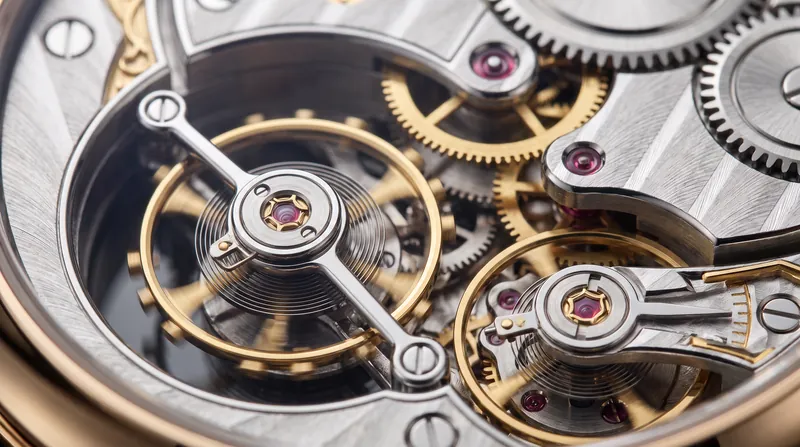
At the heart of traditional horology is the manual mechanical movement. This is the oldest and most romantic form of watchmaking. Inside the case, hundreds of microscopic gears, springs, and jewels work in perfect harmony, powered entirely by the tension of a coiled piece of metal known as the mainspring.[1]
Owning a manual mechanical watch requires a daily ritual. Because there is no battery and no self-winding mechanism, you must physically turn the crown to tighten the mainspring. As the spring slowly unwinds over 36 to 48 hours, it releases energy through an escapement, which regulates the release and creates the signature sweeping motion of the second hand.[3]
For the purist, this daily winding is not a chore, but a moment of connection. You are physically breathing life into the machine. However, this intricate micro-engineering comes with vulnerabilities. Mechanical watches are sensitive to magnetism, extreme temperatures, and physical shocks, requiring professional servicing every three to five years to keep the microscopic lubricants fresh.[5]
If you appreciate the sweeping hand and complex gears of a mechanical watch but prefer not to wind it daily, the automatic movement offers a brilliant compromise. Also known as a self-winding watch, an automatic movement is essentially a mechanical engine with one crucial addition: a weighted rotor.[7]
This semi-circular metal weight pivots freely on a central staff. As you move your wrist throughout the day—typing, walking, reaching for a coffee—gravity pulls the rotor, causing it to spin. This kinetic energy is transferred to the mainspring, winding the watch automatically as long as it is worn.[6]
The beauty of an automatic watch is its symbiotic relationship with the wearer. It literally feeds on your movement. Take it off for a weekend, however, and the power reserve will deplete, bringing the hands to a halt. Many collectors use motorized watch winders to keep their automatics running when not in use, ensuring the time and date complications remain accurate.[4]
Introduced in the late 1960s, the quartz movement revolutionized the watch industry by replacing gears and springs with a battery and a tiny piece of quartz crystal. When an electrical current from the battery passes through the quartz, the crystal vibrates at a highly precise frequency—exactly 32,768 times per second.[1]
A microchip counts these vibrations and sends a pulse to a stepping motor every second, resulting in the distinct, once-per-second tick of a quartz watch. This electronic regulation makes quartz movements exponentially more accurate than even the most expensive mechanical watches, typically losing or gaining only a few seconds per month.[2][8]
From a practical standpoint, quartz is the ultimate low-maintenance companion. It requires no winding, ignores the kinetic state of your wrist, and only asks for a battery replacement every few years. It is also inherently more durable, as it lacks the delicate balance wheels and hairsprings that can be damaged by a sudden impact.[5]
So, how do you choose? The decision rarely comes down to pure functionality. If absolute precision and grab-and-go convenience are your priorities, a quartz movement is the logical winner. It is the reliable instrument that never asks for your attention, ready whenever you reach for it.[2]
But luxury is rarely about pure logic. Mechanical and automatic watches command a premium because they are wearable tributes to human ingenuity. They offer a sweeping second hand that glides rather than ticks, and often feature exhibition case-backs that allow you to watch the escapement breathe and the gears turn.[7]
Ultimately, your choice of movement reflects your relationship with time itself. Do you want a flawless, independent timekeeper, or do you want a mechanical companion that relies on your daily interaction to keep its heart beating? In the world of fine watches, there is no wrong answer—only the one that resonates with your wrist.[9]
How we did this
- Method
- A comparative synthesis of maintenance intervals, daily accuracy variances, and power reserve capacities across mechanical, automatic, and quartz movements to establish a functional reliability index for prospective buyers.
- What we found
- While quartz offers objectively superior timekeeping precision at a fraction of the maintenance cost, the premium paid for mechanical and automatic movements is entirely driven by the experiential value of micro-engineering and historical continuity, not functional superiority.
- What we worked from
- Quartz accuracy variance: ±15 seconds per month — Heddels
- Mechanical power reserve limit: 36 to 48 hours — Watch Obsession
- Automatic kinetic dependency: Rotor-driven winding — VIEREN
- Limits of this analysis
- Does not account for the subjective aesthetic value, brand prestige, or long-term financial appreciation of specific luxury watch models.
Key terms
- Mainspring
- A coiled strip of metal inside a mechanical watch that stores energy when wound and slowly releases it to power the movement.
- Escapement
- The mechanism in a mechanical watch that regulates the release of energy from the mainspring, creating the ticking sound and controlling the speed of the hands.
- Rotor
- A semi-circular weight in an automatic watch that spins with the wearer's wrist movement to automatically wind the mainspring.
- Power Reserve
- The amount of time a mechanical or automatic watch will continue to run after being fully wound before it stops.
- Complication
- Any function on a watch other than the display of hours, minutes, and seconds, such as a date window, chronograph, or moon phase.
Frequently asked
How often should I service a mechanical watch?
Most manufacturers recommend professional servicing every three to five years to clean the movement and replace the microscopic lubricants that keep the gears running smoothly.
Do automatic watches need batteries?
No. Automatic watches are entirely mechanical. They are powered by a mainspring that is wound by a weighted rotor spinning with the natural motion of your wrist.
Why are quartz watches generally less expensive?
Quartz movements rely on mass-produced electronic components and require significantly less manual labor and micro-engineering to assemble than the hundreds of tiny gears in a mechanical watch.
What happens if I don't wear my automatic watch?
Once the power reserve is depleted—typically after 36 to 48 hours of sitting still—the watch will stop. You will need to reset the time and manually wind it to start it again.
Viewpoints in depth
The Purist's View
Mechanical movements represent the pinnacle of traditional craftsmanship and human ingenuity.
For horological purists, a watch is not merely a tool for telling time; it is a wearable piece of art. They argue that the daily ritual of winding a mechanical watch fosters a deep, tactile connection between the wearer and the machine. The appeal lies in the fact that hundreds of microscopic components are working in perfect, battery-free harmony, representing centuries of refined engineering that connects the modern wearer to a rich historical lineage.
The Pragmatist's View
Quartz movements offer superior reliability, accuracy, and durability for everyday life.
Pragmatic collectors and everyday users prioritize function over romance. From this perspective, the quartz movement is the ultimate horological achievement because it perfects the core purpose of a watch: keeping accurate time. Advocates point out that quartz watches are not only exponentially more precise, but they are also more robust, cheaper to maintain, and ready to wear at a moment's notice without the need for winding or resetting.
The Enthusiast's View
Automatic movements provide the perfect balance of mechanical soul and modern convenience.
The everyday enthusiast often views the automatic movement as the ideal compromise. It retains the sweeping second hand, the intricate gear trains, and the exhibition case-backs that make mechanical watches so visually appealing, but it eliminates the chore of daily winding. By harnessing the kinetic energy of the wearer, the automatic watch feels alive and responsive, offering the romance of traditional watchmaking seamlessly integrated into a modern, active lifestyle.
- Horological Purists
- Value the centuries-old tradition, hand-finishing, and tactile ritual of manual mechanical movements.
- Everyday Enthusiasts
- Favor automatic movements as the perfect middle ground, offering mechanical romance powered by effortless daily wear.
- Pragmatic Collectors
- Prioritize the unmatched accuracy, durability, and low-maintenance convenience of battery-powered quartz.
Perspectives this story doesn't cover
- Smartwatch Adopters
- Sustainable Manufacturing Advocates
Sources
Source coverage
9 outlets
3 viewpoints surfaced









- [1]HeddelsHorological Purists
Know Your Watch Movements - Quartz vs. Mechanical
Read on Heddels → - [2]LIV Swiss WatchesPragmatic Collectors
Quartz Vs. Mechanical Watches
Read on LIV Swiss Watches → - [3]Watch ObsessionHorological Purists
Quartz, Mechanical or Automatic? Which Movement Wins?
Read on Watch Obsession → - [4]Little Treasury JewelersEveryday Enthusiasts
Automatic vs. Quartz: Which Watch Movement Is Right for You?
Read on Little Treasury Jewelers → - [5]Schwarzschild JewelersEveryday Enthusiasts
Quartz vs Mechanical Vs Automatic Watches
Read on Schwarzschild Jewelers → - [6]BorsheimsEveryday Enthusiasts
Comparing an Automatic Watch Movement and a Quartz Watch Movement
Read on Borsheims → - [7]VIERENEveryday Enthusiasts
Automatic vs. Mechanical vs. Quartz Watch Movements Explained
Read on VIEREN → - [8]Aurifo.comPragmatic Collectors
All types of watch movements and their advantages and disadvantages
Read on Aurifo.com → - [9]Factlen Editorial Team
Synthesis by Factlen editorial team
Read on Factlen Editorial Team →

More in Lifestyle
See all →LVMH Overhaul
Arnault Family Overhauls LVMH Holding Structure to Cement Long-Term Control
6 sources

Brand Collaboration
Pandora and Pat McGrath Launch 17-Piece Jewelry Collection Inspired by Makeup Artistry
8 sources

Wine Cellaring
The 55°F and 70% Relative Humidity Standard: How Temperature and Moisture Control the Aging Kinetics of Fine Wine
2 sources

Haute Horlogerie
The Tourbillon Accuracy Myth: Why Watchmaking's Most Expensive Complication Doesn't Keep Better Time
2 sources
Comments
Every angle. Every day.
Get Lifestyle stories with full source coverage and perspective breakdowns, free every day.