
Iran's Assembly of Experts and the Process of Choosing Khamenei's Successor
Following the death of Ayatollah Ali Khamenei, Iran's Assembly of Experts faces the monumental task of selecting a new Supreme Leader. This transition tests the resilience of the Islamic Republic's foundational theology and will reshape the broader Shi'a world.
By Joao Marques
Share this story
In short
- Iran's 88-member Assembly of Experts is currently deliberating to select the country's third Supreme Leader.
- The transition tests the doctrine of Velayat-e Faqih, which grants absolute political authority to a senior Islamic jurist.
- Debate centers on whether the next leader requires unparalleled theological credentials or pragmatic security and administrative acumen.
The death of Ayatollah Ali Khamenei has triggered the first leadership transition in the Islamic Republic of Iran since 1989, initiating a complex succession process that blends modern statecraft with centuries-old Shi'a theology. For nearly four decades, Khamenei served as the ultimate arbiter of Iranian politics, military strategy, and religious doctrine. His sudden absence leaves a profound vacuum at the apex of a system designed around the absolute authority of a single jurist.
As the nation navigates this unprecedented moment, the mechanisms of succession are being tested in real time, offering a rare glimpse into the institutional architecture that governs one of the Middle East's most influential powers. The transition is not merely a political handover; it is a theological event that will resonate far beyond Iran's borders, affecting millions of Shi'a adherents worldwide who look to the Supreme Leader for spiritual guidance.[4]
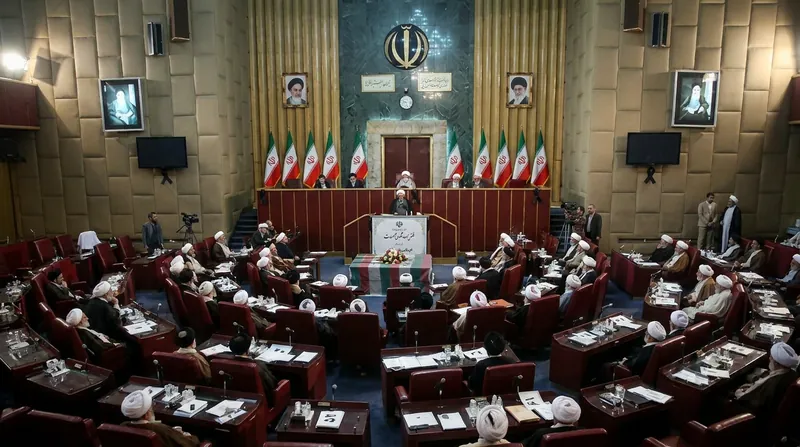
At the center of this transition is the Assembly of Experts, an 88-member clerical body constitutionally mandated to select, supervise, and theoretically dismiss the Supreme Leader. Composed entirely of Islamic jurists elected by the public from a pre-vetted pool of candidates, the Assembly is the only institution with the legal authority to name Khamenei's successor. Following the declaration of the Supreme Leader's death, the Assembly was immediately tasked with convening to deliberate on the next head of state.
Under Article 111 of the Iranian Constitution, the body must assess potential candidates based on their religious scholarship, moral integrity, and practical leadership abilities. The stakes of these closed-door deliberations are immense, as the chosen individual will inherit command of the armed forces, control over state media, and the final say on all major domestic and foreign policies.[1][2]
Much of the current deliberation reportedly centers on Mojtaba Khamenei, the 56-year-old second son of the late leader. Despite maintaining a remarkably low public profile for decades, Mojtaba has long been viewed by analysts as a highly influential figure operating behind the scenes within his father's office. He possesses the religious title of Hojjatoleslam—a mid-ranking clerical status—and has cultivated deep ties with the country's security apparatus over the years.
Proponents of his candidacy argue that his intimate knowledge of the state's inner workings and his established relationships with key military commanders make him uniquely qualified to ensure institutional stability during a volatile period. However, his potential elevation also raises questions about the optics of hereditary succession within a republic that was explicitly founded on the overthrow of a dynastic monarchy.[2]
The exact status of the Assembly's decision remains shrouded in a fog of conflicting reports, reflecting the intense sensitivity of the process. Several regional news outlets have claimed that the Assembly has already reached a consensus, with some reporting that Mojtaba Khamenei secured the necessary two-thirds majority in a rapid, closed-door vote.
Conversely, other officials and media networks have pushed back against these assertions, stating that the vetting process is still actively underway and that no final leader has been officially designated. Members of the Assembly's presidium have publicly emphasized that the constitutional procedures are being followed meticulously and that any premature announcements are speculative. This informational ambiguity highlights the delicate balance the state must strike between projecting continuity and managing internal factional debates.[1][2][3]
To fully grasp the mechanics and the gravity of this succession, one must understand the foundational doctrine of the Islamic Republic: Velayat-e Faqih, or the Guardianship of the Islamic Jurist. This theological framework posits that legitimate political authority cannot be separated from religious authority. It argues that the state must be guided by a preeminent scholar of Islamic law who ensures that all legislation and governance adhere strictly to divine principles.
The Supreme Leader is not merely a political executive; he is the ideological custodian of the revolution. The doctrine transforms the abstract concept of religious guardianship into a concrete system of absolute political sovereignty, making the selection of the Vali-e Faqih the most consequential decision in the Iranian state structure.
The doctrine of Velayat-e Faqih was systematically formulated by Ayatollah Ruhollah Khomeini during his exile in the 1970s, fundamentally reshaping the trajectory of modern political Islam. Khomeini argued that during the 'occultation' of the Twelfth Imam—the messianic figure in Twelver Shi'ism who is believed to be hidden until the end of times—the Muslim community cannot be left without righteous leadership.
He posited that a single, highly qualified jurist must assume comprehensive guardianship over the ummah, wielding executive, legislative, and judicial authority to enforce Islamic law. This concept provided the ideological scaffolding for the 1979 revolution, transforming a theoretical theological argument into the constitutional bedrock of a modern nation-state.
Khomeini's formulation represented a massive paradigm shift within traditional Shi'a theology. For centuries, the dominant clerical establishment had largely favored a quietist approach to political power, arguing that any government established before the return of the Twelfth Imam was inherently imperfect and that clerics should focus on scholarship and spiritual guidance rather than direct political rule.
Khomeini's formulation represented a massive paradigm shift within traditional Shi'a theology.
By asserting that clerics had a divine mandate to govern directly, Khomeini centralized power in the hands of the jurist and created a system where political dissent could be equated with religious deviation. The current succession crisis is thus not just a test of political maneuvering, but a continuation of this profound theological experiment.
The specific qualifications required for the Supreme Leader are explicitly outlined in Article 109 of the Iranian Constitution. The document mandates that the leader must possess the scholarly qualifications necessary to issue religious rulings (fatwas) on various issues of Islamic law. Beyond theological mastery, the candidate must demonstrate justice, piety, and a deep understanding of contemporary political and social issues.
The constitution emphasizes courage, administrative capability, and the practical wisdom required to lead a complex nation-state. These dual requirements—demanding both unparalleled religious erudition and shrewd political acumen—create a remarkably narrow pool of viable candidates, forcing the Assembly of Experts to weigh spiritual authority against pragmatic leadership skills.
Historically, the interpretation of these qualifications has proven flexible when political necessity demands it. In the original 1979 constitution, the Supreme Leader was required to be a marja' al-taqlid, or a Grand Ayatollah—the highest rank of religious authority in Twelver Shi'ism. However, as Khomeini's health declined in 1989, it became clear that none of the existing Grand Ayatollahs fully supported his absolute political vision.
Consequently, the constitution was amended just before his death to lower the theological requirement, allowing a lower-ranking cleric with strong political credentials to assume the role. This pivotal amendment paved the way for Ali Khamenei, who was not a Grand Ayatollah at the time, to be elevated to the Supreme Leadership, establishing a precedent that political reliability can supersede traditional clerical hierarchy.
This historical precedent is highly relevant to the current deliberations surrounding Mojtaba Khamenei and other potential candidates. Today, the debate within the clerical establishment centers on whether the next leader needs to possess universally recognized theological credentials or if security acumen and institutional continuity are more critical.
While some traditionalist clerics in the seminary city of Qom reportedly favor candidates with decades of extensive jurisprudential teaching, pragmatic elements within the state apparatus prioritize a leader who can navigate severe geopolitical pressures. If a candidate with mid-ranking religious credentials is chosen, it would reaffirm the 1989 precedent that the Islamic Republic values ideological alignment and administrative control over strict adherence to classical clerical seniority.[4]
While the Assembly of Experts holds the formal constitutional authority to select the leader, the Islamic Revolutionary Guard Corps (IRGC) plays a massive, albeit unwritten, role in shaping the outcome. Over the past three decades, the IRGC has evolved from a purely military organization into a sprawling economic and political powerhouse deeply intertwined with the Supreme Leader's office.
Reports indicate that senior IRGC commanders have actively pushed for a candidate who guarantees the continuity of their institutional privileges and strategic objectives. The military apparatus views the succession not just as a religious transition, but as a critical national security vulnerability that must be managed tightly to prevent internal destabilization or foreign exploitation.[2]
To ensure the continuous functioning of the state while the Assembly deliberates, the Iranian Constitution provides a specific contingency mechanism. Under Article 111, an interim leadership council is immediately formed to assume the executive duties of the Supreme Leader. This triumvirate consists of the President, the Chief of the Judiciary, and a jurist from the Guardian Council selected by the Expediency Discernment Council.
While this interim body can manage day-to-day state affairs and coordinate military responses, it fundamentally lacks the absolute spiritual and ideological authority vested in a singular Supreme Leader. The temporary nature of this council underscores the urgency facing the Assembly of Experts to finalize their selection and restore the unified command structure.[1][3]
The implications of this succession extend far beyond the borders of Iran, directly impacting the broader geopolitical landscape of the Middle East and the global Shi'a community. The Supreme Leader of Iran claims a unique transnational authority, serving as the ideological compass for a vast network of allied militias, political parties, and religious institutions across Lebanon, Iraq, Yemen, and beyond.
The new leader will inherit the complex task of managing the 'Axis of Resistance' while navigating intense economic sanctions and military confrontations. How the incoming Vali-e Faqih chooses to balance revolutionary ideology with pragmatic statecraft will determine the regional security environment for the next generation.[4]
Ultimately, this transition represents the ultimate stress test for the institutional resilience of the Islamic Republic. The system was forged in the fires of revolution and sustained by the charismatic authority of its founders, but it must now prove that it can successfully execute a second generational transfer of power under immense external pressure.
Whether the Assembly of Experts opts for a rapid consolidation of power behind a well-connected insider or engages in a protracted deliberation to satisfy competing factions, the outcome will redefine the mechanics of Shi'a political theology. The world is watching to see if a governance model built on the absolute guardianship of a single jurist can peacefully pass the mantle without fracturing the very state it was designed to protect.[4]
Terms to know
- Velayat-e Faqih
- The Guardianship of the Islamic Jurist; the foundational doctrine of Iran granting a senior cleric supreme political and religious authority.
- Assembly of Experts
- An 88-member body of Islamic scholars elected by the Iranian public, constitutionally responsible for selecting the Supreme Leader.
- Marja' al-taqlid
- A Grand Ayatollah or 'source of emulation,' representing the highest level of religious authority in Twelver Shi'a Islam.
- Occultation
- The theological belief that the Twelfth Shi'a Imam is hidden by God and will return at the end of time to establish justice.
- Hojjatoleslam
- A mid-ranking title for Islamic clerics, literally meaning 'authority on Islam,' ranking below an Ayatollah.
Questions readers ask
Who is currently running Iran?
An interim leadership council comprising the President, the Chief of the Judiciary, and a Guardian Council jurist is managing executive duties until a new leader is chosen.
Can the public vote for the Supreme Leader?
No. The public elects the 88 members of the Assembly of Experts, who in turn hold the exclusive constitutional authority to select the Supreme Leader.
Does the new leader have to be a relative of Khamenei?
No. The constitution does not mandate hereditary succession, though Mojtaba Khamenei, the late leader's son, is reportedly a leading candidate due to his political influence.
How long does the Supreme Leader serve?
The Supreme Leader serves a lifetime appointment, though the Assembly of Experts theoretically holds the constitutional power to dismiss him if he loses his qualifications.
Different angles
Theological Traditionalists
Scholars who argue the Supreme Leader must possess unparalleled religious credentials.
For traditionalist clerics, particularly those based in the seminaries of Qom, the legitimacy of the Islamic Republic rests entirely on the spiritual authority of the Vali-e Faqih. They argue that lowering the theological requirements to accommodate a politically convenient candidate undermines the foundational premise of the state. From this perspective, the leader must be a universally recognized master of Islamic jurisprudence capable of issuing independent fatwas, ensuring that all state actions remain strictly aligned with divine law.
Security and Institutional Pragmatists
Factions prioritizing state survival, military continuity, and geopolitical strategy.
Pragmatic elements within the state, heavily influenced by the Islamic Revolutionary Guard Corps (IRGC), view the succession primarily through a national security lens. They argue that in an era of intense regional warfare and economic sanctions, the Supreme Leader must possess exceptional administrative capability and a deep understanding of military strategy. For this camp, a candidate's established relationships with the security apparatus and their ability to maintain internal cohesion are far more critical than their rank within the traditional clerical hierarchy.
- Institutional Pragmatists
- Focus on stability, continuity, and political acumen over strict theological seniority.
- Theological Traditionalists
- Emphasize the necessity of deep religious scholarship and adherence to classic Shi'a jurisprudence for the Supreme Leader.
- Security Hardliners
- Prioritize a leader who will maintain the military's influence and aggressively manage regional conflicts.
Perspectives this story doesn't cover
- Iranian civil society and protest movements
- Diaspora opposition groups
Sources
Source coverage
4 outlets
3 viewpoints surfaced




- [1]Al MayadeenSecurity Hardliners
Assembly names new leader following martyrdom of Sayyed Ali Khamenei
Read on Al Mayadeen → - [2]Middle East MonitorInstitutional Pragmatists
Iran's Assembly of Experts selects Mojtaba Khamenei as new Supreme Leader
Read on Middle East Monitor → - [3]RudawSecurity Hardliners
Assembly of Experts: A leader has not yet been chosen
Read on Rudaw → - [4]Factlen Editorial TeamInstitutional Pragmatists
Synthesis by Factlen editorial team
Read on Factlen Editorial Team →
More in Culture
See all →Canon Law
Why SSPX Bishop Consecrations Trigger Automatic Excommunication Under Canon Law
2 sources
Secular Pilgrimage
Why Half a Million People Walked the Camino de Santiago This Year
5 sources

Sacred Texts
How AI is Rescuing and Translating the World's Oldest Sacred Texts
3 sources

Modern Pilgrimage
The Modern Pilgrimage Boom: Why Millions Are Walking Ancient Sacred Trails
6 sources

Comments
Every angle. Every day.
Get Culture stories with full source coverage and perspective breakdowns, free every day.