
The Inverse Square Law and the Line Array: How Concert Sound Systems Deliver Uniform Volume Across a Stadium
Modern stadium concerts rely on line array speaker systems to project sound evenly over massive distances. By manipulating the physics of wave interference, these systems convert spherical sound waves into cylindrical ones, halving the rate of volume loss and saving the front rows from deafening noise.
By Austin Blake

- Acoustic Engineers
- Focus on the mathematical precision, phase coherence, and waveguide design required to create a true cylindrical wavefront.
- Touring Production
- Value the scalability, predictable coverage, and reduced physical footprint of modern self-powered arrays for efficient load-ins.
- Concert Audiences
- Care primarily about speech intelligibility and experiencing high-fidelity sound without suffering hearing damage in the front rows.
Perspectives this story doesn't cover
- Venue Acousticians
- Local Noise Regulators
Key terms
- Inverse Square Law
- A principle of physics stating that a specified physical quantity is inversely proportional to the square of the distance from the source.
- Point Source
- A traditional speaker design that radiates sound spherically in all directions from a single point.
- Cylindrical Wave
- A sound wave that expands outward in a cylinder shape, minimizing vertical dispersion and preserving acoustic energy over distance.
- Sound Pressure Level (SPL)
- The objective measurement of acoustic volume, expressed in decibels (dB).
- Phase Coherence
- When multiple sound waves align perfectly in time, combining their energy rather than canceling each other out.
Key points
- Line arrays use wave interference to convert spherical sound waves into cylindrical waves, projecting audio further.
- The inverse square law dictates that traditional point-source speakers lose 6 dB of volume every time the distance doubles.
- By forming a cylindrical wave, line arrays halve this attenuation rate to just 3 dB per doubled distance.
- The curved 'J' shape allows engineers to steer high frequencies to the back rows while gently covering the front.
- Acoustical pioneer Harry Olson first demonstrated the underlying physics of line arrays in 1957.
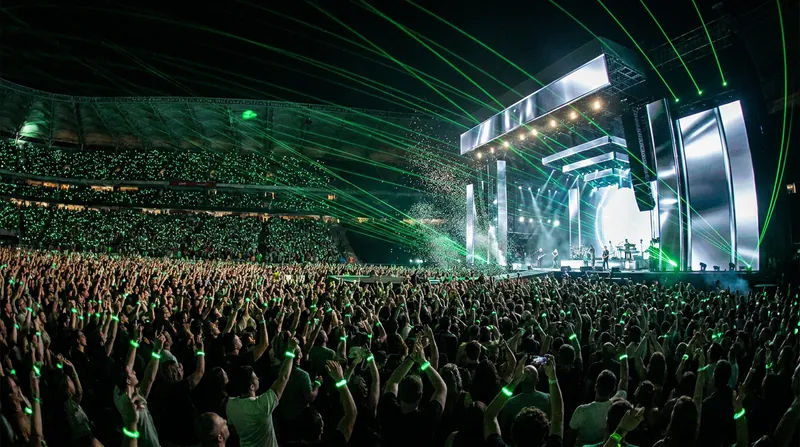
When a front-of-house engineer walks into an empty 80,000-seat stadium for load-in, their primary job is not just making the band loud. It is making the band loud for the person in the very back row, without permanently deafening the person standing against the barricade. The tool they use to decide exactly where the sound goes—and where it doesn't—is the line array. These towering, curved columns of black speaker cabinets flank nearly every major concert stage today, serving as a highly engineered acoustic loophole to the laws of physics.[3]
For most of the 20th century, live sound relied on point-source speakers. A point source radiates audio outward in a spherical pattern, much like a bare lightbulb casting light in all directions. The physics governing this expansion are unforgiving. As David Stewart notes for Sweetwater, "The inverse square law tells us that SPL drops by 6dB each time the distance doubles from a point source of sound in a free field of intensity."[3]
That 6-decibel drop represents a massive loss of acoustic energy. If a traditional speaker delivers a comfortable 94 dB to a fan standing 40 meters away, the inverse square law dictates that the sound pressure level at 20 meters must be 100 dB. At 10 meters, it hits 106 dB. To reach the back of a large festival crowd, the speakers at the stage had to push punishing, dangerous volumes, blasting the front rows with chaotic, overlapping sound waves while the back rows strained to hear over the crowd noise.[1][3]
The line array solves this by changing the shape of the sound wave itself. Rather than acting as individual, isolated speakers, the closely spaced drivers in a line array constructively interfere with one another. When identical acoustic sources are placed closely along a vertical axis and fed the same signal in phase, they couple acoustically.[2]
This physical arrangement restricts the sound from expanding as a sphere. Instead, the acoustic energy pushes forward as a cylindrical wave. Because the energy is prevented from scattering upward into the ceiling or downward into the floor, it retains its power much longer. A pure cylindrical wave only loses 3 dB per doubling of distance in the near field, effectively halving the attenuation rate of a traditional speaker.[1]
This physical arrangement restricts the sound from expanding as a sphere.
The theoretical foundation for this was laid long before modern stadium tours. The acoustic effect of narrowing a beam with increasing frequency was first demonstrated by pioneer Harry Olson, who published his findings in his 1957 textbook, Acoustical Engineering. However, it took decades of advancements in digital signal processing and waveguide technology to turn Olson's column speaker concepts into the full-frequency, high-output arrays used today.[4]
Modern professional line arrays can deliver 120 to 140 dB SPL peaks in the front rows, but their true value is their predictability. The physical shape of the array—often hung in a distinct "J" curve—is meticulously modeled in 3D acoustic software before the cabinets are ever flown.[2]
The top cabinets in the array are angled slightly upward or straight ahead, tasked with throwing high-frequency energy to the furthest seats. The bottom cabinets are sharply angled downward, with their volume often electronically attenuated, to cover the front rows without overwhelming them. This allows the engineer to steer the sound like a laser beam, keeping it focused on the audience and off reflective surfaces.[3][4]
While line arrays handle mid and high frequencies exceptionally well, they are not a universal solution for the entire audio spectrum. Low-frequency bass energy is inherently omnidirectional, meaning true low-frequency extension still requires dedicated subwoofers. These are typically ground-stacked in cardioid configurations to reduce stage bleed and deliver tight, focused bass to the crowd.[2]
The transition from spherical to cylindrical waves is not infinite. All physically realizable sources have a near field and a far field. As the waves continue to propagate over massive distances, they eventually revert to spherical expansion. The goal of the system designer is to build an array tall enough to keep the entire audience within that cylindrical near field for as much of the frequency spectrum as possible.[1]
The next time you attend a major arena show, look at the rigging above the stage. Those suspended columns are not just a stack of loud boxes; they are a precise manipulation of wave interference, ensuring that the 15,000th fan through the door hears the exact same mix as the person standing at the rail.[2][5]
Frequently asked
Why do line array speakers hang in a curved 'J' shape?
The curve allows engineers to aim the top speakers at the distant back rows while angling the bottom speakers sharply downward to cover the front rows, ensuring even volume across the venue.
Can I use a line array for a small indoor gig?
While possible, point-source speakers are often better suited for small rooms. Line arrays require significant distance to form a proper cylindrical wave and can be overkill for tight spaces.
Do line arrays eliminate the need for subwoofers?
No. While line arrays handle mid and high frequencies exceptionally well, low-frequency bass energy is omnidirectional and still requires dedicated subwoofers, often placed on the ground.
Sources
Source coverage
5 outlets
3 viewpoints surfaced





- [1]ProsoundtrainingAcoustic Engineers
Line Array Attenuation - Ideal vs Actual
Read on Prosoundtraining → - [2]T.I AudioAcoustic Engineers
Acoustic Principles Behind Line Array Speaker Design
Read on T.I Audio → - [3]SweetwaterTouring Production
What Exactly Is a Line Array?
Read on Sweetwater → - [4]WikipediaConcert Audiences
Line array
Read on Wikipedia → - [5]Factlen Editorial Team
Synthesis by Factlen editorial team
Read on Factlen Editorial Team →
Comments

More in Entertainment
See all →Ad Tech
Server-Side Stitching and the Manifest File: How Dynamic Ad Insertion Delivers Targeted Podcast Ads
5 sources

Matchmaking Math
How Skill-Based Matchmaking Actually Works: The Mathematics of Elo, Glicko, and TrueSkill
3 sources

Box Office Economics
The 90/10 Split and the House Nut: How Movie Theaters and Studios Divide Box Office Revenue
5 sources

Sustainable Touring
How Major Stadium Tours Are Decoupling Live Music from Carbon Emissions
4 sources
Every angle. Every day.
Get Entertainment stories with full source coverage and perspective breakdowns delivered to your inbox.